
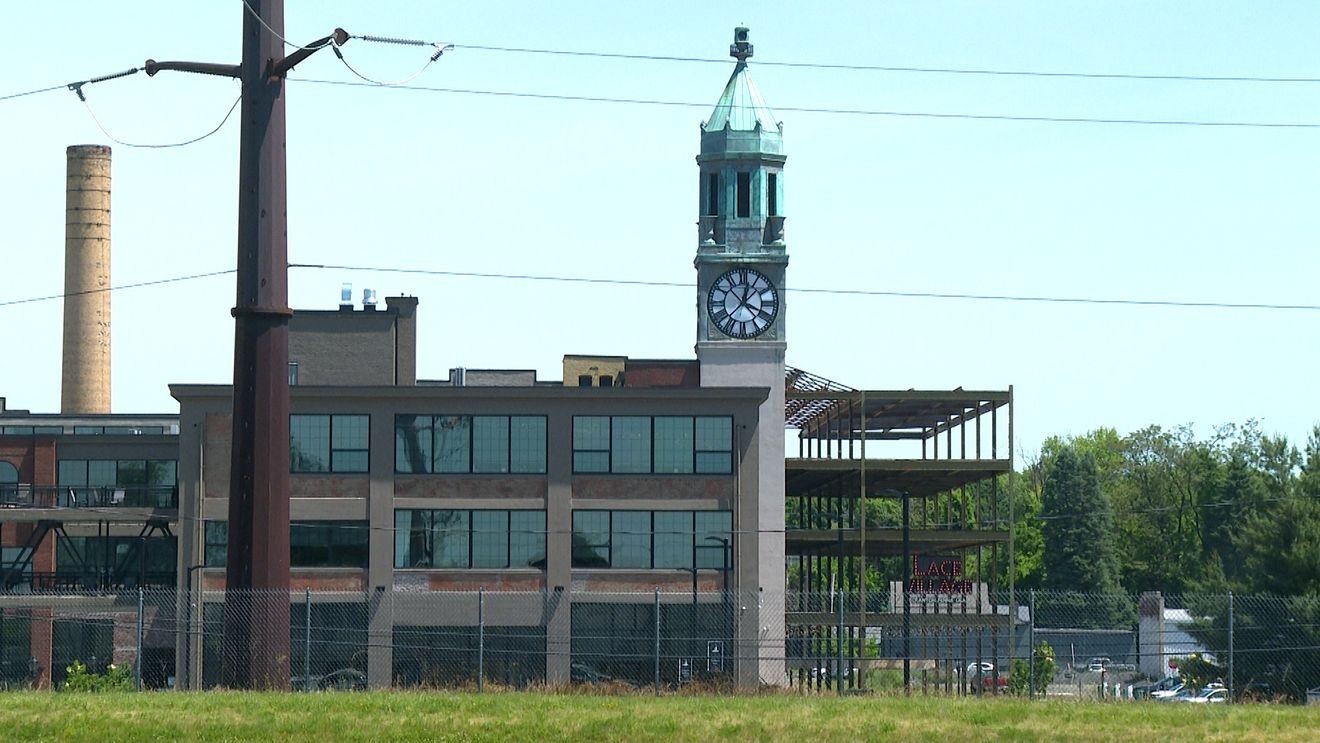
SCRANTON, LACKAWANNA CO. (WOLF) — For more than a century, the Scranton Lace Company was woven into the fabric of Northeastern Pennsylvania.
The factory complex produced lace that decorated homes around the world, provided jobs for thousands of local workers and helped shape generations of families in the Scranton area.
Today, while most of the machinery is gone, the legacy remains alive through both the archives preserving its history and the transformation of the historic property into a thriving community once again.
Originally established in the late 19th century, the Scranton Lace Company grew into one of the world’s leading manufacturers of Nottingham lace. At its peak, the company employed more than 1,600 workers, making it one of the largest employers in the region and one of the largest employers of women in the United States.
The company became known not only for its products, but also for the way it treated employees.
“It was one of the largest employers in the Scranton area. At one point it employed over 1,600 people, which was a lot,” said Gia Tugend, executive director of the Waverly Community House. “It was a lot of women, which was very significant during the time period. And it was also very unique in that it provided a lot of opportunities for its employees outside of the workplace.”
The factory featured amenities that were uncommon for industrial workplaces at the time, including a theater, bowling alley and infirmary.
“It had so much for employees to do to be able to enjoy their quality of life,” Tugend said. “It wasn’t just a workplace for a lot of them. It was kind of like a home.”
That philosophy was heavily influenced by Henry Belin Jr., one of the company’s early leaders and a key figure in the creation of the Waverly Community House.
“The direct tie to the Waverly Community House, Henry Belin Jr., who was the director of Scranton Lace for a number of years, he really believed that if you provided your employees with a good quality life outside of the workplace, that it would in turn make them happier and more productive,” Tugend explained.
The result was a remarkably low employee turnover rate and a company culture that left a lasting impression on generations of workers.
For much of the 20th century, Scranton Lace products were a household staple.
“At some point everyone’s grandmother had lace tablecloths or lace curtains,” Tugend said. “Scranton Lace was one of the number one manufacturers of Nottingham lace. They made everything. They made curtains, they made tablecloths, they made clothing. It was super significant at the time.”
The factory’s influence extended far beyond Northeastern Pennsylvania, shipping products across the country and around the globe.
Women working at the factory often earned wages above what was typical for many female workers of the era, helping make the company a significant economic force in the region.
As world events changed, so did the factory.
During World War II, production shifted to support the military effort. The company manufactured camouflage materials and parachutes for the U.S. Marine Corps, linking a Scranton factory to a pivotal chapter in American history.
“They made parachutes for the Marine Corps. They are stored here,” Tugend said. “That’s something that’s really interesting. It ties into our national history as well.”
When the factory closed in 2002 after more than a century of operation, many feared its history could be lost.
That changed in 2012 when the Waverly Community House began acquiring company records and artifacts.
Today, the archive houses an extensive collection that includes photographs, lace samples, punch cards, accounting ledgers, personnel files and other historical records.
In 2025, the collection expanded further when the organization acquired a significant collection of Scranton Lace artifacts from the Lackawanna Historical Society.
The archive has become an important resource for historians, researchers and families looking to learn more about relatives who once worked at the factory.
“It’s a staple of our culture and of our community here,” Tugend said. “Everyone knows about Scranton Lace. Everyone either has a relative who worked there or maybe a piece of material from the factory.”
While the archives preserve the past, the former factory site itself is helping create the future.
In 2006, developers acquired the dormant property with plans to transform it into a mixed-use community. The undertaking required years of work and extensive demolition and restoration.
Property manager Michael Basalyga said the project involved removing many deteriorated structures while preserving the most historically significant and structurally sound buildings.
“The deconstruction piece was massive, as you can imagine, taking down all those buildings,” Basalyga said. “We were able to reclaim an awful lot and repurpose and reimagine an awful lot.”
Many original materials were salvaged and incorporated into the redevelopment.
“The bricks that you can see on the townhomes are original Scranton Lace brick,” Basalyga said. “We’ve repurposed a lot of metal, a lot of wood, trying to keep it as original to as it was back in the day.”
Today, Lace Village features townhomes, apartments and commercial spaces spread across more than 11 acres. Businesses including a salon, yoga studio and café operate on the property, while additional retail and community spaces continue to be developed.
Amenities such as pickleball courts, green space, community gardens and gathering areas are designed to recreate the sense of community that once defined the factory.
“We really wanted to set out and build a village, and we’ve kind of built a village,” Basalyga said. “We are so fortunate to have a great group of people here.”
The connection to the factory’s history remains strong.
“On a weekly basis, we’re contacted by somebody who had a relative that worked here, or they worked here, or they knew somebody,” Basalyga said. “It’s been really well received, the transformations and the repurposing of what’s happened here.”
For many in Northeastern Pennsylvania, the lace factory is more than a historic building. It is a reminder of the generations of workers, families and innovators who helped build the region and whose legacy continues to shape it today.