
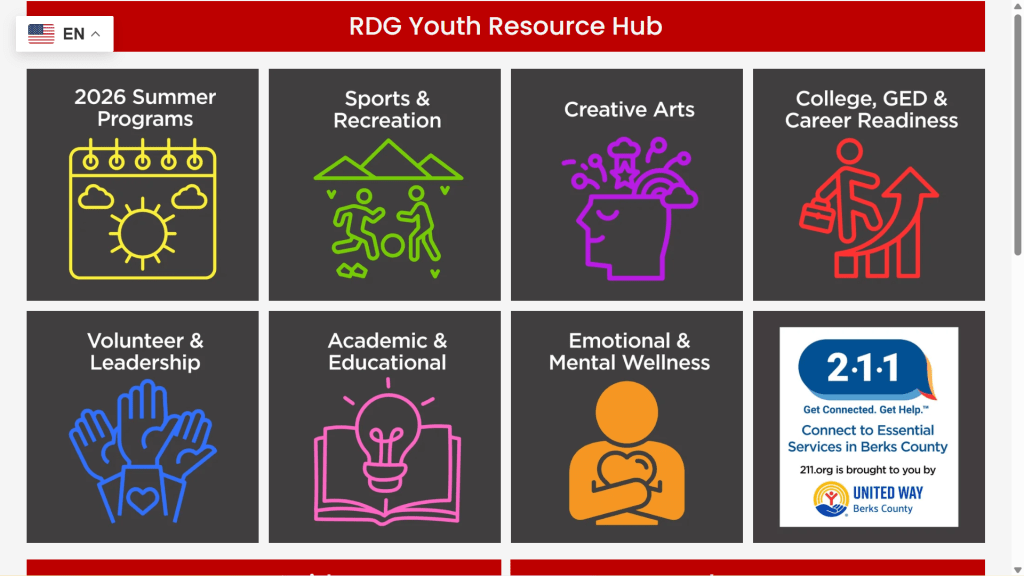
A new online platform launched by the Daniel Torres Hispanic Center aims to help Reading families find free and low-cost programs for children and teens.
The interactive map, called the RDG Youth Hub, is designed to connect families with summer programs, after-school activities, sports, arts, mental health resources and other opportunities for students in kindergarten through 12th grade.
The project also addresses barriers that often keep young people from participating in activities outside of school, said Laura Cordero, the center’s director of community impact.
Cordero said the hub grew out of years of collaboration with youth-serving organizations working together through the Greater Reading Thriving Together Initiative, a community-driven movement launched by the Hispanic Center with the Harwood Institute for Public Innovation.
“One of the most important parts of this project is that it was shaped directly by community voice,” Cordero said. “We had to start listening to the community to understand the needs and opportunities and solutions.”
Conversations with parents, students, teachers and nonprofit agencies revealed recurring challenges for families seeking programs for children, she said, including transportation, affordability, scheduling conflicts and simply not knowing where to find information about available activities.
“What we heard is families and parents identified barriers like transportation, affordability, scheduling and lack of information,” Cordero said. “Where do they go to find out about opportunities for their youth?”
The initiative began with simpler tools, including a summer activity slideshow shared through schools and a Google map launched last summer. That map was viewed more than 68,000 times, Cordero said, far exceeding organizers’ expectations.
“We were totally floored,” she said. “We knew this was a need because that told us it was a need.”
The new platform allows users to search by age group, interest area and location. Families can enter their home address to find nearby opportunities or programs located near bus stops. Listings also include contact information, costs, scholarship availability and program dates.
Transportation was a major consideration in designing the map, Cordero said.
“Transportation is such a barrier when it comes to accessing opportunities and after-school programs,” she said.
Families appreciate the ability to enter an address and see what’s close to their homes, schools, workplaces or bus stops, she said.
The center worked closely with Reading School District officials to spread awareness about the platform through school posting and messaging systems, parent meetings and community events.
The organization also employs a bilingual youth navigator who can help families identify programs that fit their interests and circumstances, Cordero said.
For the center, she said, the project is also tied directly to violence prevention efforts.
“Violence prevention starts long before a crisis occurs,” Cordero said. “Our approach is proactive, not just reactive.”
Meaningful activities and connections for young people can help create safer communities, she noted.
“Every young person deserves access to safe, enriching opportunities where they can learn, they can connect and grow,” she said. “This youth hub is one way we’re working with our community partners to make it easier to access and make that access more equitable and more impactful for families across Reading.”
Cordero said the hub also can help agencies identify service gaps across the city.
“Maybe there’s a lot of programming offered for elementary in one pocket of the city and nothing for teens,” she said. “If you overlay that with crime mapping data, you might find out, hey, this is a hotspot in our community, and there’s no teen opportunities offered.”
The map is expected to continue growing as organizations submit additional programs and updates throughout the year.
The center is focused on opportunities serving Reading School District students and prioritizing free or low-cost programming with hopes of expanding in the future, Cordero said.
Organizations interested in adding programs to the map can contact the center by emailing info@centrohispano.org.
To view the hub, visit RDGyouth.org.