
What does a typical day look like for a police officer? The answer might surprise you.
From traffic stops to community outreach and unexpected calls, our Jade Leah Burns got an up-close look at life behind the badge.
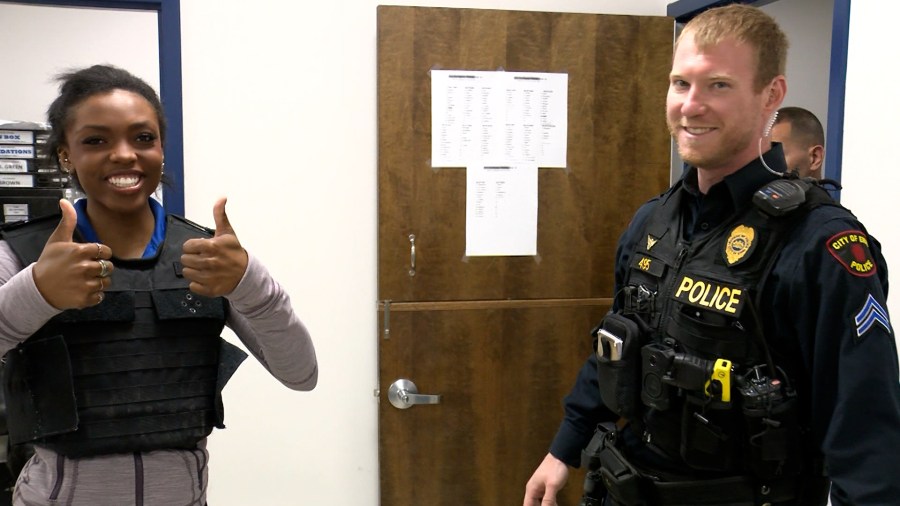
While most people avoid ending up in a police car, Burns signed up to buckle in, and Officer Josh Olszewski showed her it’s not so bad.
Before she clocked in for patrol with the City of Erie Police Department, they made sure Burns was geared up and safe for anything the day might bring.
“Vest, belt, make sure everything is good to go. Make sure I have all the paperwork I need in my bag, and my rifle is ready,” said Olszewski. “Missing adults, missing kids, that gets all read out at role call. Most recent wanted people, any news coming down from the command staff about what’s going on for the day.”
After that, they found their assigned car and hit the streets.
All the cruisers are equipped with state-of-the-art technology. It ranges from the Axon software that connects all of the car’s cameras and body cams to their call and report system.
Typically, officers make their rounds and respond to calls in one of the four zones of the city, which are broken up by upper and lower west, and upper and lower east.
One of their assignments for the day: speed checks, which Officer Olszewski said is an issue in several parts of the city.
The department has a plethora of lines set up throughout the city and officers measure speed by a stopwatch and two calculated checkpoints on the road.
“So we’ll start, and we’ll wait for them to get to the end, and we’ll finish. So it took them 3.21 seconds to go that 200 feet, gives us an average speed over that 200 feet 42.61 miles an hour. We’re looking for that egregious over the limit,” said Olszewski.
One driver the duo measured was above that range.
Once the call is completed, a full report is done to update and attach files.
The day continued at the station, where Burns and Olszewski did a quick check-in and took a look inside the cells.
Then, their shift happened to fall on a day when new recruits were training.
The two went to their shooting range and another building where they were practicing real-life scenarios.
A useful training tool is their virtual reality sets, which give officers practice and muscle memory for drawing and holstering their weapons.
“Press down, push forward and it removes the hood, and you’re able to pull out,” said Olszewski.
Burns asked, “Okay, Officer Olszewski, after going on patrol for the day, do you think I should sign up for the police academy?”
He replied, “I think you’re an outstanding candidate for the police academy. It would give you the opportunity to give the skills necessary to do the job. You already seem like you care about the city and its constituents and what goes on. I think you’re ready to take on the job.”
Copyright 2026 Nexstar Media, Inc. All rights reserved. This material may not be published, broadcast, rewritten, or redistributed.
For the latest news, weather, sports, and streaming video, head to WJET/WFXP/YourErie.com.