
On Nov. 4, eligible voters in Pennsylvania will decide whether Democratic state Supreme Court Justices Christine Donohue, David Wecht and Kevin M. Dougherty will retain their seats for another 10-year term. Judges for the Commonwealth and Superior Courts, as well as other local positions, will also appear on the ballot.
At Lehigh, the organizations Vote For Equality and Project 26 Pennsylvania are working on campus to increase voter turnout, especially for the justice election.
The justice election
The Pennsylvania Bar Association and Gov. Josh Shapiro have endorsed the justices for retention, but partisan control of the court remains in question. The court currently has a 5-2 Democratic majority, according to Spotlight PA,
If any of the three justices are not retained, the process of appointing a temporary replacement would begin. The governor can appoint an interim justice only with approval from two-thirds of the Republican-controlled state Senate, according to Spotlight PA.
If voters say “no” and the Senate blocks temporary appointments, a politically divided court could face delays in issuing statewide judicial decisions, according to WHYY.
Political science professor Jennifer Jensen said national efforts to influence judicial appointments have intensified, aiming to alter the balance of courts.
According to The New York Times, the Democratic National Committee has allocated approximately the same amount of money for New Jersey and Virginia’s governor’s races as the Pennsylvania retention elections.
Along with other conservative groups, the Republican State Leadership Committee has urged Pennsylvanians to vote “no” in the retention election, according to NBC.
Jensen said decisions made by the Pennsylvania State Supreme Court may have greater national implications.
“We’ve seen State Supreme Courts make big decisions that have implications as to what ballots get accepted or not accepted in state races, and, in fact, presidential races,” she said. ”There are potentially, not absolutely, but potentially national implications to who’s sitting on the Pennsylvania State Supreme Court.”
Harrison Smetana, ‘28, the president of Lehigh College Republicans, said he supports Republican judicial candidate Maria Battista for her effort to remain non-partisan.
The organization, along with similar groups from DeSales University and Moravian University, attended a donor event at Hotel Bethlehem in early October, where Battista and other candidates on the ballot spoke.
Smetana, who transferred to Lehigh this fall, said he didn’t have enough information to comment on the state Supreme Court election. Still, he said lower court and local elections are important because those officials make decisions on issues such as taxes, loans, firearms and abortion.
“No matter what, no matter how small the election, your vote will always matter, because especially in these smaller elections, even a few votes could change the whole thing,” Smetana said.
Efforts to increase voter turnout
Pennsylvania remains a key swing state, having split nearly evenly in the past two presidential elections.
According to Politico, President Donald Trump won the state 50.4% to Kamala Harris’s 48.7% in 2024. In 2020, former President Joe Biden carried the state 50% to Trump’s 48.8%.
Baylee Baker, ‘28, the president of Lehigh Democrats, said living in a swing state gives each vote additional weight.
Project 26 Pennsylvania focuses on state-wide engagement. According to its mission statement, the group promotes democracy in Pennsylvania by elevating youth leadership and encouraging civic engagement.
Sarah Stevens, ‘26, the organization’s Pennsylvania organizer, said the group’s name references the 26th Amendment, which guarantees the right to vote for U.S. citizens ages 18 and older.
Because Pennsylvania’s Supreme Court elections differ from how U.S. Supreme Court justices get a spot on the bench, Stevens said there can be confusion among voters about what they’re voting for.
This advocacy work is part of a larger effort as these three judges — if elected to stay — will be judges through the 2028 presidential election.
Vote for Equality, an independent organization that educates voters, has emphasized the importance of this year’s judicial elections, backing all five judges on the ballot.
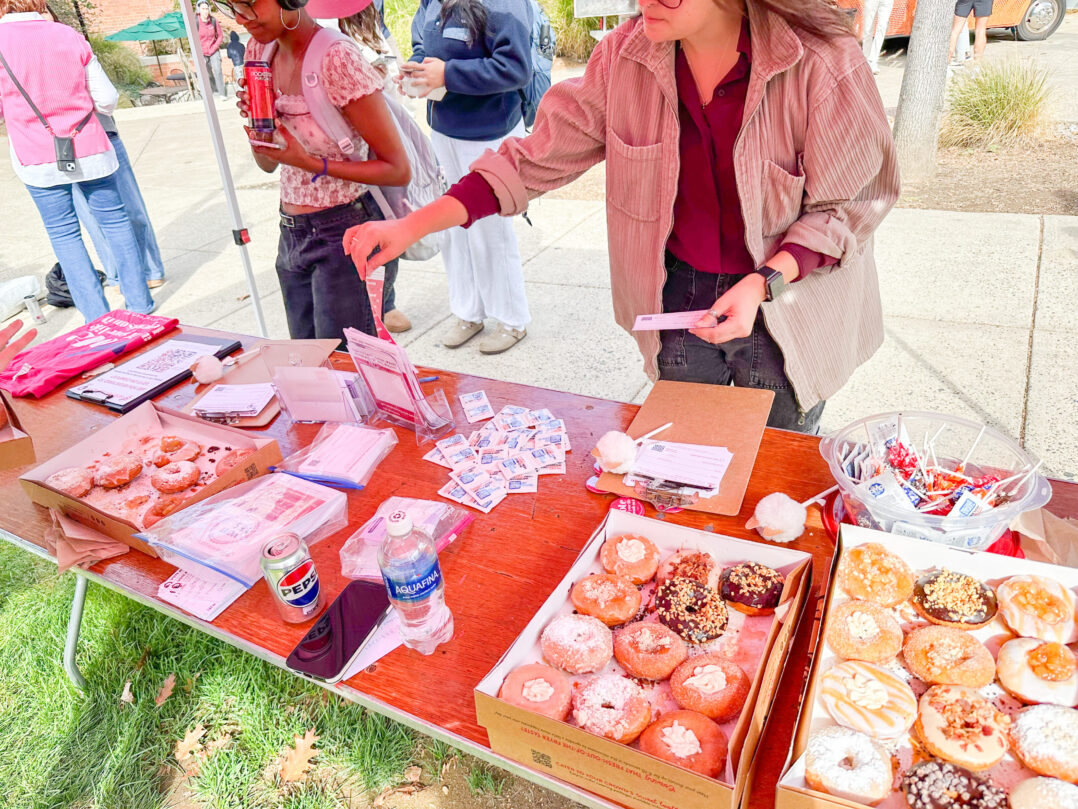
Julia Widding, ‘27, a student volunteer with Vote For Equality, helped host a campus tabling event where students could sign “pledge cards” committing to registering to vote in Pennsylvania.
Widding said some of her friends discovered their registration had become inactive, even though they’d registered and voted in the 2024 presidential election.
She also said registrants must know their Social Security numbers and have a valid ID when registering.
“It definitely is a sit-down, takes-time process,” she said. “If you’re not willing to do that before the election, you can’t vote.”
Baker said she also faced issues when registering to vote in Pennsylvania for the first time last year. Like many out-of-state students, she was required to submit an image of her signature, but the state’s online registration system repeatedly rejected it which delayed her registration.
Sophia Merlino, ‘27, the treasurer of Lehigh Democrats, said the process can be confusing, especially for first-time voters.
She said she believes voter outreach groups could benefit from providing infographics showing where students can find reliable information about registration and voting.
“Even though not everyone is going to stay here after graduation, your vote can affect things long term,” Baker said. “If you vote for what you believe will be a positive change for the community, then you’re leaving an impact beyond your four years here.”