
Now that we’re turning the clocks back to Eastern Standard Time this weekend, it’s finally beginning to feel like fall.
The branches of the dawn redwood tree in the yard are turning orange, and the wooded hillside behind the farmhouse across the street is colorful. Relatively speaking, it’s been warmer than normal until now, but that will almost certainly change as winter approaches.
However, until it gets colder in the coming weeks there won’t be much bird activity at backyard feeders. That won’t happen until temperatures get a lot lower because there’s so much natural wild food still available.
In addition to the attractive trees, many shrubs and other native plants have colored up. Native pokeweed (Phytolacca americana) plants have grown big, sometimes 8 or 9 feet tall, they’ve turned bright red, and they’re covered with purple/black berries.
Pokeweed is a plant humans should avoid because all parts of it are toxic. It’s been eaten for centuries by indigenous people because there weren’t grocery stores around hundreds of years ago. But, unless it’s boiled many times over, eating any part of it could be deadly. Back in the 1800s, many deaths were attributed to its consumption and also because it was also used as a purgative to rid people of evil spirits.
Birds and some small animals aren’t poisoned by its toxic berries, which is why this plant that’s native to the East is found in half of the country. But it’s also somehow made its way to Europe and naturalized in many places.
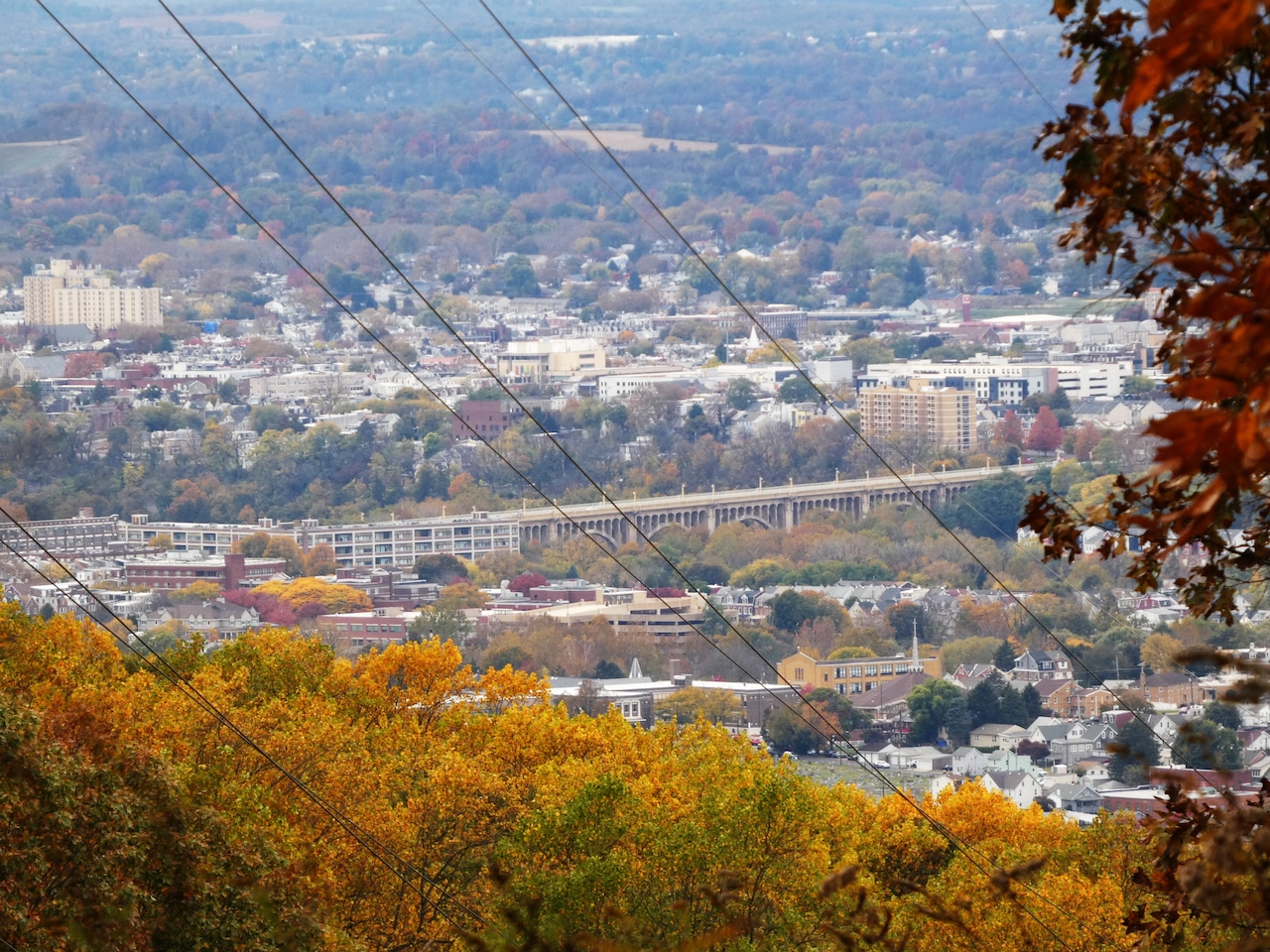 Autumn colors provide a partial frame for this view of the Albertus L. Meyers (Eighth Street) Bridge in Allentown during the late afternoon on Saturday, Oct. 25, 2025, from atop the Horizon Trail at Wildlands Conservancy’s Black River Sanctuary.Kurt Bresswein | For lehighvalleylive.com
Right now, if you look closely at trees and shrubs in wild or natural areas you will almost certainly see clusters of bright red bittersweet berries. These berries are also toxic to humans if ingested, but they’re usually only picked for decoration purposes. Even so, if you handle them without gloves be sure to wash your hands afterwards.
On a different subject, recently our older son Brian called and asked about a caterpillar he found. He was cutting open a branch that fell from a cherry tree in his yard, and its inside was almost empty except for the caterpillar.
We have heated our home exclusively with wood since we built it 46 years ago, so David has often seen something like this. The caterpillar was a carpenterworm, the larval form of a black and gray moth. But what makes finding something like this really interesting is that carpenterworms can live inside wood for years before they morph into a black and gray moth.
And, on another subject, hawk watchers at most eastern sites are currently seeing many bald eagles and occasionally golden eagles along with other raptors that include red-tailed hawks, sharp-shinned hawks, and several different falcons. But while the raptors are what people go to hawk watches to see, often there are also lots of vultures, both turkey and black, passing overhead.
People generally ignore or don’t look much at vultures, but they play an incredible role in keeping natural areas free of dead animals. But, even if you don’t like them, seeing thousands of them migrating long distances overhead is impressive. At times an airport in Panama is temporarily closed down because hundreds of thousands of vultures are migrating through the skies there.
If you purchase a product or register for an account through a link on our site, we may receive compensation. By using this site, you consent to our User Agreement and agree that your clicks, interactions, and personal information may be collected, recorded, and/or stored by us and social media and other third-party partners in accordance with our Privacy Policy.