
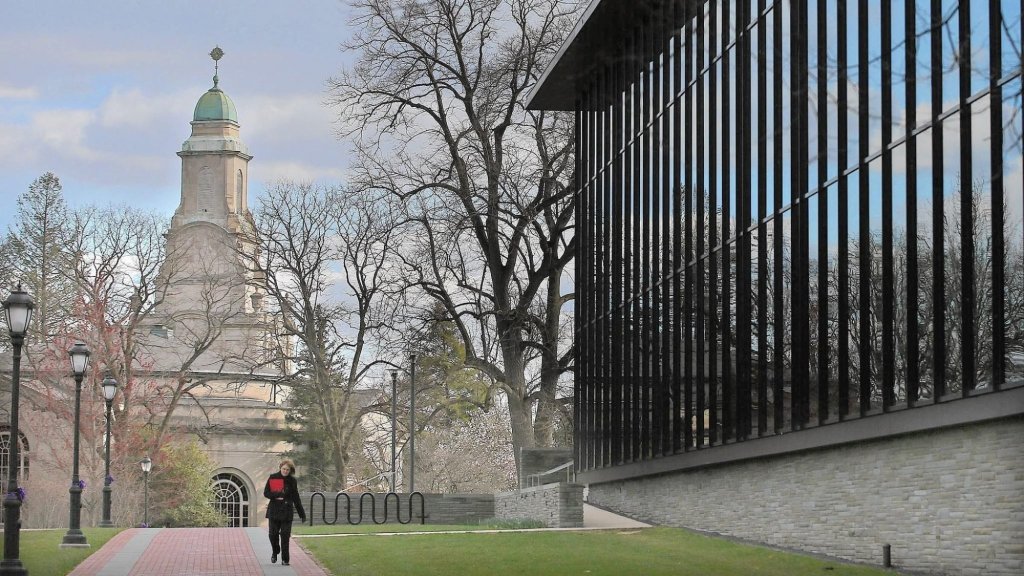
A national free speech group says Lafayette College violated students’ free speech rights after the Easton institution suspended fraternity and sorority activities due to what’s been described as antisemitic and sexist remarks during a seminar.
The Foundation for Individual Rights in Education said that even though activities were recently restored after students completed anti-bias training, the university still needs to be held accountable.
“It’s still problematic that this happened to begin with. These groups were suspended for several months and that means this could happen again if the college believes its response was correct,” said Zach Greenberg, FIRE’s director of faculty legal defense. “We’re still pursuing this case. We’re trying to hold the college accountable. We’re trying to get them to admit what they did was wrong and uphold student speech rights going forward.”
According to a letter FIRE sent to the college, which referenced reporting by campus newspaper The Lafayette, the suspension occurred after anonymous antisemitic and sexist responses were made during a Wellness 101 seminar Nov. 12 attended by about 600 fraternity and sorority members.
Lafayette suspended all Greek life social events amongst its 13 fraternities and sororities until all organizations completed anti-bias training developed by the college, which began to be distributed in February.
A fraternity member, who requested anonymity to avoid retaliation from Lafayette, told The Morning Call he did not recall any such Wellness 101 sessions occurring in his prior years in Greek life and felt that attendance for this session was being heavily pushed by the college.
“I don’t remember if there was some event that had occurred before that had triggered the mandatory-ness of the talk, but they just kind of made it clear that we had to try to get as many members to the talk as possible,” the fraternity member said.
Neither Lafayette spokesperson Scott Morse nor Associate Director for Fraternity and Sorority Life Jake Bates returned requests for comment.
“There was a lot of embarrassment from the community of what had just transpired at the talk but I think, in turn, there was a lot of confusion,” the fraternity member said. “A lot of people were upset that they had basically just kicked off every single person in the entire school that is a part of these organizations.”
In May, FIRE sent a letter to the Middle States Commission on Higher Education, the academic accreditor for Lafayette, calling on it to investigate the college’s compliance with its policies regarding free speech.
“This single anonymous student’s commentary — even if widely considered offensive — at the college event is clearly protected by Lafayette’s commitments and obligations,” the group wrote. “Any reasonable conception of free expression encompasses adult college students’ right to express views that may offend students and administrators but that do not rise to the level of punishable harassment and discrimination.”
Greenberg said the organization also may pursue a legal case against Lafayette based on the college’s suspension. However, a case has not yet been filed.
Greenberg said while Lafayette is a private college, and thus is not bound by the First Amendment, it has written within its policies a commitment to students to preserve their free speech rights.
Greenberg said the suspension of the college’s Greek life violates the expectations of students that they are still entitled to these rights on campus, especially since all of Lafayette’s Greek life was punished for the language of a few members.
“The college punished 13 different groups for what only perhaps one student said, so it’s punishing students for the words of another individual,” Greenberg said. “That’s a guilt by association issue that we feel violates the First Amendment because you should only be accountable for the words you say and punishing groups for their association with other groups is an affront to free speech and freedom of association as well.”
Even though the suspension on Lafayette’s Greek life has been lifted, the fraternity member said students remain uncertain about what they are allowed to say, especially when it may involve a university’s reputation.
“I’m a strong believer in college as a place where you come to grow and really challenge your personal views and if you don’t have anybody there to challenge your personal views, because they either feel that they can’t share their views or that they are at a risk of being punished for their views, it becomes a really dangerous line to draw,” he said. “In my experience, there wasn’t anything that signaled to me that Lafayette was really trying to go after students’ rights to free speech, but this incident definitely opened the door for potential questions about where the college’s views are about their image in conjunction with how students choose to speak freely on campus.”