
Another Pittsburgh Pride weekend has entered the history books. Both QBurgh and city police estimate that more than 300,000 people participated throughout the weekend, despite Saturday’s rain, which caused organizers to shut down early (though not as early as Morgan Wallen did). But Sunday brought great parade weather. QBurgh noted that 2026 Pride also featured the largest number of vendors, and “the largest number of marching contingents ever to participate.”
June is Pride Month, of course, and festivities continue all month long. The celebration of the queer community commemorates a routine police raid at the Stonewall Inn in Greenwich Village, New York City, on June 28, 1969, and the unexpected rebellion of the bar’s gay and transgender patrons.
The Gay Liberation Front was founded in New York City a month later. A year after that, in 1970, Chicago, Los Angeles, San Francisco and New York hosted the first gay pride marches in commemoration of Stonewall. Philadelphia followed in 1972. Pittsburgh joined the movement in 1973 (which isn’t bad: Cleveland’s first was in 1977).
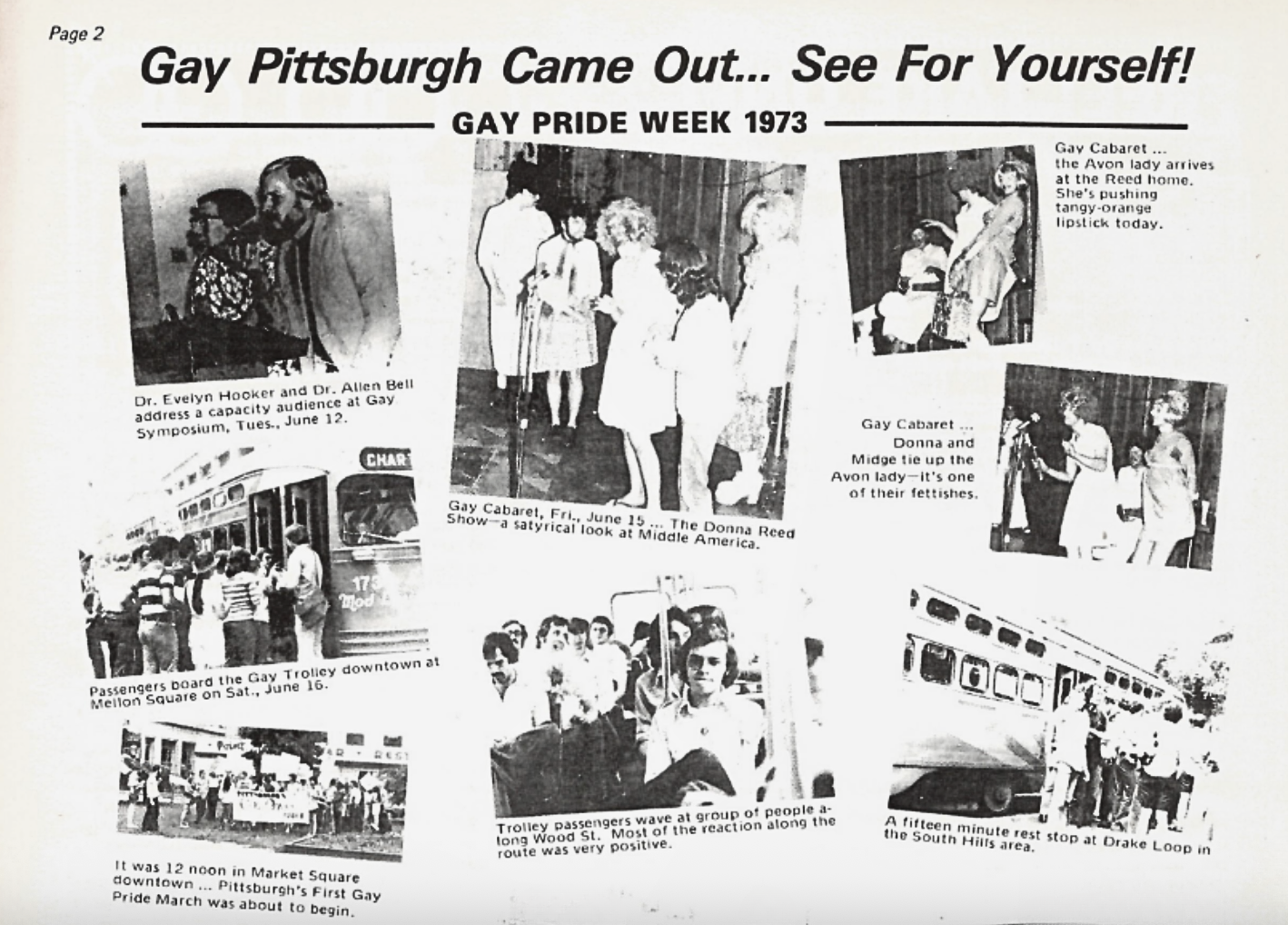
On Sunday, June 17, 1973, Watergate news filled the papers. Golf fans crowded Oakmont Country Club for the final round of the U.S. Open. It was the last day of the city’s first Pride Week, which featured Lesbians/Feminist Night at the 1209 Club Uptown and a Gay Trolley ride through Downtown and the South Hills. That Sunday morning, about 60 people lined up in Market Square. At 1 p.m., Pittsburgh’s first March for Gay Pride began.
The weather was classic Pittsburgh in mid-June: overcast and muggy with a high of 82. The route was ambitious: from Downtown to Flagstaff Hill in Schenley Park, more than 3 miles away. By contrast, this year’s march from 11th and Liberty to Allegheny Commons Park West was less than half the distance.
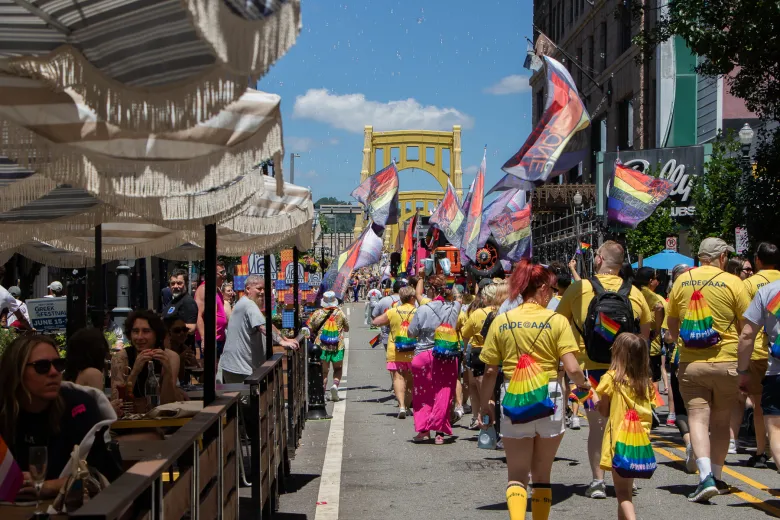 The Pittsburgh Pride March, June 7, 2026. Photo by Alexis Wary.
The Pittsburgh Post-Gazette reported that it was a boisterous crowd, with a full repertoire of chants, including “2 4 6 8, we don’t overpopulate” and “Come out, come out, wherever you are.” Songs included “We Shall Overcome” and “When the Gays Go Marching In.”
Participants marched on the sidewalk, accompanied by a police vehicle. Three “slightly muscular men in short dresses or halter-back tops” waved to onlookers. Marcelus Luck III, “a tall, muscular exotic dancer,” marched with a 7-foot boa constrictor on his shoulders.
Reporter Stephen Franklin wrote:
“As marchers passed the Arena Turkish and Russian Baths on Forbes Avenue, some men stood on the steps, apparently wearing only towels around their waists. ‘Oh, the boys!’ one marcher shouted out. “I love the baths! I’ll see you there next week!’”
After more than two hours, participants reached Schenley Park. The July 1973 edition of The Pittsburgh Gay News, a free monthly publication, reported that the number of marchers had doubled by the end. A short rally was held, and the city’s first Pride Week ended with a Gay Picnic in North Park.
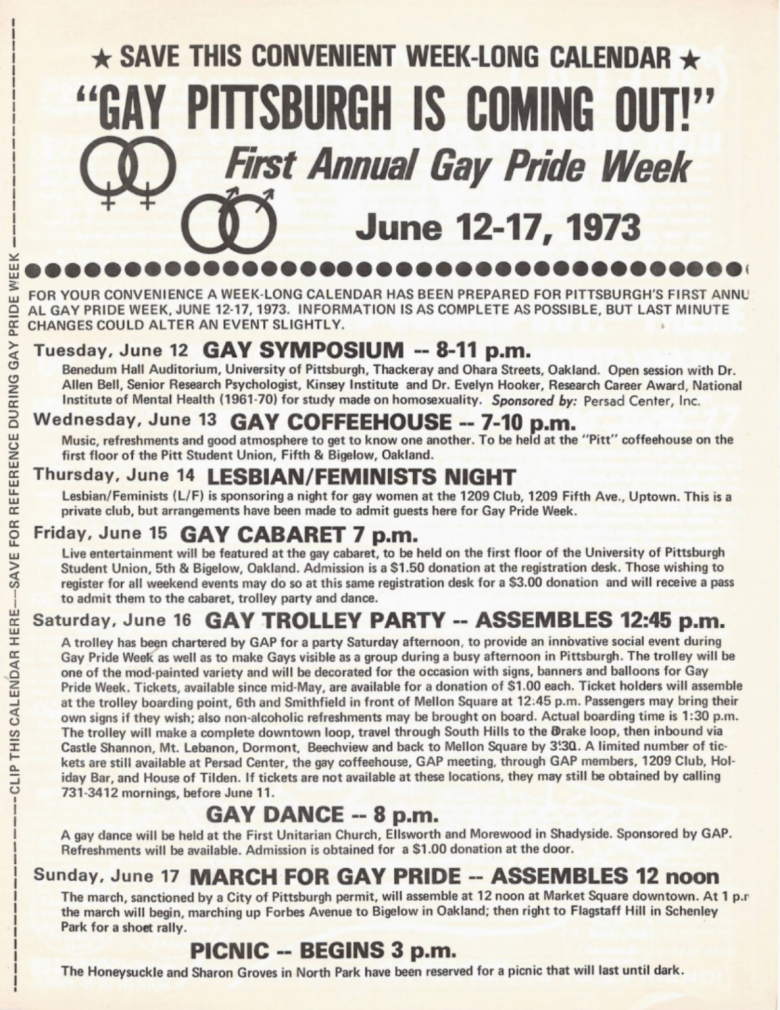 The schedule for the first Pittsburgh Pride week in 1973 from Pittsburgh Gay News, June 1973. Image courtesy of QBurgh.
Randy Forrester, who had co-founded The Persad Center the year before, told the Post-Gazette at the time that he’d hoped for more marchers, but “if you were gay, would you put your face on this line? No, you’d probably think of your job or your family.”
David March, a gay activist in the city in the 1970s and ‘80s, missed that first parade but, as he recalls now, he has no regrets: “A lot of people I knew referred to it as the death march.” It was so hot and sticky that the live snake carried by Marcelus Luck didn’t make it the whole way.
“He arrived at the park with a dead snake,” March said. “Provisions were not made for accompanying pythons.”
At the time, March was involved with Gay Alternatives Pittsburgh, an advocacy group. As a civil service employee, he was protected by anti-discrimination policies that went into effect in 1975. “So I came out with a bang.
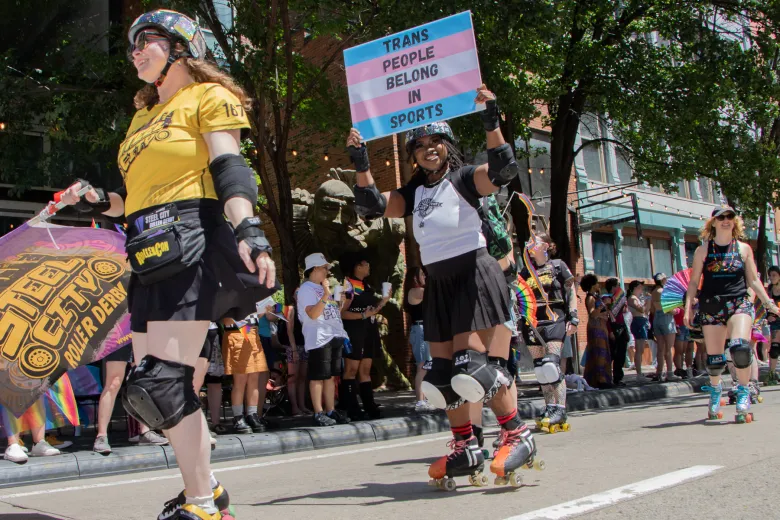 Steel City Roller Derby at the 2026 Pride March. Photo by Alexis Wary.
“Back in those days, you were automatically thought of as a child molester,” he said. “We were normal people.”
March’s advocacy included an appearance on the local daytime talk show hosted by Marie Torre. (Shoutout to old Pittsburghers.) His car license plate read “Gay Lib” and during the Bicentennial, “Gay ‘76.”
“But once AIDS hit (in the early 1980s), that was everybody’s focus,” he recalled. “Everything else seemed to pale in comparison.”
At age 77, March said he and his husband didn’t get out to the Pride parade this year, “but up until recently we did.”
“When I was growing up (gayness) wasn’t talked about,” March recalled. “I grew up watching Audie Murphy and John Wayne.” Now, he said, “Whenever I hang an American flag, I also hang the Rainbow Flag.”