
Astrobotic put its Griffin-1 lunar lander on display Monday at the company’s Pittsburgh headquarters as the spacecraft heads into environmental testing ahead of a planned launch in late 2026.The lander is being developed under NASA’s Commercial Lunar Payload Services program. Astrobotic says Griffin-1 is designed to carry what would be the largest commercial payload ever delivered to the moon’s surface.Pittsburgh’s Action News 4 anchor Kelly Sasso was at the Astrobotic unveiling and will have more information tonight on Pittsburgh’s Action News 4 starting at 4 p.m.The spacecraft is completing final integration in Pittsburgh before being shipped to California for testing. Later this year, it is expected to go to Cape Canaveral, Florida, for final launch preparations and subsequent launch on a Space-X Falcon Heavy Rocket.Astrobotic CEO John Thornton said the unveiling marked a milestone for both the company and the region.“It’s fantastic to see the cross-section of Pittsburgh and Pennsylvania standing up, coming together, celebrating this big, big moment in space,” Thornton said. “Pittsburgh is in the space race.”He said the company’s work reflects the growth of the space industry beyond traditional centers.“This is not a thing that happens in Houston or San Francisco or L.A. or Florida anymore,” Thornton said. “It happens right here in Pennsylvania.”Looking for more news in your area | Subscribe to the WTAE YouTube ChannelThornton said Griffin is the result of nearly two decades of work.“This is the product of 19 years of Astrobotic development,” he said, standing in front of Griffin. “We envisioned this as a small, squat lander that could deliver large payloads to the surface of the moon and get payloads down close to the surface and deploy right off the top.”The mission is expected to carry 10 payloads from six nations, along with additional payloads aboard Astrolab’s FLIP rover, according to Thornton.“It will actually be the largest commercial payload delivery ever attempted to the surface of the moon,” he said.NASA’s Carlos García-Galán, program executive for the Moon Base, said the mission fits into a larger push to build a sustained presence beyond Earth.“This is going to be humanity’s first outpost in deep space,” García-Galán said. “We’re building on the rise of the Apollo program where the objective was to get there, and we still remember that one of humanity’s greatest accomplishments.”He said the next phase of exploration will focus on operating and building on the moon as a step toward Mars.“We’re taking that torch, and we’re going from getting there to actually learning how to work and building the capabilities of everything,” García-Galán said. “We need to take the next step, which is to go to Mars, and it all starts with machines like this.”Astrobotic said several payloads already have been integrated onto Griffin-1, including BEACON, a joint mission with Mission Control Space Services, and LandCam-X, a European Space Agency payload designed to improve landing precision and safety. Astrolab’s FLIP rover, the mission’s largest payload, is expected to be integrated in Florida before launch.The company said Griffin-1 will undergo qualification and acceptance testing in California to verify it can withstand launch, spaceflight and lunar mission conditions. After launch, the spacecraft will be operated from Astrobotic’s Mission Control Center in Pittsburgh.The unveiling comes as Astrobotic also prepares for a change in ownership. Earlier this month, the Pittsburgh-based company announced that it is being acquired by Voyager Technologies in a deal reported by WTAE’s news partners at the Trib to be worth up to $300 million.Denver-based Voyager is a publicly traded aerospace and defense company. Astrobotic said its Pittsburgh headquarters will become the hub of Voyager’s lunar program.“Joining Voyager provides the scale, resources, and long-term commitment our mission calls for,” Thornton said in a statement. “Our team, our technology, and our homes in Pittsburgh and Mojave remain at the center of what we’re building. Together with Voyager, we can accelerate the timeline for establishing America’s Moon Base.”The transaction is subject to regulatory approvals and is expected to close by early July. Download the WTAE app to stay connected with breaking news. Sign up for our email newsletters to get breaking news in your inbox.
PITTSBURGH —
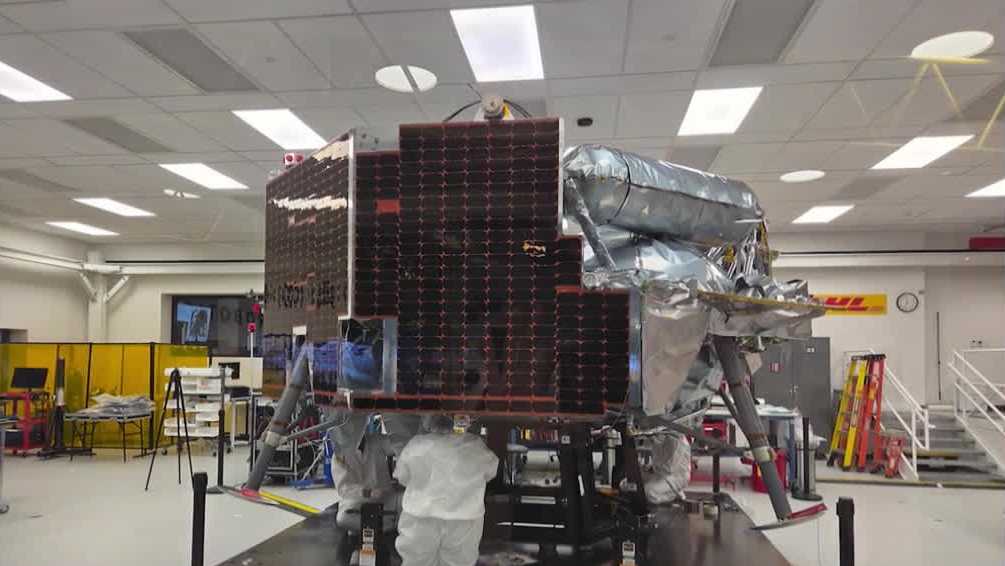
Astrobotic put its Griffin-1 lunar lander on display Monday at the company’s Pittsburgh headquarters as the spacecraft heads into environmental testing ahead of a planned launch in late 2026.
The lander is being developed under NASA’s Commercial Lunar Payload Services program. Astrobotic says Griffin-1 is designed to carry what would be the largest commercial payload ever delivered to the moon’s surface.
Pittsburgh’s Action News 4 anchor Kelly Sasso was at the Astrobotic unveiling and will have more information tonight on Pittsburgh’s Action News 4 starting at 4 p.m.
The spacecraft is completing final integration in Pittsburgh before being shipped to California for testing. Later this year, it is expected to go to Cape Canaveral, Florida, for final launch preparations and subsequent launch on a Space-X Falcon Heavy Rocket.
Astrobotic CEO John Thornton said the unveiling marked a milestone for both the company and the region.
“It’s fantastic to see the cross-section of Pittsburgh and Pennsylvania standing up, coming together, celebrating this big, big moment in space,” Thornton said. “Pittsburgh is in the space race.”
He said the company’s work reflects the growth of the space industry beyond traditional centers.
“This is not a thing that happens in Houston or San Francisco or L.A. or Florida anymore,” Thornton said. “It happens right here in Pennsylvania.”
Looking for more news in your area | Subscribe to the WTAE YouTube Channel
Thornton said Griffin is the result of nearly two decades of work.
“This is the product of 19 years of Astrobotic development,” he said, standing in front of Griffin. “We envisioned this as a small, squat lander that could deliver large payloads to the surface of the moon and get payloads down close to the surface and deploy right off the top.”
The mission is expected to carry 10 payloads from six nations, along with additional payloads aboard Astrolab’s FLIP rover, according to Thornton.
“It will actually be the largest commercial payload delivery ever attempted to the surface of the moon,” he said.
NASA’s Carlos García-Galán, program executive for the Moon Base, said the mission fits into a larger push to build a sustained presence beyond Earth.
“This is going to be humanity’s first outpost in deep space,” García-Galán said. “We’re building on the rise of the Apollo program where the objective was to get there, and we still remember that one of humanity’s greatest accomplishments.”
He said the next phase of exploration will focus on operating and building on the moon as a step toward Mars.
“We’re taking that torch, and we’re going from getting there to actually learning how to work and building the capabilities of everything,” García-Galán said. “We need to take the next step, which is to go to Mars, and it all starts with machines like this.”
Astrobotic said several payloads already have been integrated onto Griffin-1, including BEACON, a joint mission with Mission Control Space Services, and LandCam-X, a European Space Agency payload designed to improve landing precision and safety. Astrolab’s FLIP rover, the mission’s largest payload, is expected to be integrated in Florida before launch.
The company said Griffin-1 will undergo qualification and acceptance testing in California to verify it can withstand launch, spaceflight and lunar mission conditions. After launch, the spacecraft will be operated from Astrobotic’s Mission Control Center in Pittsburgh.
The unveiling comes as Astrobotic also prepares for a change in ownership. Earlier this month, the Pittsburgh-based company announced that it is being acquired by Voyager Technologies in a deal reported by WTAE’s news partners at the Trib to be worth up to $300 million.
Denver-based Voyager is a publicly traded aerospace and defense company. Astrobotic said its Pittsburgh headquarters will become the hub of Voyager’s lunar program.
“Joining Voyager provides the scale, resources, and long-term commitment our mission calls for,” Thornton said in a statement. “Our team, our technology, and our homes in Pittsburgh and Mojave remain at the center of what we’re building. Together with Voyager, we can accelerate the timeline for establishing America’s Moon Base.”
The transaction is subject to regulatory approvals and is expected to close by early July.
Download the WTAE app to stay connected with breaking news. Sign up for our email newsletters to get breaking news in your inbox.