

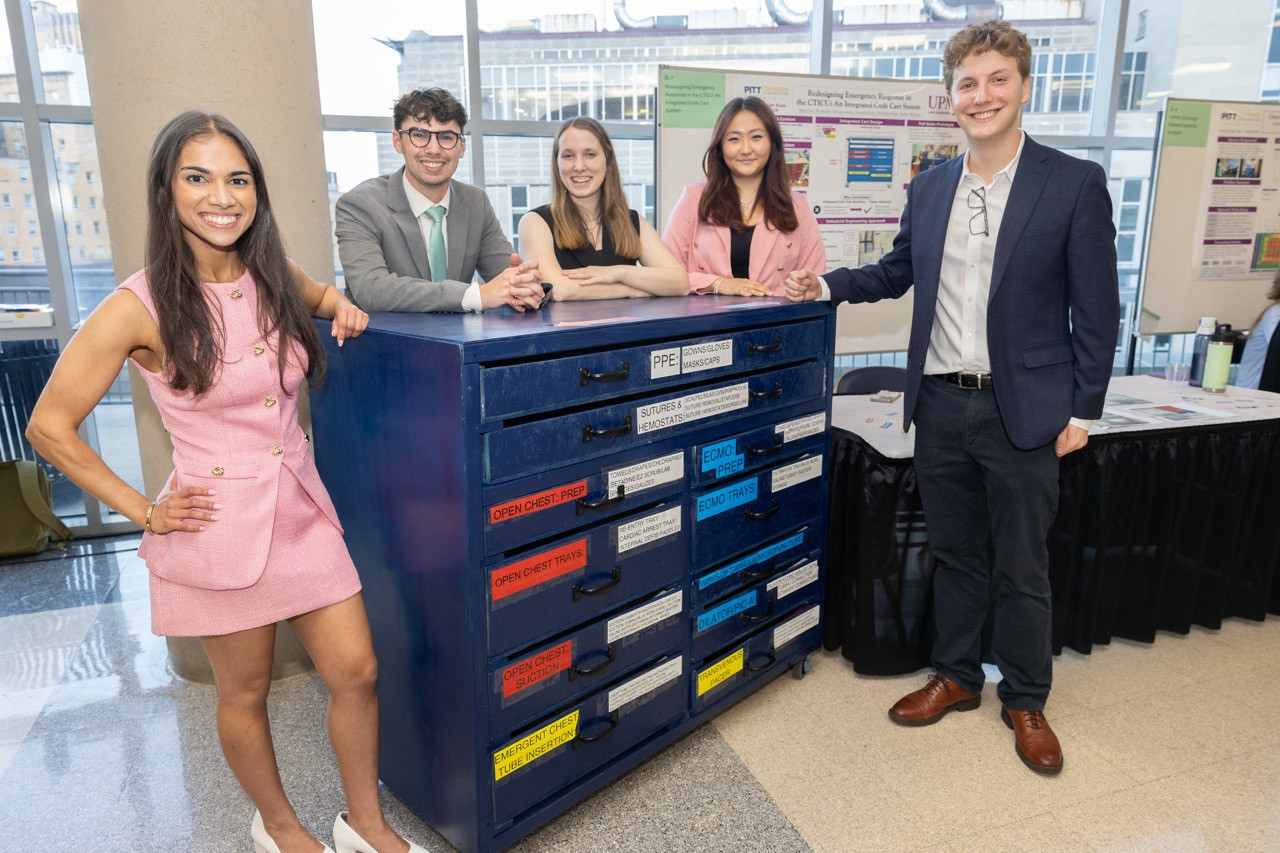
Team with Cart
“It’s a high-pressure, high-risk, low-frequency event.”
In the Cardiothoracic Intensive Care Unit at UPMC Presbyterian Hospital, two emergency carts hold supplies needed in the unlikely event of opening a patient’s chest to provide immediate life support.
“The carts have been around for over 50 years, and they weren’t designed with a systematic approach that applies human factors elements,” said Holt Murray, medical director of the Cardiothoracic Intensive Care Unit at UPMC Presbyterian Hospital and assistant professor of Critical Care Medicine. The carts are also infrequently used.
“Even our higher-volume procedures, like an extracorporeal membrane oxygenation (ECMO), happen around 90 times a year. When you factor in a nurse’s schedule, working three and a half shifts a week, there is low exposure to them,” he said.
Yet the specialty supplies are extremely time-sensitive, and someone with minimal experience must be able to reach them quickly.
Murray was eager to partner with the Swanson School to rethink how the carts were constructed and organized. “I was delighted to have a bunch of engineers come in and look at our processes.”
Those engineers were Pitt seniors Maya Jain, Cindy Lkhagvasuren, Garrett Rojik, Madelyn Shaw, and Aidan Wolynn. The team visited the hospital and met with Murray, nurse practitioner Lorenza Schwartzmiller, and nurses on the floor. They worked closely with Schwartzmiller, combining physician nursing and engineering to solve a complex problem.
“From the get-go, we understood how high-risk it is,” Jain said.
As they began the redesign, the team ran tests, timing nurses as they pulled equipment from the existing carts. “They could see within a few nurses what the fundamental engineering problem was,” Murray said.
The students inventoried the carts, measuring and weighing all items, and set to work modeling and designing something new. “We really had to understand how all the supplies were used so we could develop the order in our cart,” said Rojik.
“We turned to our visual management techniques. You know, when operators go on the manufacturing floor, they know exactly where their tools are. They have an outline for it and a standard workspace,” Jain added.
The two carts are used for different lifesaving procedures. As the team explored models, they chose to combine both into one larger cart, with each half devoted to a procedure. “We spent hours trying to figure out how we could fit everything into the carts,” Jain said.
‘;