
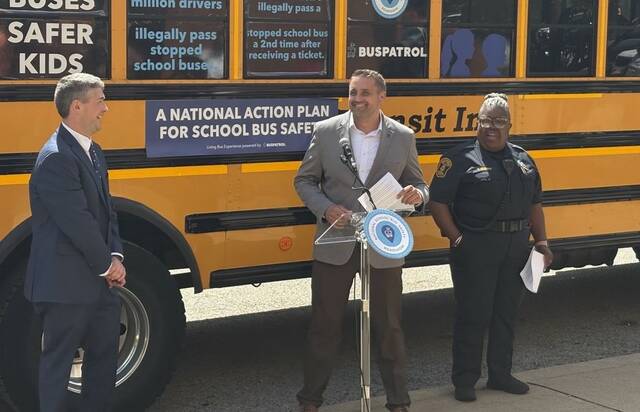
The number of vehicles that illegally passed city school buses decreased 8% this school year over last.
Pittsburgh Public Schools officials attribute the decrease to new technology that identifies drivers who ignore the blinking lights and stop signals of a school bus.
In short, as more people got expensive tickets for the violation, more people learned to obey the law.
Between August 2025 and June, PPS’ fleet of 243 buses recorded 10,328 stop-arm violations, officials said Wednesday.
Last school year, PPS issued 9,165 tickets, a decrease from 9,961 the prior year.
The district reviews the bus recordings for fairness and accuracy before mailing a ticket.
In 2023, PPS partnered with BusPatrol, a safety technology company. BusPatrol installs AI-powered cameras to monitor traffic and catch drivers who illegally pass stopped school buses.
Michael McNamara, the PPS chief operating officer, believes communication and awareness of the issue has led to the reduction of violations. PPS reports 5.9% of violations were committed by repeat offenders since the program’s inception.
“School bus safety depends on awareness, compliance and shared responsibility across the community,” said Toi Kenney, a PPS police officer. “Parents, school, law enforcement and drivers all have a role to play by working together and remaining vigilant.”
State law requires drivers traveling in both directions to stop when a school bus displays flashing red lights and an extended stop arm. Violations can carry a minimum $300 penalty and can add 5 points to a driving record.
“The effort is not about issuing citations for the sake of enforcement,” Kenney said. “It’s about protecting the children and reinforcing safety behaviors on our roads. Every violation we prevent is a potential injury avoided.”
Data found the highest number of violations – 251 – occurred in the 500 block of 40th Street in Lawrenceville. Other hot spots were the 5500 block of Penn Avenue, the Smithfield and Carson streets intersection, the 1700 block of East Carson Street and the 300 block of South Braddock Avenue.
It showed 57% of violations happened during afternoon bus routes.
That data can be used to help make bus stops safer for children, said Rick Birt, BusPatrol’s vice president of government operations and safety. Officials can discuss opportunities to move or relocate a problematic bus stop, determine if in-person enforcement is needed or if engineering changes to the road.
“This is what we call a safe system approach,” Birt said. “This is really looking at the totality of the environment in which our children are moving, and then finding all the resources that we have, all measures we can deploy to make sure we’re keeping them safe.”
Transportation Director Megan Patton said violators often do not understand when they need to stop for buses. Kenney said vehicles need to slow down when a bus driver activates amber lights on the bus. Motorists must stop when the bus’ red lights are activated and the stop-arm begins to extend.
“We can prevent tragedies before it even happens,” Kenney said. “Children boarding and exiting the school buses are counting on adults to make responsible decisions.”