
How did the city of Erie’s general fund budget end up with a $12 million deficit heading into 2027?
The deficit is the result of a variety of financial factors/conditions.
Here is a breakdown, based on city financial figures; previous reporting by the Erie Times-News; and financial analysis from Public Financial Management Inc. which has been hired by the city as its state-required consultant for the Pennsylvania Department of Community and Economic Development’s Strategic Management Planning Program.

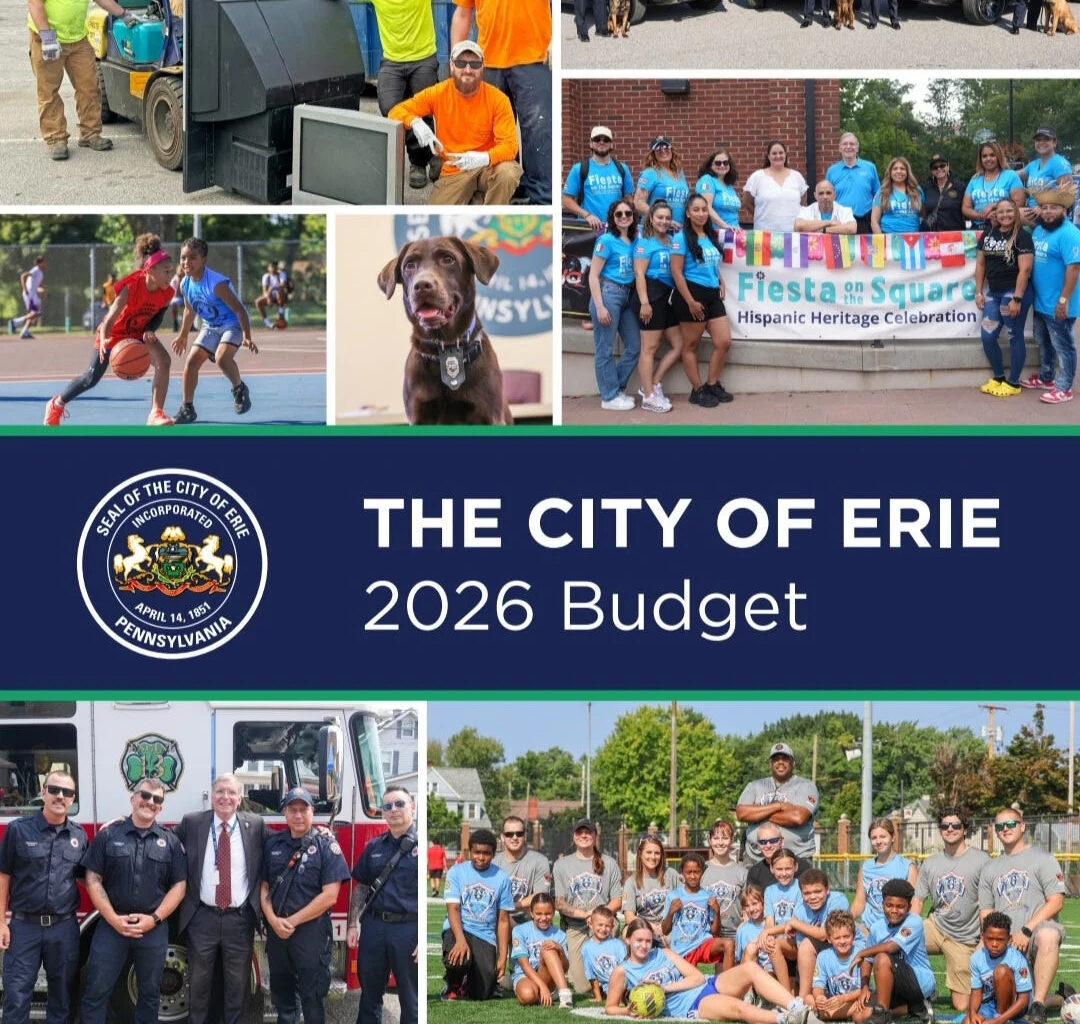
The cover of the city of Erie’s 2026 final budget.
PFM is helping Erie Mayor Daria Devlin’s administration craft a long-range financial management plan.
“Nearly all Pennsylvania governments struggle to achieve structural balance,” said Gordon Mann, PFM’s director.
“Pennsylvania governments are relying on a tax revenue that’s frequently flat,” Mann said. “Meanwhile most of government’s major expenses – salaries, health insurance, utilities – grow over time.”
From 2024: Future deficits loom large during Erie City Council budget talks. What it means for taxpayers

Gordon Mann, director of the Philadelphia-based consulting firm Public Financial Management, talks with city of Erie officials May 14 during a public study session on a $12 million budget deficit the city faces.
Pension funding
The city’s 2026 budget includes $32 million in general fund revenue that is restricted and can only be used for employee pensions. That money is not available to fund other needs. PFM said that creates an immediate budget hole of at least $8 million.
Previous coverage: City of Erie sees layoffs, expense cuts in wake of $12M budget crisis
Flat tax base
Erie’s real estate tax revenues have little growth without tax rate increases. The city has only raised property taxes once since 2020.

Erie Mayor Daria Devlin.
The taxable assessed value of all city properties has stayed at roughly $3.2 billion since 2022 and over that same time period, the city only saw a 9% increase in current property tax collections — from $37 million in 2022 to the $40.7 million that was budgeted for 2026.
Consultant’s pitch: Budget cuts, property tax hikes mentioned as ways to close $12M budget gap
Increased personnel/operating expenses
Overall operating expenses for city government grew 32.6% between 2021 and 2025.
Further, spending on city salaries/wages, much of that mandated by employee union contracts, has increased by an average of 4.2% each year since 2022 and spending on expenses such as materials, supplies, contracted services and utilities has increased nearly 33% over the last four years.
Inflation has impacted those costs.
The city’s personnel related costs, such as salaries, health insurance and pensions, make up roughly 84% of annual budgets and grow about 3% each year. City government has also added 46 full-time employees since 2021, nearly half of those (21 employees) within the Erie Bureau of Police.
Short-term revenues drying up
The city has received more than $173 million in recent years that have been depleted and therefore cannot be considered long-term revenue sources.
The city has also used large portions of that money to plug budget holes.
That includes the roughly $97 million the city received from Erie Water Works as part of a lease prepayment deal, as well as $76 million in American Rescue Plan funding awarded to Erie during the COVID-19 pandemic.
Almost $79 million of the water lease money was used to pay down long-term city debt and was escrowed/restricted for that purpose. Much of the remaining $18 million was used largely to balance previous city budgets and avoid property tax increases; city officials say there is roughly $6.5 million in unrestricted water lease money left.
The ARP funding was used for a variety of city initiatives; there is about $2.1 million left. PFM stated that the city used nearly $45 million of the ARP funding in previous general fund budgets.
‘Financial health’
PFM is expected to present its long-range financial plan to city officials this summer.
“Real financial health means recurring revenues cover recurring expense. Real financial health means the city is responsibly spending taxpayer money to fund the services taxpayers expect at a price they are willing to pay,” PFM’s Mann said.
“Real financial health means the City can make necessary investments in the infrastructure residents use every day – roads, parks, bridges, etc. That’s the goal.”
Contact Kevin Flowers at kflowers@timesnews.com. Follow him on X at@ETNflowers.
This article originally appeared on Erie Times-News: The forces at play regarding the city of Erie’s $12M budget crisis