
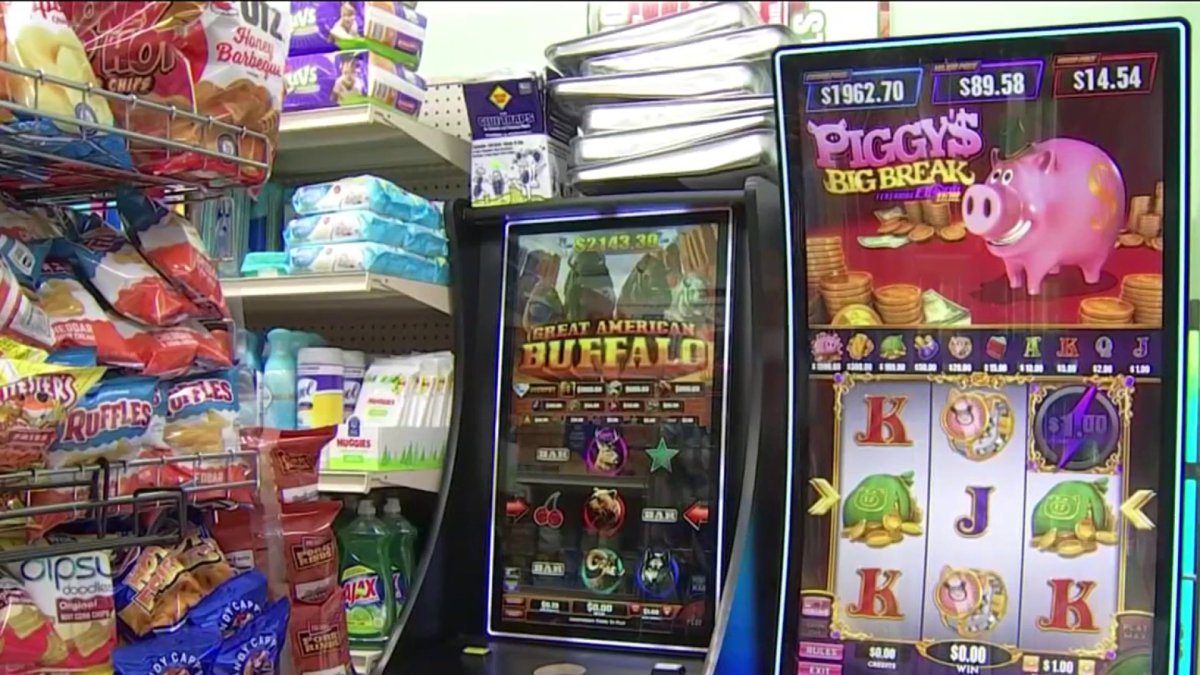
What to KnowPennsylvania’s highest court has ruled that skill games are considered slot machines under state law. This means they must comply with crime and gambling statutes.However, law enforcement cannot act for 120 days, giving the legislature time to decide on regulation.An estimated 70,000 machines are in operation across the state. Republicans say addressing skill games is crucial for this year’s budget, while Democrats are reviewing the decision.Taxing these games could bring in over $1 billion annually. If the legislature fails to act, the devices could be seized by law enforcement.
Skill games are slot machines under Pennsylvania law and must adhere to the commonwealth’s crime and gambling statutes, the state’s highest court ruled Monday.
However, the ruling says that law enforcement can’t take any action for 120 days. That gives the legislature a four-month window to decide whether to regulate the machines, which have proliferated across the state in taverns, gas stations and corner stores despite existing in a legal gray area. An estimated 70,000 machines are operating in Pennsylvania.
Republicans who control the state Senate said the ruling makes addressing skill games a “critical piece” of resolving this year’s budget, while Democrats who lead the state House said the caucus is still reviewing the decision.
Taxing skill games as part of a regulation scheme could eventually bring in more than $1 billion annually in much-needed revenue, according to the Independent Fiscal Office. Should the legislature fail to act, the devices would be subject to seizure by law enforcement.
There were two skill games cases before the court. The justices ruled on both together.
One, a 2019 case in which a bar and skill games supplier filed a petition for return of property after police seized their machines, centered on the question of what the devices are: Do they involve enough luck to be considered gambling or enough skill that an experienced player can consistently win?
The Dauphin County Court of Common Pleas and Commonwealth Court both ruled in that case that the games are skill-based and therefore not subject to regulations for slot machines.
In the other case, Pace-O-Matic, a major skill games developer and distributor, sued the state to get a judgment about whether the games are legal. Commonwealth Court ruled the state’s existing law regulating gambling doesn’t apply to skill games.
In both cases, a majority of state Supreme Court justices said Commonwealth Court’s interpretation of statutes was “deeply flawed,” and the court was “incorrect on both points.”
A skill game, they wrote, is a slot machine “several times over” because it meets the general definition of slot machine in state statute, and because it meets the ordinary English definition of “a coin-operated gambling machine that pays off according to the matching of symbols on wheels spun by a handle.” Whether it involves some minor element of skill is irrelevant, they said.
As for whether the Gaming Act applies to skill games — and not just to licensed slot machines in casinos — the court said it clearly does, and listed several instances in which the language of the act appears to include entities and facilities that aren’t licensed.
The court’s core holding was “premised upon the court’s misreading of fundamental aspects of the statutory scheme,” they wrote.
The justices noted that their ruling isn’t necessarily the final word on skill games.
“Naturally, because all that follows is a consequence of statutory law, our General Assembly also remains free at any time to take whatever legislative action it may deem appropriate,” they wrote, adding that their decision “does not constitute an endorsement of, any particular policy view concerning the proliferation of ‘skill games’ throughout our Commonwealth.”
Will the legislature act?
The ruling starts a 120-day clock for legislators to pass legislation legalizing, regulating, and taxing the devices, or to allow a widespread law enforcement crackdown on the market.
State lawmakers have tried for years to come up with a regulatory scheme for skill games. Though there’s broad consensus that this regulation should happen and that taxation would bring the state needed revenue, a deal has eluded them.
In a statement, state Senate Republican leaders said the games’ proliferation is “a matter of public safety which must be addressed.” The ruling means gaming reform is now a “critical piece of resolving this year’s budget,” they said.
A spokesperson for the state House Democrats said Monday they are reviewing the ruling, as did a spokesperson for Democratic Gov. Josh Shapiro.
State lawmakers’ greatest hurdle in regulating skill games has been their inability to reach a consensus on the proper rate to tax their gross revenue.
Shapiro’s proposed budget this year would set the rate at 52% to more closely align with the state’s existing 55% tax on electronic games and casino slot machines.
State Senate Republican leaders previously introduced a proposal for a 35% rate and reiterated their support for that approach in their statement Monday. Other Republicans argue that rate is too high and proposed a 16% tax.
Complicating talks over the years are wealthy interests’ strong preferences: Casinos support a higher tax rate for skill games, and the skills industry argues such a rate would sink them and harm the small businesses and veterans’ organizations that depend on the money.
Small businesses and fraternal clubs that operate skill games “are now potentially left facing an impossible choice: cease operating these games and lose an important source of revenue, or endure a legislative solution that could bring excessive regulation and crippling taxation, which will force them to cease operating these games and lose an important source of revenue,” the statement continued.
Some lawmakers are also cautioning their colleagues against rushing regulations that don’t protect public health in the search for easy revenue.
“What we are talking about here is the potential largest expansion of gambling in Pennsylvania history since the casinos,” state Rep. Ben Waxman (D., Philadelphia) told Spotlight PA this month. “And we cannot make short-term decisions with really long-term consequences.”
Pace-O-Matic released a statement in reaction to Monday’s ruling, saying:
“We are disappointed with the decision by the Pennsylvania Supreme Court and strongly believe it does not accurately reflect the facts presented – notably, the same facts that led to a string of lower court rulings affirming the legality of our skill games, including a unanimous Commonwealth Court ruling. Sadly, this opinion will have far-reaching consequences, with more than 10,000 Pennsylvania small businesses and fraternal clubs becoming the real victims. They are now potentially left facing an impossible choice: cease operating these games and lose an important source of revenue, or endure a legislative solution that could bring excessive regulation and crippling taxation, which will force them to cease operating these games and lose an important source of revenue. The better option is for the legislature to support a commonsense piece of legislation that will tax and regulate skill games fairly, like the bipartisan bills sponsored by Senator Yaw (SB 1079) and Representative Burgos (HB 2213). However, we do agree with the court that ‘determining and manifesting the public policy of Pennsylvania is the prerogative of the legislative branch of our government,’ and in accordance with the court-ordered 120-day stay of action, we will continue work with lawmakers toward a legislative solution for skill games. Our number one priority continues to be supporting our small business and nonprofit partners across the commonwealth. Pace-O-Matic will always abide by the rule of law.”
Philly Mayor calls for limits on skill games
The issue has been part of Pennsylvania budget negotiations for years as lawmakers have considered regulating and taxing the machines as a source of revenue.
“They shouldn’t be on our neighborhood commercial corridors or in neighborhood convenience stores. They shouldn’t,” Philadelphia Mayor Cherelle Parker said.
Parker said Philadelphia should not have to accept the machines everywhere in order to receive funding for priorities such as schools and public transit.
“That’s a false choice. We shouldn’t have to make it,” Parker said.
The mayor said she would support skill games in casinos and private clubs such as VFW halls.
Parker also said the city’s research has found skill game machines concentrated in areas with high poverty rates. NBC10 asked the city to share that data.
In a statement shared by the mayor’s office, Mayor Parker wrote:
“I’m pleased the Pennsylvania Supreme Court decided that skill games are slot machines. They should not be easily accessible in neighborhoods that already face high rates of poverty, crime and violence.” “You only find them concentrated in our most vulnerable communities. You won’t find these kind of stores – stop and go’s, smoke shops – and these slot machines – in wealthy neighborhoods. They aren’t there. It’s predatory, and it’s not right. As Mayor, I don’t have the luxury of turning a blind eye to ills like street homelessness, the opioid crisis, or our housing and affordability crisis. This kind of predatory activity only exacerbates seemingly intractable problems that we are challenged with solving. And no one has come running to save our city with the revenue it needs to address these systemic issues. I’m going to be watching this issue very carefully. In no way, shape or form do I think these slot machines should be in our neighborhoods already struggling from socio-economic and public safety issues. If they are going to go anywhere, they should be in private clubs and casinos. They should not be accessible to our children or in our most vulnerable communities. I am lifting my voice in opposition, and I am not going away.”
Part of this story was originally reported for broadcast by NBC Philadelphia. AI tools helped convert the story to a digital article, and an NBC Philadelphia journalist edited the article for publication.