
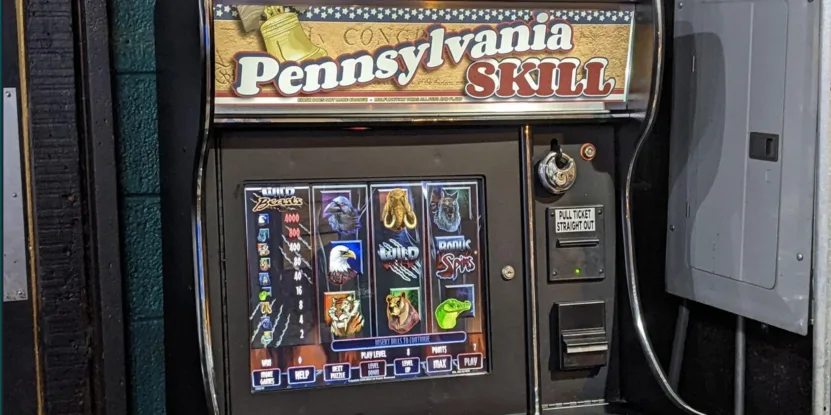
This week, the state Supreme Court ruled something was true that everyone already knew was true: the so-called “skill games” popping up in bars, delis, and gas stations across the commonwealth are, in fact, unlicensed slot machines — and illegal.
The court’s opinion, written by Justice David Wecht, was an appeal from a lower court ruling that held that the state’s Gaming Act only covered licensed slot machines while at the same time the state’s criminal statutes did not make operating an unlicensed slot machine with a “skill” component a crime. It was an absurd loophole that Wecht and the other justices found was not in keeping with a plain reading of the law or the expressed intent of the legislature.
This is a ruling with many winners, not least of which is the rule of law, itself. It is a good, honest reading of a statute that never should have been this badly misunderstood. It is also good for those problem gamblers who find themselves besieged by games of chance in places they might not expect. It is good for casinos, who did the work and followed the rules to install their own machines in accordance with the law, only to find themselves undercut by quasi-legal operators. And finally, in a society awash in vice, it is good for a little less gambling to be taking place as a general matter.
Who loses? The companies that own and produce these machines are bound to be unhappy, but they gambled on an unlikely reading of the law and lost. It’s all in the game. Bar owners are also losing out on the profits they took, but there are still plenty of reasons to go to bars. And where fundraisers are needed, there are still many allowed under the Small Games of Chance Act.
But as a practical matter, the biggest losers are the governor and the state legislators, who had collectively cast hungry eyes on the untaxed profits of these “skill games” and figured to balance the state’s budget this year by taxing them. Now, they will have to make some harder choices about what to fund and how to fund it. That’s fine, though: it’s actually their job to make hard choices, not to just hope for a windfall to smooth over the budget gaps.
They will continue to try: the governor’s proposals to legalize and tax marijuana are a similar sleight-of-hand trick: shifting the burden of paying for our government onto the shoulders of a small group of addicts. It creates the unfortunate situation that the state is now deeply invested in people continuing to indulge in the habits they use to destroy themselves. It is not the taxes from a guy who smokes weed a couple times a year or takes an annual jaunt to a casino that accounts for the vast majority of these taxes; it is the habitual user — the addict.
If people think a government service is worth having, they must also think it is worth paying for. At the federal level, Congress is even worse on this score, running up massive deficits despite the country being (mostly) at peace and not in a recession. The states, constrained by balanced budget provisions, have a harder time doing this, but still always search for the easy way out.
Pennsylvania’s politicians need to make some hard choices and tell voters the truth: you can’t have every benefit you want without paying the taxes necessary to fund them. Slots aren’t going to do it, now.