
By Michael Thomas Leibrandt
Looking to get the family away from a weekend immersed in digital screens — or perhaps you need a break from the effects of blue light yourself? Either way — Good Ole’ Philadelphia has you covered. It’s never been a better time to get a head start on the celebration of the two and a half centuries since the birth of our nation and an enjoyable sightseeing tour through Philadelphia’s neighborhoods that have existed since the American Revolution — and well before.
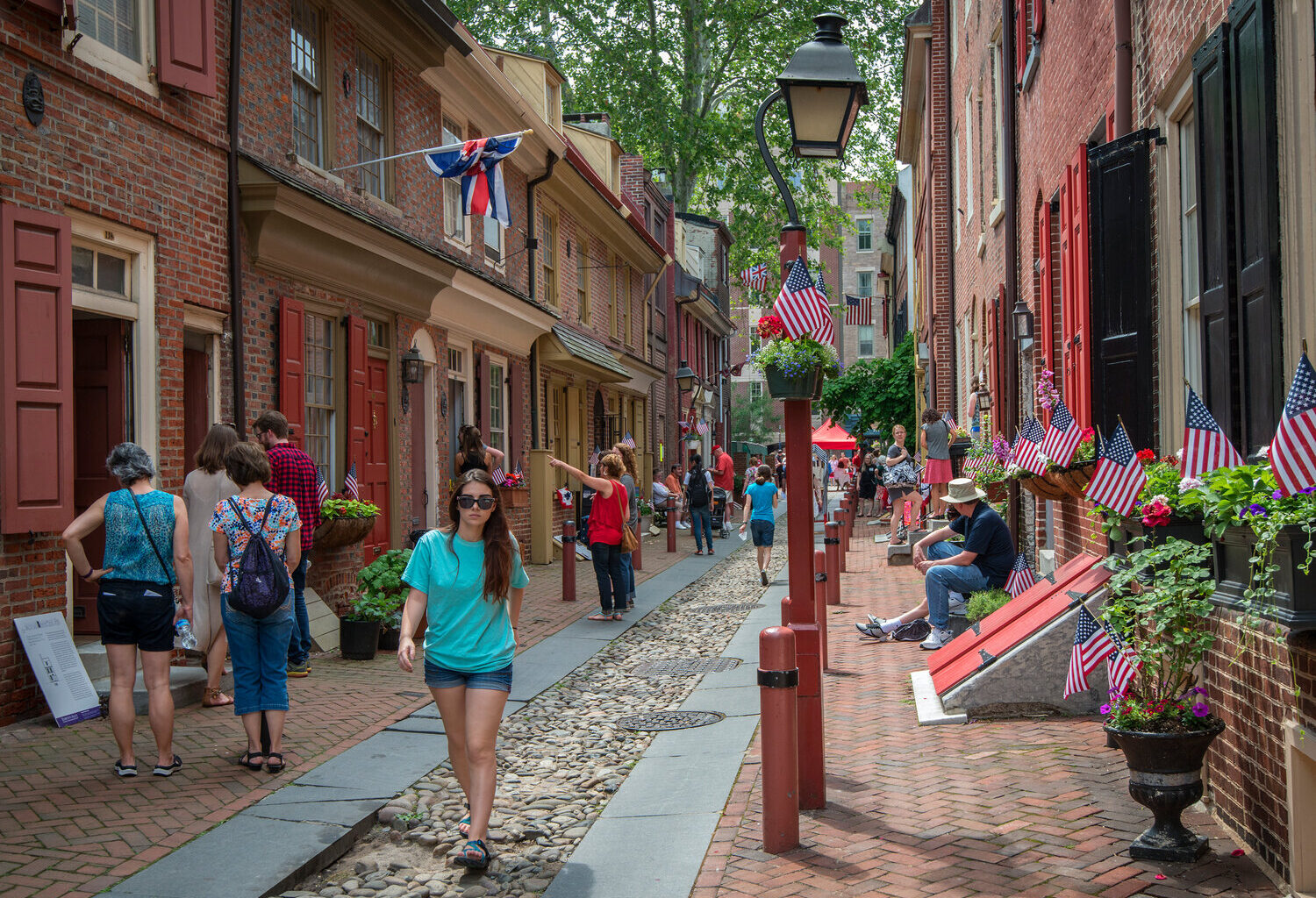
The Phillies may be well into the first part of their 2026 regular season as the oldest, one-name, one-city sports franchise in all of America, which might inspire you to take a walk through America’s oldest, continuously inhabited street — otherwise known as Elfreth’s Alley.
Constructed in a gorgeous Georgian and Federal Style — Elfreth’s Alley houses were built between 1703 and 1836 —during which time the street was blossoming with artisans such as blacksmiths. During the American Revolution, it was also the place of ghost stories. According to legend — a traitorous soldier of the King’s Army was actually hanged in the alley — demonstrating a horrible end to anyone who turned against the crown. Today — if your trip can be scheduled around June — you can always visit during the annual tradition of Elfreth’s Alley Day. Visitors can see the modern living quarters located in these old houses during the celebration and even tour the Elfreth’s Alley Museum.
Germantown may have originally grown as a suburban-like retreat for some Philadelphians, but it was also at the heart of the American Revolution, fighting directly around Philadelphia at the time of the British Occupation. Founded by German settlers Francis Daniel Pastorius and thirteen families around the same time as the beginning of William Penn’s Philadelphia, Germantown was a suburb of the City in 1776. During the Revolutionary War — Germantown was a campsite for Hessian forces fighting for the British — and was targeted by Washington’s colonial army in an attempt to retake the City in October of 1777.
The focal point of the desperate fighting in Germantown was at Pennsylvania Chief Justice of the Supreme Court of the Province of Pennsylvania Benjamin Chew’s Cliveden House. Visitors today can still tour the house during the warm months. Not to be confused with the hotel in Great Britain, Cliveden was occupied by English troops during the Continental Army assault. The damage done to the outside decorative sculptures and the interior of the house is still visible today. For over four decades, the House has featured a reenactment of the Battle each autumn.
A little way up Germantown Avenue is the Germantown White House — once occupied by British commander General Sir William Howe. Visitors can also see Stenton — built between 1723 and 1730, which was also occupied by the British in 1777 and was nearly destroyed if not for the bravery of a woman named Dinah.
Any time of the year is a great one to see the fabulous architecture that is City Hall, dating back to its completion in 1901, with that statue of William Penn proudly looking down upon his Philadelphia. If you took in some ice skating at Dilworth Park this winter, then you have already enjoyed it. The British troops occupying Philadelphia in 1777 actually did us a favor by cutting down all of the trees around what is today City Hall. The result — French General Rochambeau’s Army utilized it as a campsite before marching to Yorktown in 1781. It was also the site of Philadelphia’s first Municipal Water System from 1801 to 1815.
Much like the Phillies and Elfreth’s Alley, Philadelphia has another section that boasts another impressive national honor. One of its oldest sections — Society Hill — has more of a collection of original eighteenth and nineteenth century buildings still in existence than any other in the country. Perfectly situated between the electricity of South Street, Philadelphia’s waterfront, and historic attractions, Society Hill was named after the “Society of Free Traders.” The area around Dock Creek was established not long after Penn’s Philadelphia.
And if you’re looking for architecture dating back to the American Revolution itself, Society Hill is a terrific visit. The Powel House dates from 1765 and was the home of a former Mayor of Philadelphia. It also once hosted Benjamin Franklin, John Adams, and George Washington. At the corner of 2nd and Pine Street are the ruins of the Head House Square Shambles. What’s left of the former market is yet another remembrance of early commerce and trade in our city. Just west on Pine Street is St. Peter’s Church, Philadelphia — dating from 1761 — and attended by some of those very same Founding Fathers.
When in Washington Square at the Tomb of the Unknown Soldier — which was constructed on an old Potter’s Field — among whose burials include many patriots of the American Revolution and casualties of the British Occupation of Philadelphia alike, it is a truly moving experience. When you leave Society Hill and approach Old City, a trip to the Museum of the American Revolution is a must.
And when it comes to the history of the American Revolution, we’ve got another thing going for us. It’s not only that we saved the best for last. “America’s most historic square mile” allows you to see the heartbeat of American freedom in 1776 within short walking distance. Enjoy Independence Hall, the Liberty Bell Center, the Betsy Ross House, and Carpenter’s Hall — all in close proximity.
At the conclusion of your trip — complete with great memories and steps and a personal fulfillment of the combination of spring weather coupled with the unmistakable first-hand understanding of the crucial role that Philadelphia played in America’s freedom — another viewpoint may occur to you. It’s actually an amazing day to spend in Philadelphia — at any time of the year.
MORE: Court ruling paves way for Trump admin to replace President’s House exhibit
Keywords
Philadelphia history,
America 250,
Independence Hall,
Elfreth’s Alley,
Society Hill,
Germantown,
Museum of the American Revolution,
Liberty Bell,
Revolutionary War,
historic Philadelphia