
This isn’t Crocodile Dundee’s Outback, mate.
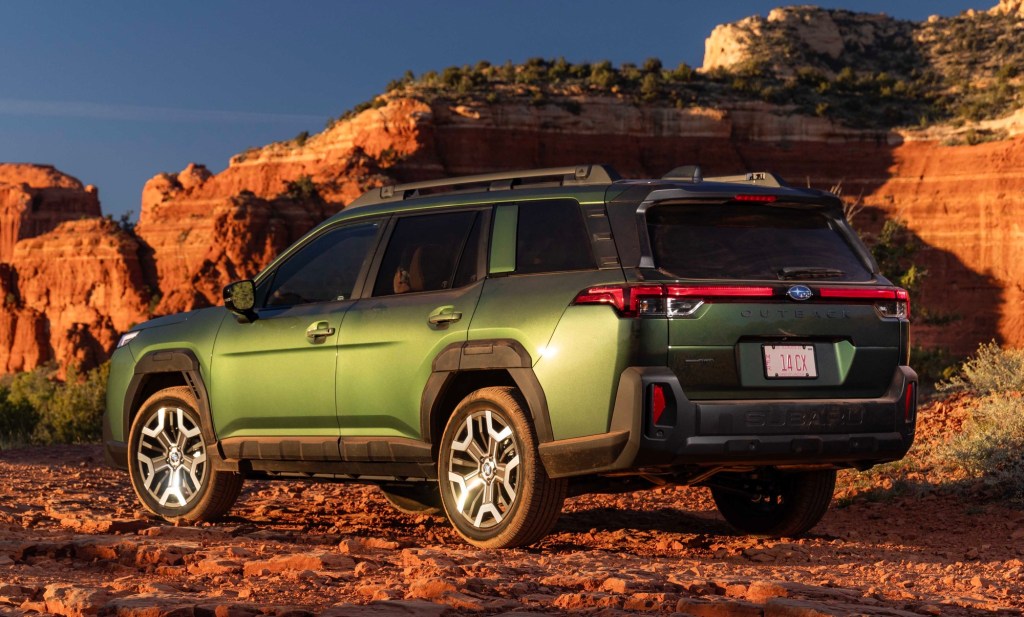
Comprehensively redesigned for 2026, Subaru has stroked and stoked its sales-leading wagon to give it a more SUV-like look and feel.
Gone are the softer, rounded contours of the tallish station wagon driven by Australian actor Paul Hogan in the company’s turn-of-the-century ad campaign. In its place is a boxier and roomier vehicle designed to appeal to new buyers while preserving a measure of the quirkiness beloved by the brand’s legion of faithful customers.
Other big changes involve an updated cabin that maintains the previous-generation Outback’s user-friendly, no-nonsense functionality along with a simplified and improved infotainment interface.
There are six trim levels offered — Premium, Limited, Limited XT, Wilderness, Touring and Touring XT — all of which are equipped with standard all-wheel systems (this is Subaru, after all). Premium, Limited and Touring-trimmed models are powered by a naturally aspirated 2.5-liter flat-four (or “boxer”) engine rated at 180 horsepower and 178 foot-pounds of torque. The remaining three trims enjoy a considerable boost courtesy of a standard turbocharged version of the same engine, which pumps out 260 horses and 277 foot-pounds of twist.
Pricing starts at $36,445 for basic Premium-trimmed samples and rises to nearly 50 grand for those dressed in Touring XT duds. The model’s entry-level asking price is higher for 2026, reportedly due to the retirement of the previous generation’s base model. That being written, Premium trim boasts a fairly long list of standard gear, including 18-inch alloy wheels, a powered rear liftgate, heated front seats, a digital gauge cluster, wireless Apple CarPlay and Android Auto connectivity, a quicker and better-organized 12.1-inch infotainment interface, faux-leather upholstery and lots more.
In addition to the turbocharged mill, fully tricked-out Touring XT-trimmed Outbacks are equipped with premium leather upholstery, larger alloy wheels, an auto-dimming rearview mirror, ventilated front seating, a 360-degree exterior camera array, an eight-speaker Harmon-Kardon audio system and enhanced safety tech (driver-attention-sensing emergency-stop and hands-free semiautomated driving assist).
Regardless of trim level, all Outbacks are fitted with the company’s EyeSight lineup of safety-sensing and driver-assistance tech, including smart cruise control, forward-collision mitigation, blind-spot monitoring, lane-keeping assist and centering, and auto high-beam headlight controls.
Our tester came in rough-and-ready Wilderness trim, and as such represented the most off-road-oriented entry in the model line. Sporting 9.5 inches ground of clearance (roughly seven-tenths of an inch taller than other trims), riding on a more-aggressive set of all-terrain tires, and wearing an abundance of trim-specific badging and copper-tinted exterior accents, it certainly made a statement about Subaru’s attempts to grow an SUV-friendly customer base. All told, it’s probably all the off-road vehicle most folks will need. The absence of a low-range transfer case and the long front and rear overhangs mean this is not the best choice for rock-hopping and stump-jumping, however.
The $44,995 base MSRP covered the turbo-four engine, a torque-sensing continuously variable automatic transmission with eight-speed manual-shift mode, selectable drive modes and traction settings for various off-roading conditions, and weather-resistant synthetic leather upholstery. Other standard finery included the upgraded audio system, a wireless smartphone charging pad, a power-adjustable driver’s seat, heated steering wheel and more.
The bottom line rose to $50,535 with the addition of a $4,090 options package that added napa leather upholstery with copper-tinted stitching, ventilated front seats, a 12-way power-adjustable driver’s seat with lumbar and thigh support, an eight-way power-adjustable front-passenger seat, a powered moonroof and more. Factor in the $1,450 delivery tab and there you have it.
The sport-ute driving experience has come a long way in the last few decades, as the vast majority of choices on the market offer well-controlled and carlike handling and ride qualities. In this regard, our Wilderness-trimmed tester delivered in spades. The smooth, comfortable and quiet ride was complemented by the turbo-four’s torquey power delivery that hustled the Outback to 60 mph in a tick or three over six seconds. That’s roughly two seconds quicker than the base engine’s time, which to our mind makes the turbo unit worth the upcharge.
Instrumentation was easy to read and operate, especially concerning the now-smaller but better-organized and quicker-thinking infotainment interface that replaces the previous, vertically oriented iPad-like display. The abundant climate-control buttons were a little on the small side, but a day or three of driving made them seem like second nature.
Thanks to a taller roofline and more rectilinear shape, the new Outback offers abundant legroom in both rows of seating. The wide and tall 34.6-cubic-foot cargo hold expands to 80.5 cubic feet with the 60/40 split-folding seatbacks stowed, which along with a set of standard roof rails makes this a good choice for families on the go. Properly equipped, the turbo-powered Outback is rated to tow up to 3,500 pounds, or 800 pounds more than nonturbo models.
2026 Subaru Outback Wilderness
Vehicle type: Four-door, five-passenger midsize all-wheel-drive crossover.
Engine and transmission: 2.5-liter turbocharged horizontally opposed four-cylinder (260 horsepower and 277 foot-pounds torque), continuously variable automatic.
Base/as-tested prices: $44,995/$50,535.
EPA estimates: 21 mpg city, 27 mpg highway, 23 mpg combined.
The good: Complete redesign gives 2026 Outback a decidedly more SUV-like profile; powerful and reasonably fuel-efficient turbocharged boxer-four engine; roomy and well-organized cabin with adult-friendly accommodations in both rows of seating; smooth and comfortable cruising quality; nimble handling; improved in-cabin technology; generous cargo capacity; Wilderness trim’s off-road-ready capability.
The bad: Big price jump over previous model year; long front and rear overhangs limit off-road adventures; arguable over-abundance of plastic body cladding.
Bottom line: With a more SUV-like presence, the redesigned Outback hopes to lure new buyers while preserving the qualities Scoobie loyalists expect.