
The chalkboard at the Gulick’s Fruit Farm in Lower Mount Bethel Township reads, “No Fruit 2026. No cherry 2026. No peaches 2026.” In Lowhill Township, Weathered Vineyards’ newly opened tasting room stands in front of painstakingly cultivated vines nearly bare of grapes. Bethlehem and Emmaus farmers markets have shared Facebook posts urging customers not to abandon growers whose signature crops won’t make it to their stands.
The devastation is real for Lehigh Valley fruit farmers, and they’re not alone.
An April heat wave spurred early blossoming at orchards and vineyards, but subsequent nights of extreme cold killed the buds, with farmers reporting near total losses to crops ranging from cherries, peaches and pears to apples and grapes.
Some assistance is now on its way.
Federal natural disaster designations have been declared to assist farmers across a wide swath of the mid-Atlantic, including counties in Pennsylvania, New York, New Jersey, Delaware, Maryland, D.C., Virginia and West Virginia. Northampton County is currently on the list. Lehigh County, however, is not.
“I pray Lehigh County gets approved. In my opinion if they do for one county they must do for all. This is great news,” Kelly Gulick wrote The Morning Call after learning federal natural disaster designations include Northampton.
Asked about Lehigh County, a U.S. Department of Agriculture spokesperson wrote on June 17, “State and local partners are currently working to see if these counties would meet the required documentation that would support a disaster declaration. As of now, USDA does not have anything further to announce.”
Federal funding isn’t the only potential source of relief for farmers contemplating whether they will need to take out loans, draw on retirement savings or call on friends, family and customers to help them weather a year in which their harvest will be virtually nonexistent. The Shapiro administration has also requested a $20 million recovery package to be included in budget negotiations, a Pennsylvania Department of Agriculture spokesperson said.
Tending to the trees
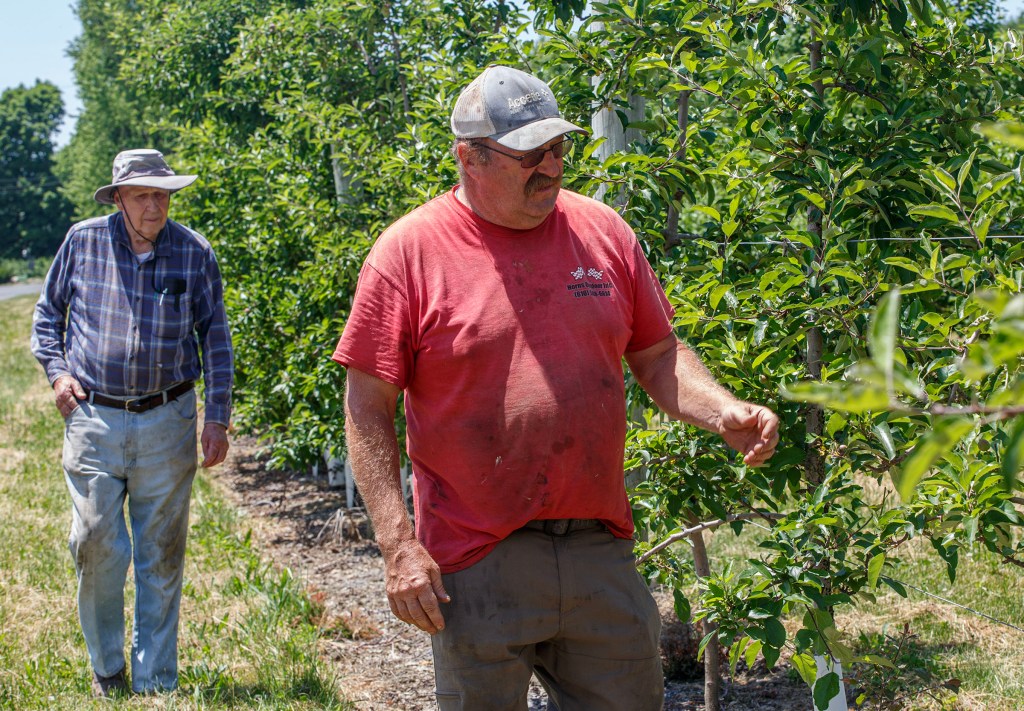
Kelly Gulick’s husband, Todd, is a sixth-generation farmer on land his family has cultivated since the 1850s. The 160-acre operation has a small staff, consisting mainly of Kelly, 56; Todd, 57; Todd’s father, Jim, who turns 88 on Monday; and neighbor Kelly Swisher, who helps operate their on-site farm stand.
Other family members pitch in, including Kelly and Todd’s daughter Julia, who helps with weekend harvests in the fall.
Loyal customers come from all over the Lehigh Valley to buy from the farm stand and pick their own fruit, activities the farm won’t be able to support this year.
“It’s heartbreaking,” Kelly Gulick said. “You feel like you’re letting people down.”
She said the farm has a strong following among customers of Eastern European heritage, with Russian, Polish and Ukrainian visitors reporting the orchards make them nostalgic.
“When they’re here, it brings them home to their home countries,” she said.
Beyond their local customers, the farm sees visitors drive in from areas ranging from New York City to Scranton to South Carolina. Some customers aim to ship fruit home, flying back to Utah and Florida with boxes of produce.
A Facebook post explaining the extent of the farm’s losses garnered 100 comments in three weeks, with customers pledging to return later in the summer for sweet corn and in the fall for pumpkins and one offering to start a GoFundMe if the family agreed.
Kelly Gulick said she’s heard of other farmers going that route, but wasn’t sure that was right for her family. The farm is exploring merchandise options, like T-shirts and hats, and is planning to sell baked goods.
The Gulicks are now looking to see how low the interest rate will be on the USDA Farm Service Agency emergency loans they hope to access. Knowing the couple will also need to utilize their retirement accounts, Kelly Gulick said she anticipates federal funding will help minimize the tax penalties that come with early withdrawal.
Looking back on the historic combination of extreme weather that led to the crop loss, Todd Gulick said the farm had been left with few options.
Strawberry farmers who have the resources to do so can run a continuous spray of water to protect their crops, he said, explaining that the formation of ice creates heat that provides a small amount of insulation to the fruit.
That kind of irrigation-based solution is rare in orchards, he said. If an inversion exists, farmers can use large windmill-like machines to try and cut through the cold air layer and draw warmer air down toward the trees, he said, noting that some farms use helicopters to achieve the same goal.
Even those with the necessary equipment could find that the weather makes that strategy moot, he said: “That’s IF warm air is there.”
Managing the vines
Rich Woolley is a vineyard owner with his wife, Dana, but — as the name of their business, Weathered Vineyards, indicates — he is also a weatherman.
He watched the stretch of early April 90-degree days cause the vines burst into buds and new leaves nearly two weeks ahead of schedule.
“Then we hit 23 degrees. On the 21st of April. And I knew it was coming, and I went to bed that night — as a meteorologist, I know it’s coming. So that’s a curse because you worry about it five days ahead of everybody else,” Woolley said. “But I knew it was coming. There’s nothing we can do about it being that cold.”
Lighting fires amid the vines wouldn’t have nearly been enough to offset the damage from blossoming vines being subjected to that extreme cold, he said.
“That pretty much wiped the crop out this year,” Woolley said.
Grape vines grow three sets of blossoms. The early budding meant nearly all of those were wiped out, but some vines had latent buds inside their woody stems that can now be seen growing into new leaves and sprouts.
Woolley’s head winemaker, Hillary Gary, is advising him to focus on nurturing those new branches, ensuring the vines build enough carbohydrates to survive the winter rather than harvesting the few grapes that are still growing.
“It’s tough to be out there, pruning all winter, and then see it absolutely obliterated,” Gary said.
Woolley and Gary start tending to the vines in January, getting everything ready to go for the growing season by the start of April.
“So all those hours were spent in cold and wind and miserable conditions, and then it just starts to grow and — whoop — gets wiped out,” Woolley said.
He estimates that about 10% of his 5,000 vines died completely, although others should make it through the next winter with careful cultivation.
Woolley and wife Dana recently invested in the construction of a much larger tasting room on the Weathered Vineyards land that also hosts live music and private events.
They normally source from other growers when they need to supplement their own grapes. Woolley estimated it would cost at least $30,000 to try and buy enough grapes to replace an entire lost 2026 harvest.
But this year Woolley said the freeze damage has affected vines in such a large area that he’s not sure who will even have crop to sell.
“Pretty much everybody from Michigan to Virginia to New York was hit, so I’m not sure,” Woolley said. “I think there’s still a little bit of grape up in the Lake Erie region, right on the lake.”