
January 2007.
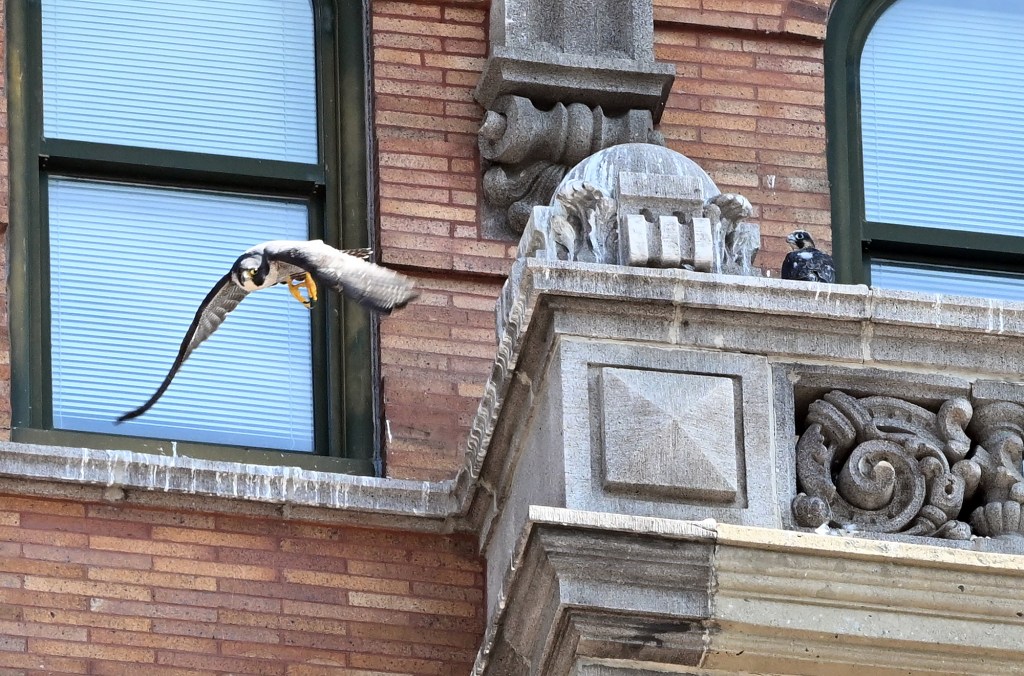
A lone peregrine falcon perches atop the cross at Christ Episcopal Church, Fifth and Court streets in Reading, on what would be a favorite falcon hunting and observation perch in succeeding years.
The falcon swoops through the downtown among the Madison building in the 400 block of Washington Street, Christ Episcopal and the Berks County Courthouse in the 600 block of Court.
In March, a second peregrine appears in the skies above Reading, and courtship flights are observed, raising the possibility that peregrines would nest for the first time in Berks County.
Dr. F. Arthur McMorris of Bala Cynwyd, the peregrine falcon specialist at the Pennsylvania Game Commission, noted that in 2006, only 14 peregrine falcon pairs had successfully nested in Pennsylvania.
He hoped Reading would be the 15th.
By the end of May, his hope is realized. Three eggs were laid in a nest of loose gravel atop the Madison, and two falcons hatched.
Unfortunately, the two young wouldn’t survive to adulthood, but the falcons persisted and changed nesting location the following year to the Callowhill Center on Penn Square.
On June 1 of this year, Patricia Barber, endangered bird biologist for the game commission, banded four nestlings at the Callowhill site.
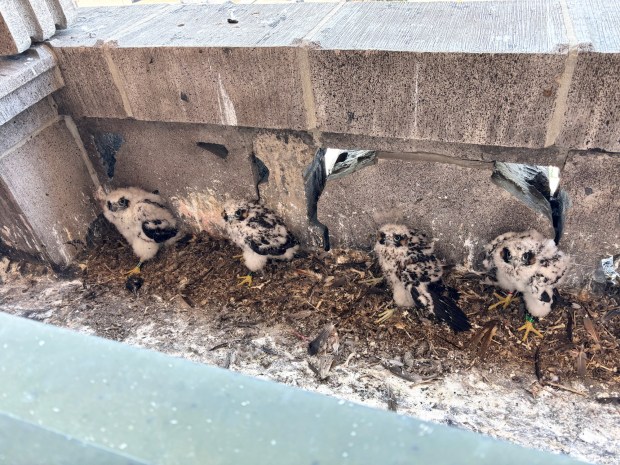 Four peregrine falcon young sit at the nest site in downtown Reading on June 1 after banding. This is the 20th nesting season for peregrines in Reading. (Courtesy of Patricia Barber, Pennsylvania Game Commission)
This is the 20th nesting in downtown Reading for a species that was once extirpated from the East due to the effects of the pesticide DDT.
Those four nestling falcons make a total of 50 peregrines that successfully hatched and fledged from Reading.
Peregrines had previously nested in Pennsylvania on cliffs along major rivers. Following World War II, the widespread use of persistent pesticides like DDT that had accumulated in prey species caused eggshell thinning in the raptors. The weight of the brooding birds would crush the eggs.
The same fate awaited the bald eagle, which also has made remarkable comebacks through recovery efforts since the pesticide was banned in 1972.
According to the game commission, the last nesting of peregrines in the state during the DDT era occurred in 1959, and shortly thereafter, the bird nearly disappeared in the East.
Peregrine counts at Hawk Mountain reached their lows in the early 1970s with six birds recorded both in 1972 and 1975.
Similarly, the bald eagle reached a low of 13 for the 1974 season at Hawk Mountain.
The peregrine was placed on the federal Endangered Species List in 1972, and due to the recovery efforts like those in Pennsylvania, was removed from the list in 1999.
The falcons remained on the state endangered species list until 2019.
The Reading nesting pairs have turned over in that time, but the original male that hatched out in Harrisburg in 2005 remained in Reading for 14 seasons, a remarkable run.
The current male hatched from Callowhill in 2018.
The success story of the peregrine falcon in Berks is one that has its roots in the hawk slaughter along the Kittatinny Ridge a century ago until the formation of Hawk Mountain Sanctuary in 1934 put an end to the practice in northern Berks.
According to state records, two peregrines were shot at Hawk Mountain on Oct. 22, 1927.
An immature male was also shot there on Oct. 6, 1929, and another male was taken there on Oct. 3, 1933. Both of these specimens are in the Reading Public Museum collection.
The peregrine falcon was never a common migrant at Hawk Mountain. The pre-World War II single-day high count was 11 on Oct. 7, 1937, with a season high of 45 in 1941.
Since the falcon’s recovery, the 10-year average at Hawk Mountain has been 62, with a season-high of 90 in 2014 and a peak daily count of 31 on Oct. 5, 2002.
Prior to the successful nesting in the city beginning in 2007, Reading had played a role in the peregrine’s reintroduction and comeback in the East during the early 1990s.
The Pennsylvania Game Commission released peregrines in Allentown, Harrisburg, Williamsport and Reading as part of a “hacking” project to bring the bird back to the East. Hacking is the process whereby immature birds are gradually released into the wild by human intervention.
The game commission placed nestling falcons at several sites in Reading from 1993 to 1995. The nestlings were taken from nests on bridges in Philadelphia, where fledgling success was low due to the danger of drowning in the Schuylkill River.
In 1993, a male and female peregrine were hacked from the top of the Berks County Services Center at Reed and Court streets. The female survived the summer but was found dead in Maine in 1995.
In 1994, two males and one female peregrine were hacked from atop the Eisenhower Apartments at Ninth and Franklin streets.
The female made it to Toronto, where she was found nesting the following year. Canadian Fish and Wildlife officials documented two young, 3 weeks old, on June 14, 1995, the first nesting of a peregrine hacked in the statewide program.
The female had mated with a male hatched in Akron, Ohio, and according to the Canadian Peregrine Foundation, represented the first peregrine falcon nesting in southern Ontario in 30 years.
The pair successfully nested each year until 2002, when both were killed defending their brood of five young from other peregrines. The five young were rescued, raised and released.
The pair had successfully raised a total of 29 young.
Peregrine is Latin for “wanderer,” and Reading peregrine offspring have indeed wandered.
Because of the banding program, peregrines from the Reading nestings have been sighted and identified in disparate locations, according to McMorris, who is now retired from the game commission.
In 2012, three young from the nest were banded. One was found dead on Aug. 28, 2012, at Philadelphia International Airport after a collision with a plane. Another was observed at Hawk Hill raptor banding station in Ontario on the north shore of Lake Erie on Sept. 13, 2012, 320 miles from the nest site.
Four young were banded in 2013. One was found dead after dispersal in Massachusetts on Aug. 1, 2013. Another was sighted Aug. 9, 2013, in Lyndhurst, N.J., 100 miles from the nest site.
The 2015 nesting produced four young, all banded. One of the females from the nest was photographed in October 2015 on the beach at Holgate, N.J., chasing another peregrine. The same female was observed feeding on shorebirds in the vicinity of Barnegat, N.J., on May 5, 2016, approximately 20 miles from Holgate. Another female from the 2015 nest was observed on May 24, 2018, and again on March 24, 2019, on Parsonage Island in the Long Island Sound in New York
The peregrine falcon is perhaps the most spectacular animal in the world, a bird that can reach speeds of up to 200 mph in a diving stoop when attacking prey.
“I hope everyone in Reading realizes what a great thing they have going on,” Barber said. “It’s a free show for anyone willing to see it.”