
This is part one of our series, Designing Dignity. Check back tomorrow for part two.
Pennsylvania’s population is aging. Adults 65 and older outnumber children, accounting for more than 20% of the state’s population. While this demographic shift is often discussed in terms of retirement trends and tax revenue, other consequences are more profound: Age is the greatest risk factor for dementia.
An older population inevitably means more people living with Alzheimer’s disease and other forms of cognitive decline. And as more baby boomers reach their 70s, 80s and 90s, even if dementia rates remain the same, there will be more total cases as Pennsylvania’s senior population expands.
Is Pennsylvania’s health system ready for a rise in cases of dementia?
Some experts say no.
“I think it’s going to take some kind of tipping point crisis-type situation where it will become painfully apparent that we as a society cannot support the needs of the aging population,” said Dr. Lyn Weinberg, geriatrics division director of Allegheny Health Network.
Other regions have faced this change before. No country’s population has aged more dramatically than Japan. Nearly 30 years ago, policymakers there recognized that low birth rates and rising life expectancy were transforming that nation’s demographics. Today, almost 30% of Japan’s population is 65 or older, making it one of the oldest in the world. One result: People retire later. Another has been a sharp increase in dementia cases, according to data from the Statistics Bureau of Japan.
Pennsylvania leaders have noted shifting demographic lines in the Commonwealth with a 10-year strategic plan designed to ready the state’s infrastructure for its expanding older population. The urgency for that infrastructure is felt nowhere as acutely as in the hallways outside Dr. Weinberg’s offices.
Kiley Koscinski
/
90.5 WESA
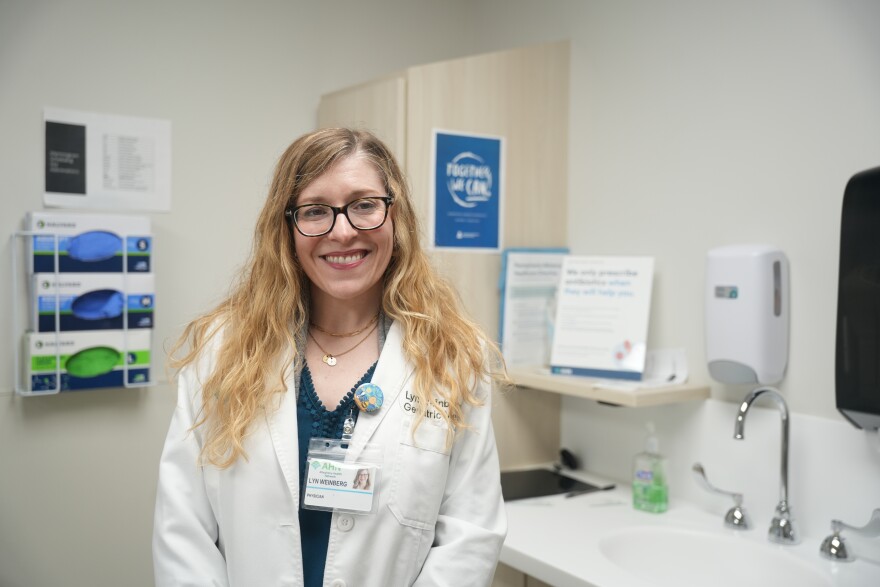
Dr. Lyn Weinberg is the geriatrics division director of Allegheny Health Network.
Tough questions follow a cognitive screening
It was an unseasonably hot afternoon in May when Nancy Stinely brought her 92-year-old mother Patricia to an appointment with a doctor at the West Penn Mellon Pavilion. Weinberg, Patricia’s geriatrician, greets the pair in the lobby before bringing them back to a patient room.
After the door closes, the mother and daughter answer Weinberg’s questions about Patricia’s medication regimen. Then the conversation turns toward how the soon-to-be-93-year-old seems confused more often than she used to be.
“Mom, there are times where you are confused about where you are. Do you remember telling me that you wanted a ride home?” Nancy asks.
“That’s when I was in those cabins that Dad bought,” Patricia responds. Nancy shakes her head as Patricia insists she was at the cabin. Nancy said sometimes her mom thinks she’s somewhere else.
Weinberg meticulously observes the pair as they disagree about how often Patricia wanders away from home. Weinberg suggests a cognitive assessment screening and presents a packet of papers. “The Montreal Cognitive Assessment” is printed across the top.
Also referred to as the MoCA, it’s the same cognitive screening purportedly given to President Donald Trump. It tests for mild cognitive impairment and early stage dementia. After about 15 minutes of quizzing to assess her memory, language and executive functioning, Weinberg asks Patricia to name today’s date.
After a few moments of silence, Patricia replies, “I don’t know.”
Weinberg asks her what year it is.
“‘43,” Patricia guessed, her eyes searching the room for a nod.
“God, I must’ve failed that.”
When later asked about the evaluation, Weinberg said that while Patricia showed signs of dementia, the screening is just one assessment tool. But after the evaluation and the Stinely family’s stories about her confusion and forgetfulness, Weinberg is certain Patricia has dementia.
What happens next can be confusing for most families. And expensive. Weinberg routinely helps families begin this journey. She said some want additional testing to determine which type of dementia is causing their symptoms. Some don’t. Weinberg lets patients decide how far to go.
“Not only do we not have great treatments for dementia at this moment, but we also don’t have great tests,” Weinberg said. “We’re really focusing on how we can help this person live their best life with dementia. And … that means something different to everybody.”
A dementia diagnosis can arrive like a dividing line: There was the time before misplaced keys and confusion could be explained away, and a time after when each lapse in memory carries a heavier weight.
Kiley Koscinski
/
90.5 WESA
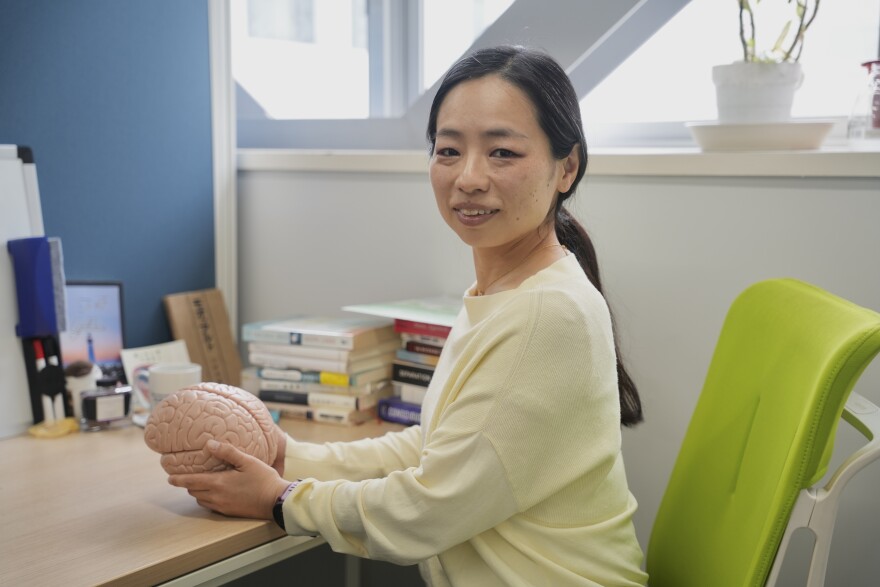
Japanese neuroscientist Ayako Onzo holds a a human brain model at her desk at the University of Tokyo.
Years of research follow a diagnosis in Japan
In Kanagawa, Japan, just south of Tokyo, Ayako Onzo crossed that same line with her 65-year-old mother Keiko in 2015. Onzo said after a year of growing frustration with her mother’s episodes of confusion and forgetfulness, an MRI scan revealed that Keiko’s hippocampus — the part of the brain that controls short-term memories — was visibly shrunken. She had dementia.
Onzo, a neuroscientist, set the course of her research to better understand the impact of dementia on her mother’s brain. She would observe Keiko’s cognitive decline as she cared for her during the next eight years. (Keiko died in 2023.)
Looking back, Ayako said she noticed her emotional connection with her mother never changed. It made her wonder what else stayed the same.
“I wanted to understand what [was] happening in her brain and what is left,” she said. “I wanted to accept her.”
Onzo needed more than observational data. She partnered with researchers at Tohoku University to measure how each region of her mother’s brain atrophied compared to the brain of someone without dementia.
Scans showed her mother’s auditory cortex — known to be related to music — were still preserved. That made sense, Onzo said. Keiko was a piano teacher and a singer.
“This is her life history, and the history remains even in this severe stage,” she said.
Onzo’s research questions whether the emotional lives of people with dementia are richer than what is assumed by the public. She believes science should explore not only what is damaged by dementia, but whether there are supportive measures that could enhance what remains unscathed by the disease.
While Onzo began researching her mother, the Japanese Government launched its “New Orange Plan,” which sought to create “dementia-friendly” communities where the seniors could age at home for as long as possible. Urban design programs studied how to make society more accessible for the aging population. Primary care and dementia support doctors were trained to detect and test patients earlier in life, making earlier intervention possible.
The initiative also created a new support network for family caregivers focused on preventing burnout. The plan created supportive services, including assisted living facilities where caregivers can bring their loved ones for a few days to give themselves a break from caregiving.
It expanded a pivotal role in Japan’s universal long-term care insurance program: the care manager, who coordinates healthcare and welfare services for the elderly. Nine years later, the U.S. began a pilot program with a similar goal for certain people on Medicare, the federal health insurance program for people over age 65.
Weinberg believes Patricia Stinely and her family qualify for help from the new program.
This story is part of a reporting fellowship sponsored by the Association of Health Care Journalists and supported by The Commonwealth Fund.