
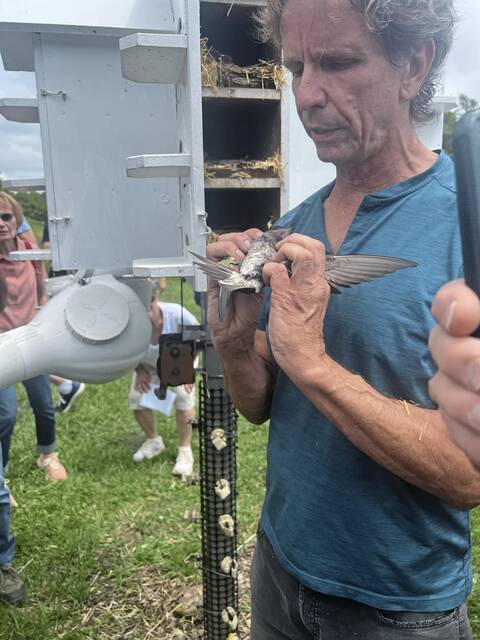
Ken Kostka is largely responsible for the Alle-Kiski Valley’s resurgence of purple martins — a bird species all but wiped out after Tropical Storm Agnes in 1972.
The Harrison Township native discovered a passion for the birds after constructing a birdhouse during woodshop at Highlands High School more than four decades ago.
“We put it up in my backyard and none came,” said Kostka, 63. “That spurred me to research why they were so scarce and try to help reestablish them.”
Purple martin populations collapsed after Agnes’ heavy rainfall decimated their food source of flying insects. Seven inches of rain over six days diverted the insects and starved the bird species.
It has taken decades of commitment by Kostka and others to make Western Pennsylvania their home again.
“They are entirely dependent on human-supplied housing in the eastern part of the country,” said Kostka. “If people were to stop putting out birdhouses, the birds would disappear.”
Kostka, now retired, worked several years as a writer and research assistant for the nonprofit Purple Martin Conservation Association in Erie.
He maintains a colony site at Harrison Hills, an Allegheny County-owned park in Harrison.
The 500-acre park off Freeport Road is home to the only colony of purple martins, which, despite their name, are dark blue, in the county’s nine-park system.
The next closest colony resides at Saxon Golf Course in Buffalo Township. In 2000, it was the sole surviving nesting site in the area.
Farther out, there are some purple martins at Crooked Creek Park, near Ford City. The birds nest in a few Pittsburgh-
area parks.
Kostka helped grow the colony at Saxon and, within five years, was able to divert at least one pair of birds to Lock and Dam No. 4 in Harrison’s Natrona section.
He and other volunteers used decoys, mirrors and music to reroute the birds to the Allegheny River shoreline.
“It’s the perfect habitat,” he said. “We were able grow that to the point where we could displace some pairs to my backyard in Natrona Heights and then to Harrison Hills.”
Three Amish-built bird houses attract up to 40 pairs of birds each season to breed. That’s up from three pairs in 2015, when Kostka first installed them.
Through the Friends of Harrison Hills advocacy group, Kostka is scheduled to give a free public presentation at 1 p.m. June 27 at the park’s Environmental Learning Center.
Outside the building is where the purple martins nest. People can learn more about the birds, which grow up to 8 inches long and have a wingspan of more than a foot. Their size enables them to perform aerial acrobatics while scouring for bugs.
Known for their speed and agility, they approach their nests with steep dives from the sky, similar to peregrine falcons.
“We have the program once a year and we talk about their history and give people a glimpse,” Kostka said. “We’ll lower the housing and let people check out the nestlings.”
Dave Brooke, a member of Friends of Harrison Hills, said the program always draws a crowd.
“Not many Martin houses are in public parks. Many are on private land that people may see as they drive down the road but do not have the opportunity to spend time observing,” he said.
“Having the colony in a location that is easily accessible to the general public provides for the enjoyment of watching them and the opportunity for educational events like we do.”
Brooke and Kostka spend several days each spring hand-feeding the returning birds to ensure they make it through cold and rainy weather. They’ve been known to fling scrambled eggs for the birds to snatch mid-air.
Kostka devotes much of the year to maintaining the habitat. Birds arrive from Brazil in the spring and remain until fall. During that time, he tracks the numbers, keeps an eye on the nests and places predator guards on the poles to keep snakes and raccoons away.
Each pair of birds lays up to seven eggs a year.
Kostka is excited to report that he checked on the colony over the weekend and found at least 45 nests with eggs this year. He would like to start repopulating neighboring communities.
“It’s been a long, gradual process to get where we are,” he said.
“It isn’t always easy because they prefer to nest in established colonies, but they’ve made a good comeback.”
Coming up
Who: Friends of Harrison Hills
What: Program on purple martins
When: 1 p.m., Saturday
Where: Environmental Learning Center, Harrison Hills, Harrison
Details: Email friendsofharrisonhills@gmail.com