
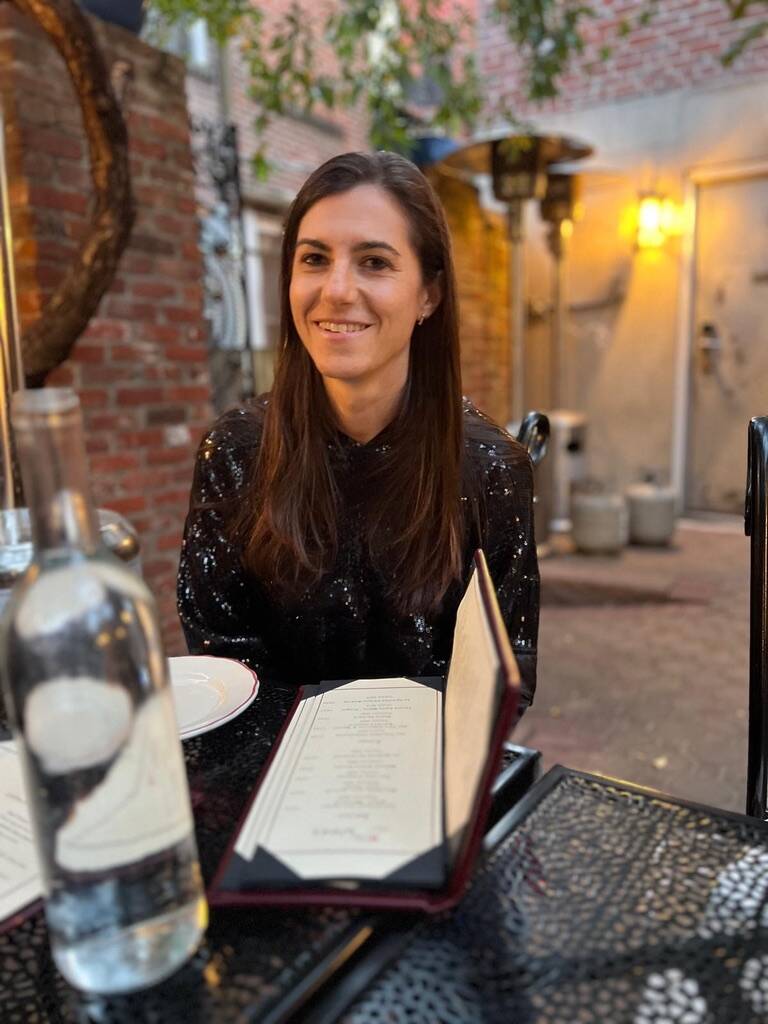
 Julie Rappoport (Courtesy of Julie Rappoport)
When Julie Rappoport moved to Center City in 2021, she didn’t know anyone other than her brother, a very busy doctor at the Children’s Hospital of Philadelphia, and some cousins.
So, she attended a Shabbat dinner hosted by the Jewish Federation of Greater Philadelphia’s NextGen group for Jews in their 20s and 30s.
At the event, Rappoport ran into a college friend who asked her to join the board of the Hebrew Free Loan Society of Greater Philadelphia. The Fairfield, Connecticut, native obliged, and she’s been a part of the Center City Jewish community ever since.
Actually, she’s now the one advertising gatherings like the NextGen dinner. Through her networking initiative, un-aPhillyated, the Fitler Square resident is building a calendar for other Center City Jews. It’s accessible via the JConnect networking platform for young Jewish adults.
“People want to know what events are going on,” Rappoport said.
The community leader is not a synagogue member, though she does go to Temple Beth Zion-Beth Israel for major holidays. Her involvement, like that of many Center City Jews, is part formal but perhaps even more informal.
Rappoport says she “builds social community through Shabbat dinners.” Whenever her friends gather on Friday evenings, she’s the one who bakes the challah, a skill she developed during COVID, “like everyone else.”
At the same time, Rappoport still serves on the board of the Hebrew Free Loan Society of Greater Philadelphia. She said she agrees with the organization’s mission of giving out interest-free loans to students, business owners and abuse victims, among other types of recipients.
Rappoport also recently participated in the Jewish Federation’s NextGen Pathway Fellowship. The program exposes potential Federation leaders to the organization’s broad spectrum of activities. Rappoport is starting to get more involved in the Federation through contributions and participation in events.
Through these efforts, the Center City resident has recognized that Jewish organizations are looking for more board involvement from millennials. That’s why she started un-aPhillyated. She thought Jewish Philly needed a group for Jews in their 30s and 40s. A group could start the process of engagement that ultimately led to organizational leadership.
“There’s a ton of stuff in the community for people in their 20s and 30s. And in college, you have Hillels and Chabads. As part of the mid- to late-30s crowd, I didn’t really relate to the people in their low 20s who often filled up the 20s and 30s events,” she said. “At the same time, in my experience with the Hebrew Free Loan Society, I was finding that there’s a leadership dearth on the boards of organizations of people in their 30s and 40s. If you talk to organizations nationally, they say they want more young people.”
These reflections prompted action. In February, Rappoport organized the un-aPhillyated community for the first time with an event at Ballers, the social sports club with courts and a restaurant/bar.
The first hour consisted of informal networking, while the second featured a conversation facilitated by Rappoport and her fellow organizers, Riley Kessler, Bara Levitt and Arielle Lechner.
“What’s working really well for you in your organizations? What are some challenges or gaps you’re finding? What are the benefits of connectedness? And what’s next?” Rappoport asked the 30 or so people in the room.
The host learned that many of the Jews in the room experienced silos between organizations across the Philly Jewish community. They also felt like they were aging out of the events for young professionals.
The crowd was divided into small groups, and each group came up with two suggestions. Then, they all voted on the ideas. The winners were a shared calendar for this demographic and ongoing activities, according to Rappoport.
“We launched it,” she said.
At the moment, un-aPhillyated has about 50 participants, and Rappoport is planning additional programming. She is also applying for a grant to support the effort.
“It will help have more meaningful events and engagement,” she said.
Rappoport hopes that the calendar, the Ballers gathering and other similar efforts can help build connections. Once those are formed, they can lead to Jews in their 30s and 40s finding organizations and taking on leadership roles.
“The calendar is a resource. What’s more likely to drive community is recurring connection,” she said.