
From Philly and the Pa. suburbs to South Jersey and Delaware, what would you like WHYY News to cover? Let us know!
Actress and playwright Anna Deavere Smith will premiere her newest stage work, “The Basil Biggs Project,” at Philadelphia’s Wilma Theater June 26-28 as part of ArtPhilly’s festival “What Now: 2026.”
The play is centered on Smith’s ancestor Basil Biggs, who was hired in 1863 to bury thousands of dead soldiers after the Battle of Gettysburg and to prepare the grounds for President Abraham Lincoln’s visit when he delivered his most famous address.
According to newspaper accounts of the time, Biggs was hired to put together a crew of seven to 10 Black men to disinter bodies from their hastily prepared shallow graves, search the corpses for any identifying effects and then rebury the soldiers in an orderly cemetery layout, which later became the Gettysburg National Cemetery.
“There were 7,000 dead bodies,” Smith said. “The Confederates had moved into their house, turned their house into a hospital. Everything was destroyed. I think, because I don’t have any letters or diaries, that the reason he took a rather grueling job is because he’d lost everything.”
Until recently, Smith had never heard of her ancestor, despite having had aunts, uncles and cousins named Biggs. In 2014, she appeared on the PBS television show “Finding Your Roots” with host Henry Louis Gates Jr., who introduced Biggs as part of Smith’s comprehensive genealogical presentation.
Sitting across from Gates, Smith’s first reaction to the revelation was, “That’s a play.”
In addition to Smith’s high-profile acting career in shows like “The West Wing” and “Nurse Jackie,” she is also known for writing documentary-style plays for which she records interviews with many people related to a particular topic and assembles verbatim excerpts into a script.
Plays like “Fires in the Mirror” (1992) and “Twilight: Los Angeles” (1994), about riots in Crown Heights, New York and Los Angeles, respectively, helped Smith win a MacArthur fellowship, often referred to as the “genius grant.”
Smith said the discovery that she was related to someone who was part of a pivotal moment in American nation-building made Biggs’ story urgent.
“Because I’ve chosen to deal in contemporary life with moments of controversy and catastrophe — race riots, kids going to jail … I’m sort of on the fringe,” she said. “But I remember what went through my head was: This is right in the center of American history. And that’s a play. I know how to write it because it’s at the very center of some of our values.”
Unlike in Smith’s previous plays, where extensive research allowed her to precisely depict her interview subjects down to their vocal tics and bodily gestures, very little is known about Basil Biggs, who never learned to write and left behind no personal accounts of his life.
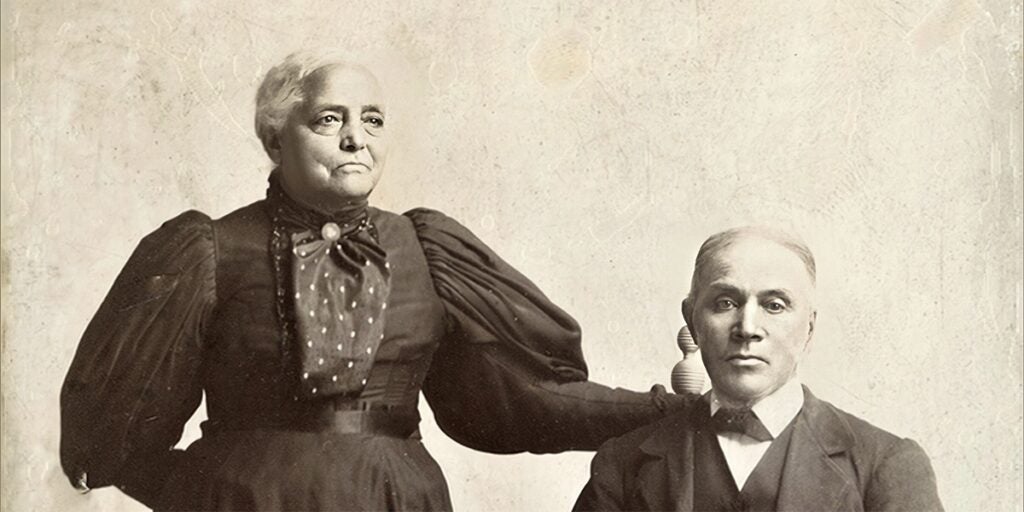 Basil Biggs is pictured with his wife Mary Jackson Biggs. (Courtesy of ArtPhilly)