
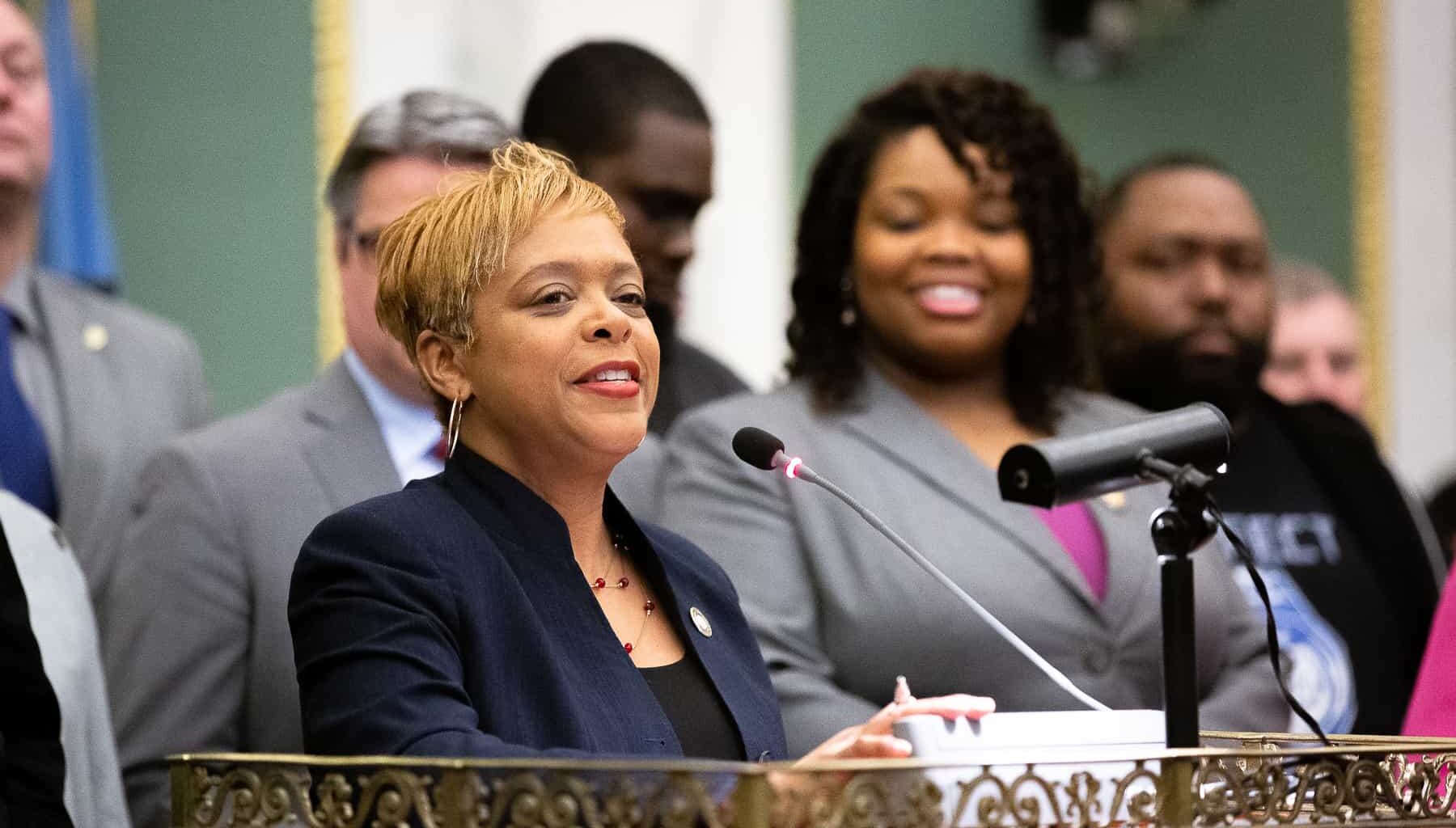
Councilmember Cindy Bass Photo: phlcouncil
The power sharing agreement reached in the 22nd Ward Race between Philadelphia City Councilmember Cindy Bass and her opponent Octavious Price is the shape of things to come.

By Denise Clay-Murray
Let’s be honest here — how much do people who don’t have a weekly column on Philadelphia’s City Government really know about the Democratic City Committee?
Sure, we know it exists. And that former Congressman Bob Brady has been in charge of it since 1986. And we know that they’re the governing body for the city’s Democratic Party, which can make or break a political contest, because most of the city’s voters are Democrats and an endorsement from City Committee carries a lot of weight.
(Granted, when you look at the city’s voter turnout numbers, you could make the argument that they haven’t really been doing all that great a job throwing that weight around, but I digress…)
City Committee is made up of ward leaders and committee people. The committee people are elected to their seats, and they then choose a ward leader whose job it is to provide them with the resources — campaign literature, sample ballots, and, most importantly, money — to get the job of getting out the vote done.
Like I said at the beginning — very few people pay attention to this stuff.
But that changed when Philadelphia City Councilmember Cindy Bass got a challenger for her 22nd Ward leader seat.
Last Wednesday, committee people from the 22nd Ward came to Democratic City Committee headquarters on Spring Garden Street for a do-over of their ward reorganization vote. That became necessary when the re-organization vote taken on June 10 was nullified because Bass declared herself the winner of a voice vote and didn’t honor the request for a roll call vote to determine if she or her opponent Octavious Price had won the seat.
The 22nd Ward election was one of three ward re-organization “do-overs” that City Committee held that night. The other two — the 14th Ward and the 17th Ward — were decided before 6:30pm.
However, the 22nd Ward vote was, well, longer. Even before the vote on Wednesday, things had gotten a tad messy, the best example being a Philadelphia Inquirer report that included video of activist — and former 22nd Ward committeeperson — Nate Holt offering someone $30 to vote for Price.
(Price denied any involvement in that, and having met him, he seems too smart to get involved with a dude stupid enough to think that $30 can get anyone to do anything in Philadelphia.)
Reporters aren’t allowed to attend ward leader elections. Since this is a party thing, not a public funding thing, I guess that makes sense. So, I sat in the hallway and waited to see what was going on.
And waited.
And waited.
And waited.
When we got to 10pm, and nothing was resolved, I asked a committeeperson I know what the scoop was.
The vote was tied. Roll Call? Tied. Secret Ballot? Tied.
Why? Because someone came all the way from Mount Airy to Northern Liberties to abstain from voting. You could have done that with a proxy and saved yourself some gas money.
After the third tie vote, a solution had to be found. Bass and Price met with party leaders and eventually with each other to see what could be done. The result was a power sharing agreement that ended with Bass retaining her ward leader seat, Price becoming ward chair, and the rest of the board being filled out with a mixture of Bass and Price supporters.
The combination of battle tested veterans and energetic newcomers can only benefit the ward, Bass said.
“I don’t see it as a problem,” she said. “I think it’s been much ado about nothing. Most of the people that we’ve connected with have been really good people who want to work together, and who really have, you know, like real concerns about voter turnout, and what’s happening on a larger scale, and in Washington. So, this is going to be good, I think, for the entire board, and we’re looking forward to working with everybody.”
After the vote, I asked Price if the complications this time around in what has traditionally been a fairly nondescript process is a manifestation of what the electoral process has become citywide.
Now, what did I mean by that? I mean that in a lot of wards, there have been conflicts between those who have called certain neighborhoods home for decades and those who are newer to the neighborhood. While both sides want a lot of the same things, there’s a perception that the newbies want to take over at the expense of those who are longtime residents.
That dynamic played out in the 22nd Ward, where longtime residents threw their support behind Bass, while the newer committee people threw their support to Price.
Eventually, everyone will get on the same page, Price believes, because some things that folks questioned at first have now become ubiquitous.
“When sliced bread first came out, there were people who looked at it and said, ‘What is this?!”, he said. “Now, no one thinks about it. I think it’ll be the same here.”
While I’m not so sure that wards around the city will rush to recreate the 22nd Ward’s power sharing plan, I do believe that it will eventually become ubiquitous. Especially if it actually gets people to the polls.
Or at the very least, it’ll inspire people to make sandwiches.
Disclaimer: The views, thoughts, and opinions expressed in the article belong solely to the author, and not necessarily to the author’s employer, The Philadelphia Sunday SUN, the author’s organization, committee or other group or individual.