
Real journalists wrote and edited this (not AI)—independent, community-driven journalism survives because you back it. Donate to sustain Prism’s mission and the humans behind it.
Nai Anwar only recently learned that Erie County, New York, passed a law last month banning businesses from collecting customers’ facial recognition data.
The 38-year-old Muslim refugee from Myanmar, who resettled in Buffalo, New York, more than a decade ago and later became a U.S. citizen, had never attended a county legislative meeting. He didn’t even know stores were capable of collecting facial recognition data from customers walking through their doors.
But one question immediately came to mind: What happens if immigration authorities get access to those databases?
The concern feels especially heavy in Buffalo, where Rohingya refugee Nurul Amin Shah Alam died on the street in February after being released by border officials in what was ruled a homicide.
“For immigrants in Buffalo, we are always concerned about [Immigration and Customs Enforcement] raids and enforcement activities,” Anwar said.
“I am a citizen now, but I have friends who are not citizens yet,” he said. “I worry about them being misidentified if authorities use facial images to track people.”
Those concerns are among the reasons Erie County lawmakers approved one of the nation’s most restrictive laws governing commercial biometric surveillance.
On May 26, County Executive Mark Poloncarz signed the Biometric Transparency and Privacy Act, prohibiting private businesses from collecting, using, retaining, or selling biometric identifier data, including facial-recognition scans. Companies that violate the law can face penalties of up to $5,000 per day.
The law, however, only applies to businesses and carves out explicit exemptions for government agencies acting within their governmental duties—including federal immigration authorities such as Immigration and Customs Enforcement (ICE)—as well as financial institutions.
A harrowing encounter
Earlier this year, Anwar said he was stopped and questioned by immigration authorities, despite carrying legitimate identification documents.
As he was leaving a Dunkin’ Donuts in the Cheektowaga neighborhood of Buffalo, a group of ICE officers surrounded him and demanded to know if he was a U.S. citizen, he said.
When the officers asked for his ID, Anwar said he presented his passport card, but the officers did not think the photo looked like him. Eventually, they realized Anwar’s photo was taken years ago, as passport cards remain valid for 10 years, and let him go. Still, the encounter left Anwar shaken and angry.
“This was my first encounter with ICE officers. I believe they stopped me because I have an Asian face,” Anwar said. “I think it is wrong to treat someone this way, without a warrant and based solely on appearance. They were effectively accusing me of falsifying an ID card based on nothing more than a visual judgment.”
The encounter left him skeptical about the capacity of immigration authorities to identify people with precision.
“In my opinion, many ICE officers on the ground are inexperienced and need much more training,” he said. “So just imagine the kinds of mistakes they could make if they had access to facial recognition data collected from retail stores.”
Invisible technology
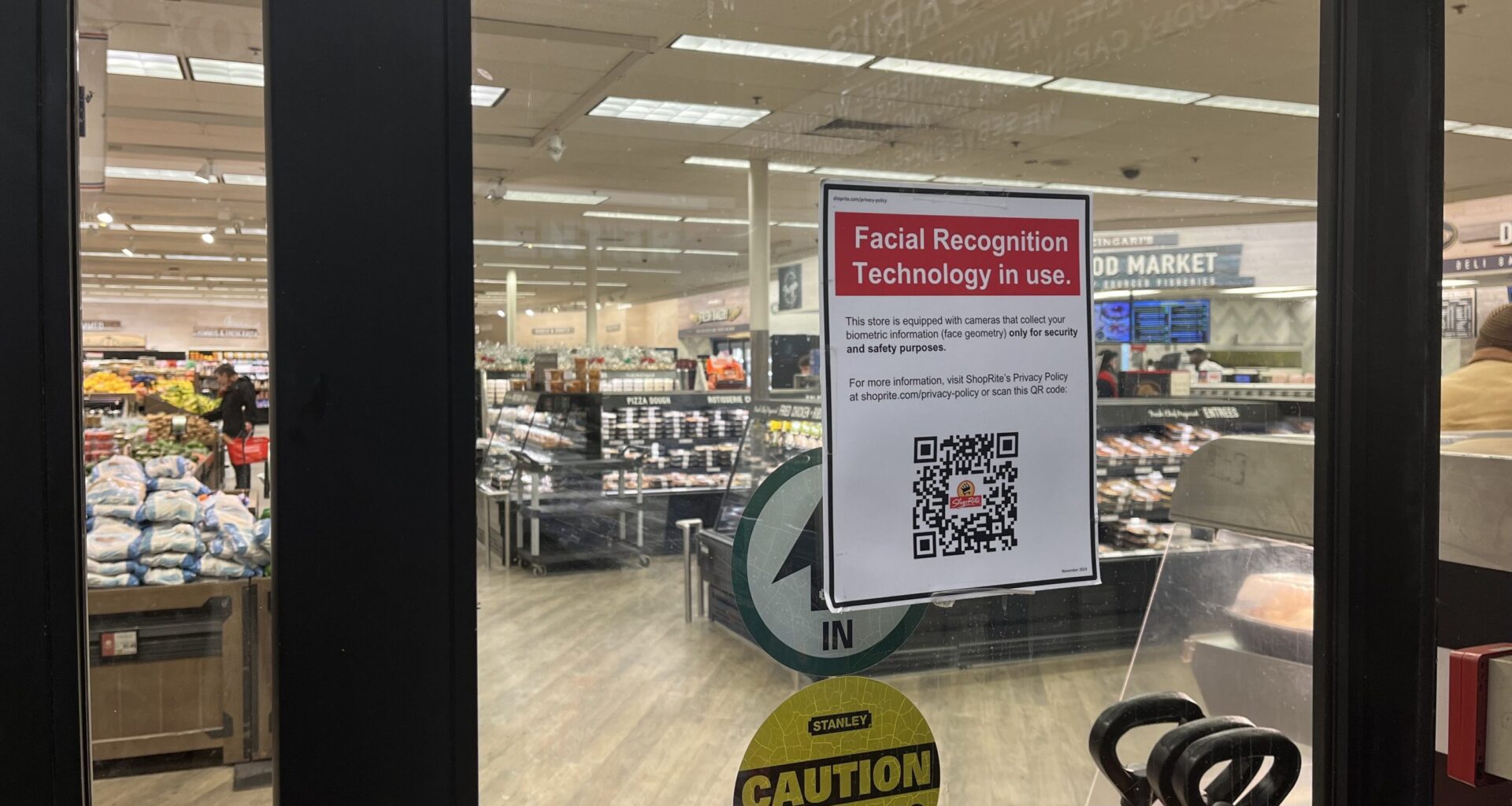
Erie County lawmakers set out to address these concerns after Wegmans, the Rochester-based grocery chain, acknowledged that it had deployed facial recognition technology in a small fraction of its stores.
The revelation came after signs, required by law, appeared in New York City Wegmans locations this winter notifying customers that biometric information could be collected on the premises. When Buffalo-based Investigative Post began asking whether similar technology was being used in Western New York, the issue quickly gained the attention of local lawmakers.
In a Feb. 26 statement, Wegmans said it used the technology in “a small fraction” of its stores to identify individuals previously flagged for misconduct.
“This technology is solely used for keeping our stores secure and safe. The data is not, and will not, be used for any other purpose,” the statement said.
Wegmans did not respond to Prism’s request for comment.
There is no evidence that retailers in Erie County have shared facial recognition data with ICE. Nevertheless, privacy advocates warn that once biometric databases exist, future access can be difficult to predict.
Federal immigration agencies have expanded their use of biometric technologies over the past decade, incorporating fingerprints, facial recognition, and other tools into identity verification and enforcement systems.
For Erie County Democratic Legislator Lawrence Dupre, who proposed the ban, simple transparency initially seemed like the appropriate response.
“The technology is invisible. It works without your knowledge or consent. You walk into a store to buy groceries and your body becomes a data point in a system you never agreed to,” Dupre said in an email interview.
But as he researched the technology, Dupre concluded that disclosure alone was not enough.
“I realized the real risk is not that you do not know your data is being collected,” he said. “The real risk is that it gets stored, sold, or stolen. Once a company has a biometric profile, that data exists forever.”
While passwords or credit card numbers can be changed, stolen biometric information cannot be replaced after a breach.
Expanding use
Dupre’s concern reflects a growing debate unfolding across the U.S. as facial recognition technology expands beyond airports, border crossings, and police departments into grocery stores, pharmacies, sports arenas, and shopping centers.
Many consumers remain unaware the technology is being used at all.
Soe Than, a longtime Burmese community leader who has lived in Buffalo’s Riverside neighborhood since the early 2000s, said he was surprised to learn that retailers might be collecting facial images from customers.
“I am aware that department stores in Buffalo have installed CCTV and security cameras,” he said. “But I was not aware that they are collecting facial images or using facial recognition technology.”
Unlike Anwar, however, Soe Than is less concerned about the technology being used for immigration enforcement.
As someone who has helped Burmese immigrants detained by ICE connect with lawyers and legal aid organizations, he believes most members of the community already have extensive records on file with the federal government.
“As far as I know, most members of the Burmese community are here legally, either as refugees or with pending asylum applications,” he said. “The government already has their biometric information, such as fingerprints.”
Yet, even he acknowledges that few residents have been part of the public conversation surrounding facial recognition.
The lack of awareness is striking considering how rapidly the technology has spread. Fight for the Future, a digital rights organization, has identified several major retailers that either use or may be using facial recognition systems. Companies including Walmart, Home Depot, and Kroger have acknowledged collecting biometric information in certain circumstances through security and monitoring systems.
Because there is no federal law requiring businesses to publicly disclose their use of facial recognition technology, the true scale of commercial biometric surveillance remains difficult to measure.
“Today, an increasing number of businesses are collecting biometric data from customers without meaningful consent,” said Lia Holland, campaigns and communications director for Fight for the Future. “Because there is no standard that requires companies to report whether they are collecting this data in a way that can be easily summarized, we aren’t sure how widespread it is.”
Facial recognition systems have long faced criticism for racial bias and uneven accuracy.
A landmark 2019 study by the National Institute of Standards and Technology found that many facial recognition algorithms produced significantly higher error rates when identifying women, Black individuals, and other racial minorities than when identifying white men.
The American Civil Liberties Union has documented at least 14 publicly known wrongful arrests in the U.S. linked to facial recognition technology, mostly of Black or Hispanic individuals. A Black woman named Kimberlee Williams spent months in jail after Maryland investigators relied on a faulty facial recognition match despite evidence placing her more than 1,000 miles away from the alleged crime.
For immigrants and refugees, stories like these raise troubling questions.
Many arrived in the U.S. after fleeing authoritarian governments, military rule, or ethnic persecution. The idea that an algorithm could mistakenly identify someone and trigger law enforcement action resonates differently among communities that have firsthand experience with state surveillance.
“Particularly under authoritarian rule, it’s important to look toward marginalized and vulnerable people to understand what a technology is ultimately intended to do,” Holland said. “Biometric collection, paired with something like a driver’s license database, places us all in the crosshairs of criminalization at any moment, no matter where or who we are.”
In another troubling incident, Anwar witnessed his close friend, who had a pending asylum case, be detained by ICE officers outside a Walmart in the Buffalo area where he worked. Anwar watched from the parking lot as his friend stepped out of the store to hand off some items to pickup customers. ICE officers approached Anwar’s friend with a list of names and asked if his was one of them, Anwar said.
“When he said yes, they handcuffed him and took him away. I had no idea how they knew his whereabouts,” Anwar said.
His friend had a valid work authorization, a driver’s license, and a Social Security Number at the time of the arrest, said Anwar, who contacted an immigration lawyer and secured his friend’s release.
For Anwar, the two encounters with ICE officers left him deeply unsettled, shaping his views on the immigration system and the technology they could be using.
“I have never experienced anything like that in my life in the United States. The officers were armed and equipped. I was terrified by the experience,” he said of his own encounter. “Seeing my friend arrested in front of me made it worse.”
Editorial Team:
Sahar Fatima, Lead Editor
Lara Witt, Top Editor
Stephanie Harris, Copy Editor
Related