
Editor’s note: Pennsylvania and New Jersey have played a key role in the nation’s 250-year history. While most are familiar with the events that happened in Philadelphia, our region also played a pivotal role in the development of the fledgling nation. In honor of the country’s 250th anniversary celebration, we will feature some of the places, people and events in the region that helped shape America’s history.
The threat Pennsylvania faced in the summer of 1775 was very real and very large.
The battles at Lexington and Concord had kicked off the American Revolutionary War just a few short months before, and the Second Continental Congress that began that May enshrined the British as hostile to the colony.
 America 250
According to local author and historian Dan Graham, leaders in Pennsylvania decided they needed to protect themselves. They decided they needed to arm themselves.
The Continental Army wasn’t yet officially formed, which meant, at least for a while, the colonies were each on their own.
Graham said that leaders in Philadelphia, the center of power in Pennsylvania, worried mostly about the city’s port.
“They weren’t so worried about places like Berks County,” he said.
To defend the waterways leading into the city, those leaders came up with a plan.
“They came up with the idea to arm merchant ships to create a navy and to put cannons on the shores,” Graham said. “That was a great idea, but it was a situation of ‘Where are we going to get the cannons?’ There were none around.”
A cannon committee organized by Benjamin Franklin was tasked with coming up with a solution, Graham said. It set out to answer the question of whether or not the people and places needed to make cannons were available locally.
The answer to both was “yes.”
Southeastern Pennsylvania had a number of working iron furnaces, including Hopewell in Berks, Cornwall in Lebanon County and Warwick and Reading in Chester County.
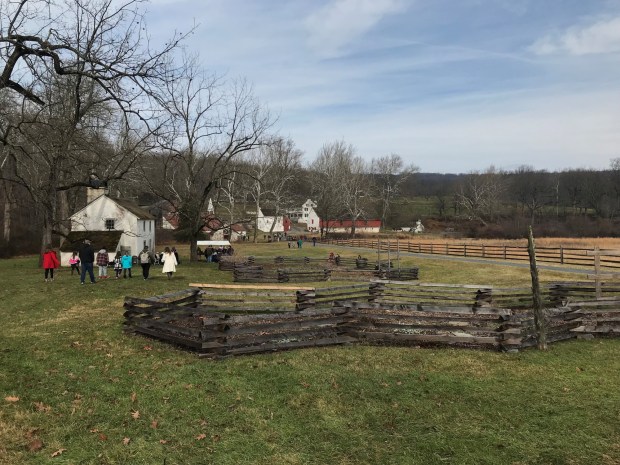 From 1776 to late 1777, Hopewell Furnace produced 12-pound cannons. (STEVEN HENSHAW/READING EAGLE)
So, the operators of the forges got to work in spring 1776. The only problem was, they didn’t quite know what they were doing.
Having never made cannons before, their early efforts were a mess, Graham said.
“They kept blowing up,” Graham said.
Eventually, an expert was brought in to help the locals figure out the pervasive kinks. And for about 18 months, local furnaces produced working weapons— 12-pound cannons at Hopewell and Cornwall, 18-pound cannons at Warwick and Reading.
By late 1777, when Gen. George Washington and his men hunkered down at Valley Forge, France had gotten involved in the war effort and were providing weapons. That meant local production of cannons fell by the wayside.
But remnants of the era of southern Pennsylvania weapon manufacturing still remain.
Graham said that half of a cannon still remains at Hopewell, while a full cannon can be found during a visit to Cornwall.
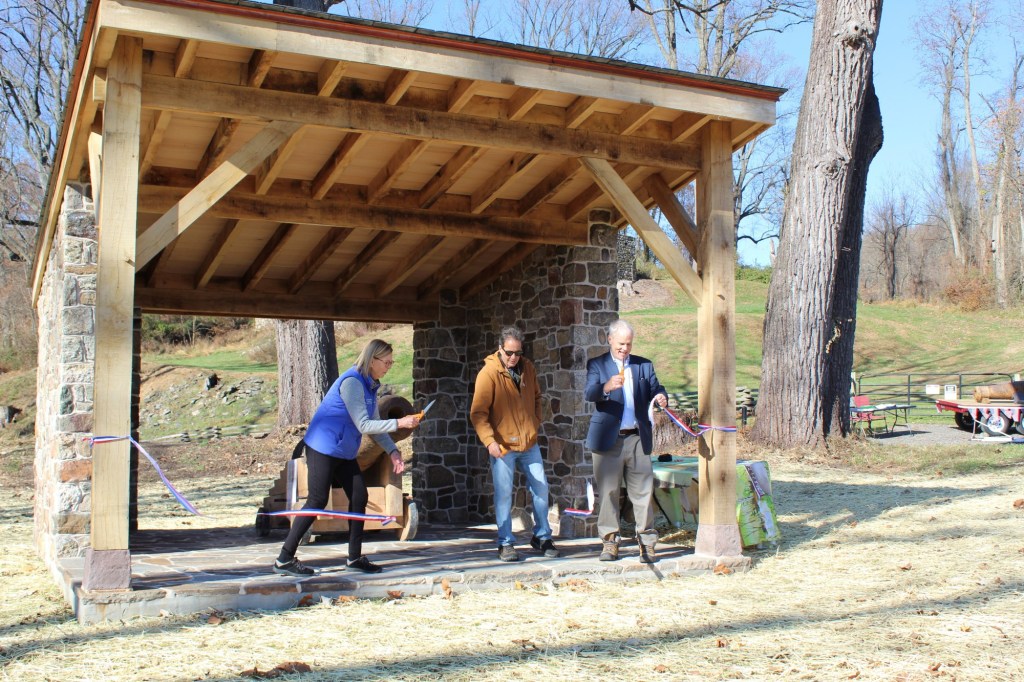
And a cache of four cannons crafted at Warwick — which had been buried to avoid their capture by approaching British forces — were unearthed in 2022. One of them has been put on permanent display at the French and Pickering Creeks Conservation Trust.