
EXETER – With state funding stagnant, healthcare costs soaring, and cyber-charter tuition stubbornly high, taxes are rising again in Wyoming Area.
The Wyoming Area Board of Education voted 7-2 to adopt its final budget for the 2026-27 school year Tuesday. The budget, compared to last year’s, increases total annual revenue 3.29% to $48.36 million; and increases annual expenditures 3.56% to $49.53 million. The resulting deficit of $1.17 million is covered by an equivalent reduction of the Wyoming Area fund balance, which is now expected to finish the 2026-27 school year at $2.01 million.
The Wyoming Area school board is raising property taxes an aggregate of 4.8% – the maximum tax increase allowable for Wyoming Area under the state Act 1 Index. How that tax hike manifests throughout the district will vary across county lines.
The school tax on Wyoming Area homeowners in Luzerne County is increasing 3.94% to $22.6469 per $1,000 of assessed value. Homeowners whose property is assessed at a value of $150,000 will have their school tax bill rise $128.69 under this rate to $3,397.04.
The school tax on Wyoming Area homeowners in Wyoming County is increasing 9.86% to $119.4070 per $1,000 of assessed value. Homeowners whose property is assessed at a value of $25,000 will have their school tax bill rise $267.90 to $2,985.18. (Assessments in Wyoming County tend to be significantly lower than their Luzerne County counterparts.)
Homeowners in both counties will be able to collect a homestead exclusion – property tax breaks generally funded by state gambling-tax revenue – that will lower their tax bills $174.09, which is about equal to last year’s homestead-exclusion savings.
This disparity in tax rates between counties is the result of a state rebalancing formula for school districts spanning multiple counties. The formula fixes the ratio of a school district’s taxes in one county to its taxes in another. It is a function of the assessed values of the counties’ tax bases, as determined by county assessors; and the tax bases’ market values, as determined by the State Tax Equalization Board.

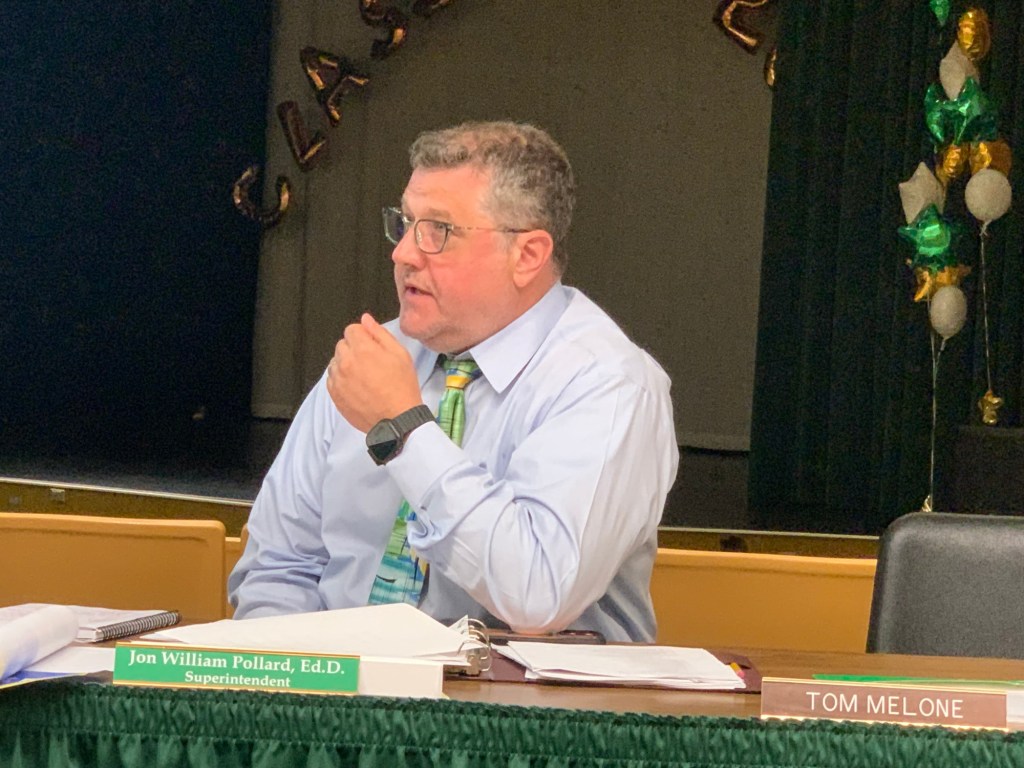
Wyoming Area school board at its 2026-27 final budget meeting on June 23, 2026 (CHRISTOPHER DOYLE/STAFF PHOTO)

Tom Melone at the Wyoming Area school board meeting June 23, 2026 (CHRISTOPHER DOYLE/STAFF PHOTO)
Show Caption
1 of 2
Wyoming Area school board at its 2026-27 final budget meeting on June 23, 2026 (CHRISTOPHER DOYLE/STAFF PHOTO)
The Wyoming Area districtwide tax base depreciated 0.01% in the last year to $984.58 million. With a tax collection rate of 90.25%, property taxes will generate $20.19 million for Wyoming Area this school year, with the tax hike adding $837,151. All local revenue sources together will generate $26.17 million, or 54.12% of all district revenue.
Tom Melone, whose firm provides business-management services to Wyoming Area, said he was alarmed by the stagnation in the district’s tax base this year after several years of growth. The Wyoming Area tax base’s assessment remains 1.91% smaller than it was 11 years ago.
“Over the years, our biggest challenge has been the drop in assessed valuation,” Melone said.
To compensate for its diminished tax base, the school board has increased taxes in Luzerne County every year for at least the last 17 years; and hiked taxes in Wyoming County 14 of the last 17 years. The aggregate impact of these taxes is equivalent to a 3.86% annual increase in Luzerne County and an annual 3.7% in Wyoming County every school year from 2010-11 through 2026-27.
These revenues are needed to keep pace with mounting costs.
The expense of benefits the district provides employees will grow 5.29% this year to $13.86 million, with that being driven by a 14.17% increase in healthcare costs; and the tuition Wyoming Area pays to cyber charter schools, moreover, has more than tripled since the start of the COVID-19 pandemic to $2.83 million for the 2025-26 school year.
“If we could solve the cyber charter school situation, taxes wouldn’t have to be increased at all,” Wyoming Area school board member David Alberigi said.
Wyoming Area officials maintain they are not receiving enough substantial support from Harrisburg to offset these losses, especially relative to other Wyoming Valley school districts with larger tax bases.
The 2026-27 budget projects the General Assembly will increase Wyoming Area’s state funding 4.34% to $20.99 million, or 43.41% of its total district revenue. (This figure does not include an additional $441,700 the General Assembly passes Gov. Josh Shapiro’s proposed education budget.)
Wyoming Area school board President Mara Valenti said the district was making cost savings. She noted that the district has reduced its staff and faculty through attrition; changed insurance carriers; and added several special education classrooms, thus preventing costly out-of-district placements.
Valenti also noted that Wyoming Area has often gone without facility upgrades and has lost faculty to richer school districts, due to a small tax base and meager state funding.
“We do not have a spending problem. We have a revenue problem,” Valenti said. “And unfortunately, our kids are the ones paying for it.”