
The floodgates opened. The impact players available were dealt. And the Pittsburgh Penguins were not involved.
The St. Louis Blues dealt Jordan Kyrou, a later 20s impact player, to the Washington Capitals for a competent mid-20s winger, the Capitals’ 2025 second-round pick, and the 16th overall pick in the 2026 NHL Draft. Chicago shockingly parted with the fourth overall pick for defenseman Bo Byram, who has No. 1 potential, but in a handful of seasons has not yet reached that plateau.
Young defenseman New Jersey Devils defenseman Simon Nemec was traded to the rebuilding Calgary Flames for a pair of what are expected to be later first-round picks, a second-rounder, and a prospect. Young forward with big potential, William Eklund, went from San Jose to Ottawa, as Ottawa spent the ninth overall pick in a package to replace Brady Tkachuk.
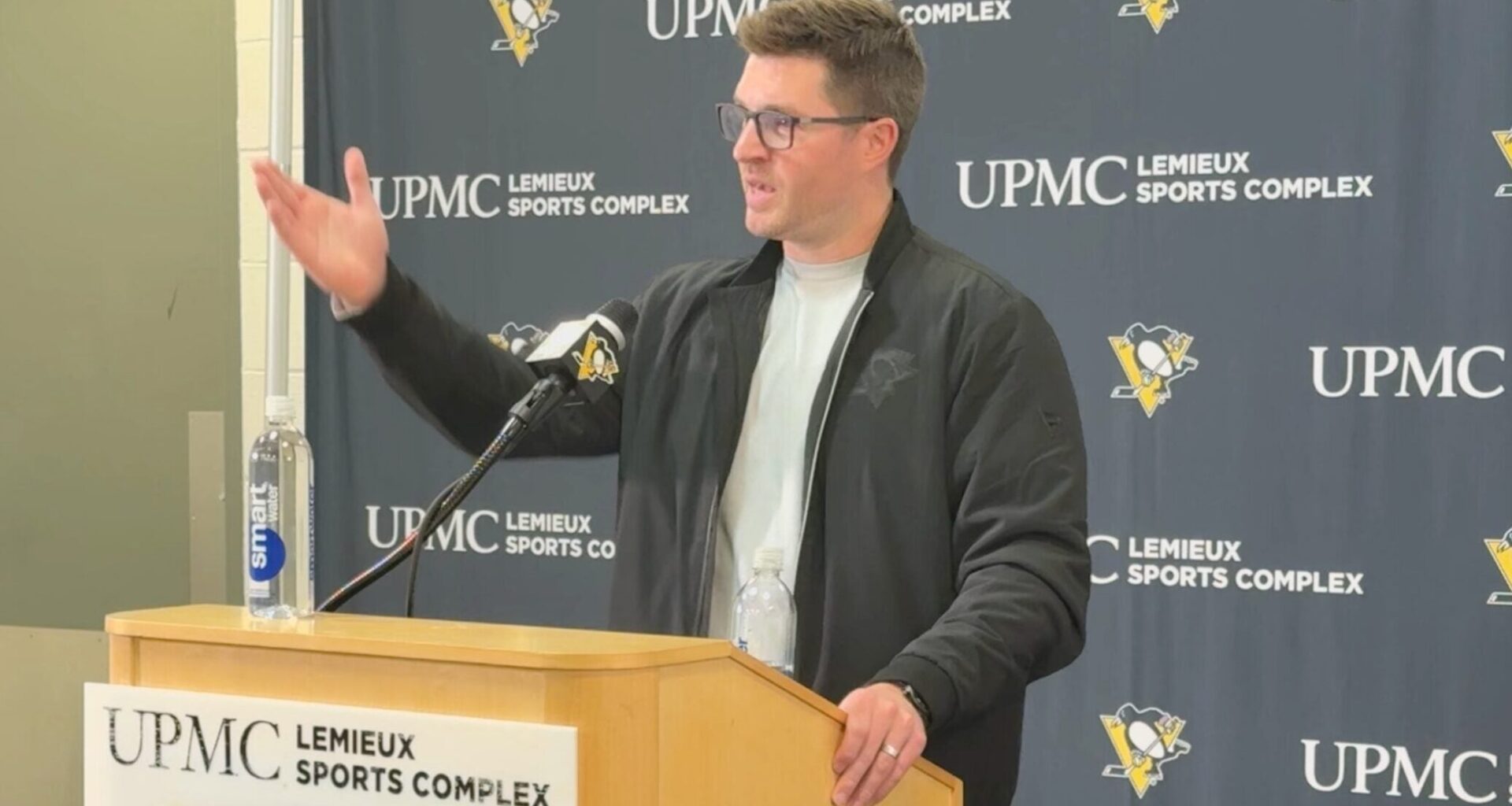
Several players who very specifically fit the criteria for general manager Kyle Dubas’s directly stated intent. And yet, the Penguins were not involved, and now the opportunities to move forward in the rebuild by acquiring a player of substance who is in his mid or later 20s have been narrowed.
You can almost hear the Penguins’ Stanley Cup odds falling further, but that’s not a terrible thing.
Gen X’ers might remember the phrase, reality bites. In the quickly changing world Tuesday, reality bit the Penguins’ plans to take a step forward in the rebuild. But the chaos of the vanishing chances also lights the runway way for a far more attainable path forward.
In fact, it seems Dubas has already pivoted toward this new path of acquiring young talent. Word from the NHL Board of Governors meeting was a poorly kept secret. The Penguins are trying to trade up from the 22nd pick in Friday’s NHL Draft.
The pivot seemingly puts an end to the errand of acquiring mid-career players to whom Dubas could build around, but instead shoves him down the path of acquiring the future through the draft. Indeed, the cost of the young players Tuesday was shocking.
Nemec for two firsts and a second? Byram for the fourth overall pick? Chaos is one thing. An overheating trade market with prices rising faster than valuations on condos in Manhattan is another.
The only move that Dubas’s trade wallet could have afforded was acquiring Kyrou, but what should be of note to all is that after seeing what other general managers received for their prized possessions on the trade market, every GM will begin asking for the moon and the stars for their desirable players. A deal such as the Penguins acquiring Egor Chinakhov for merely a second and third-round pick would seem to be an underpay today.
However, there are two sides to a trade. If the league prices are rising, that means the Penguins’ trade chips, which other teams may have undervalued, are instantly worth more, not only because of the premiums paid Tuesday but because of a growing scarcity of available players.
There are fewer top-six wingers on the market after Brady Tkachuk landed in Florida, Kyrou in Washington, Eklund in Ottawa, and Dylan Larkin awaits his move to a few preferred teams, such as Minnesota or Vegas.
St. Louis has taken Robert Thomas off the table, or priced him so unaffordably as to effectively do so. Toronto has receded from talks over Matthew Knies.
Dubas may have some options to move up in the draft with his existing capital, or he could spend some of his draft capital to move up, or use his abundance of picks to do so. As Pittsburgh Hockey Now detailed a few weeks ago, the Penguins’ current draft capital, primarily the 22nd and 39th overall picks, could allow them to jump into the range of the 14th to 16th overall pick.
Of course, it takes two to tango.
The Penguins are well poised for a sharp turn toward a youth movement as a pack of prospects await their NHL sweaters and full-time work. From Rutger McGroarty, Sergei Murashov, and others who are lesser guarantees to be successful, such as Owen Pickering, Tristan Broz, and Ville Koivunen, could quickly step into the lineup next season to earn their final prospect judgment.
Dubas also has 15 draft picks (three first-rounders, seven seconds, and five thirds) over the next three drafts, including the 2026 edition, which begins Friday.
Thus far, Dubas has been without a dance partner, but the music has changed. Building for the future with future-facing assets, many of whom (will be) acquired in the draft, is both a safer and likely longer path back to the top. And that should be OK.
And maybe next summer, Dubas and the Penguins will be in a position with a deeper pool of assets, and he can package some of those when all hell breaks loose, again.
Tags: kyle dubas Penguins Trade Pittsburgh Penguins
Categorized:Penguins Trade Talk