
ALLENTOWN, Pa. – After a controversial vote last week to adopt an ordinance to put zoning regulations in place for data centers, Allentown City Council began a process of amending the bill to make the guidelines tougher for potential developers.
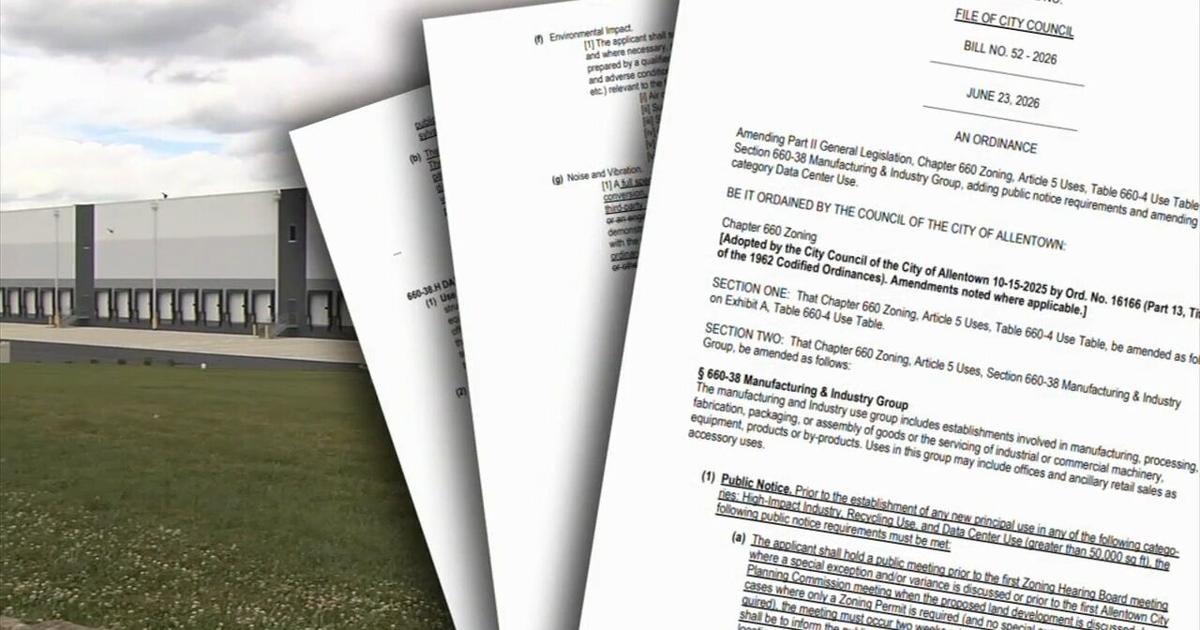
Council conducted a special meeting Wednesday night for the sole purpose of introducing what will be known as Bill 52 to begin making amendments to the zoning code dealing with data center uses.
Council President Santo Napoli explained how Allentown got to this point.
“The administration created Bill 20 – the first data center regulations – and the bill was introduced at the March 4th council meeting and referred to the Allentown Planning Commission and the Lehigh Valley Planning Commission,” Napoli said. “And after those extensive reviews, it came back to our Community Economic Development Committee meeting on May 14th.”
“During that CED meeting, a few committee members, including myself, voiced opinions that the bill should be strengthened, but we learned that amending the bill at that time would send it back to the starting process and the city would go approximately another 90 days with no regulations in place governing data centers,” he said.
The first council meeting to act on the bill was June 4, when it was tabled to allow council to conduct an executive session to obtain legal opinions and better understand the consequences of not implementing regulations as soon as possible.
“The second council meeting to act on the bill was on June 17th, and the bill passed by a 4-2 vote,” Napoli said. “During that meeting, I agreed amendments were necessary and assured my colleagues I would place an urgency on that process.”
Immediately following the special council meeting, Bill 52 was forwarded to the CED committee for further discussion.
The committee voted to forward the bill for approval at a future council meeting, but before that can happen, the amendments must be reviewed by the Allentown Planning Commission and the Lehigh Valley Planning Commission.
Napoli said council will hold a public hearing on the amendments on Aug. 5, which is a regular meeting where action could be taken on the bill.
The amendments include:
Expanding the setback to 500 feet from the current 200 feet.
Removing the industrial zoning district from a permitted use and only permit data centers within the industrial manufacturing zoning district.
Adding decommissioning standards when a data center shuts down.
Addressing noise issues.
Planning Director Jennifer Gomez said the administration will also come back with additional amendments to specifically regulate noise issues.
Most of the members of the public who addressed the committee with where far more considerate and civil than commenters at last week’s council meeting.
Most of the speakers thanked council and the administration for moving so quickly with crafting amendments.
Frank Kane, managing director, addressed some concerns which questioned why the setback can’t be expanded to 1,000 feet.
“We don’t have the capacity in the city (to locate a data center) if we put a 1,000-foot or a 1,500-foot setback,” Kane said. “We don’t have enough property in the city that would accommodate that. I think that requirement comes out of suburban townships and rural townships where there’s a lot more open space.
“And if we don’t have it (the space), we can’t pretend to have it; otherwise, we face challenges from people and then they get to propose the remedy, which is probably not what we would want,” Kane said.
Kyle Ropski, chair of Allentown’s Environmental Advisory Council, said that over the past few weeks, the discussion surrounding data center regulations generated an extraordinary level of public interest and participation.
“Residents took the time to attend meetings, submit comments, conduct research, share concerns, and engage thoughtfully in a constant conversation about the future of our community,” Ropski said. “While our council has not had the chance to do a deep dive on the wording of Bill 52 specifically, we are encouraged to see that many of the priorities reflected throughout the public engagement process are being addressed. At the same time, there are still opportunities for future refinement.”
Some speakers wanted to voice their overall objections to data centers, but councilmembers explained it is the legal responsibility of the city to provide zoning districts for all uses. They also urged residents to contact officials at the state government level.
Some residents asked council to add amendments which other municipalities are enforcing.
Vicky Kistler, director of community and economic development, clarified that data centers are not new and became popular in the 1960s.
“What is new are the hyperscale data centers which are the massive data centers,” Kistler said. “We do not have land here in Allentown that could accommodate a hyperscale data center. What I really get concerned about is that I think folks are comparing hyperscale centers to what we may potentially face here, and they’re not the same.”
“I just urge all of you, when you’re looking at data centers, we’re not talking about the millions of square feet hyperscale data centers. We don’t have the space,” she said. “Communities that you may be comparing us to that have tons of farmland, and they may have the space, and that’s why their ordinances can be different than ours.”
Because the city had no regulations regarding data centers, Langan Engineering has proposed a project to convert an existing 224,000-square-foot warehouse at 2401 W. Emaus Ave. into a data center.
The new guidelines cannot be applied to that project.