
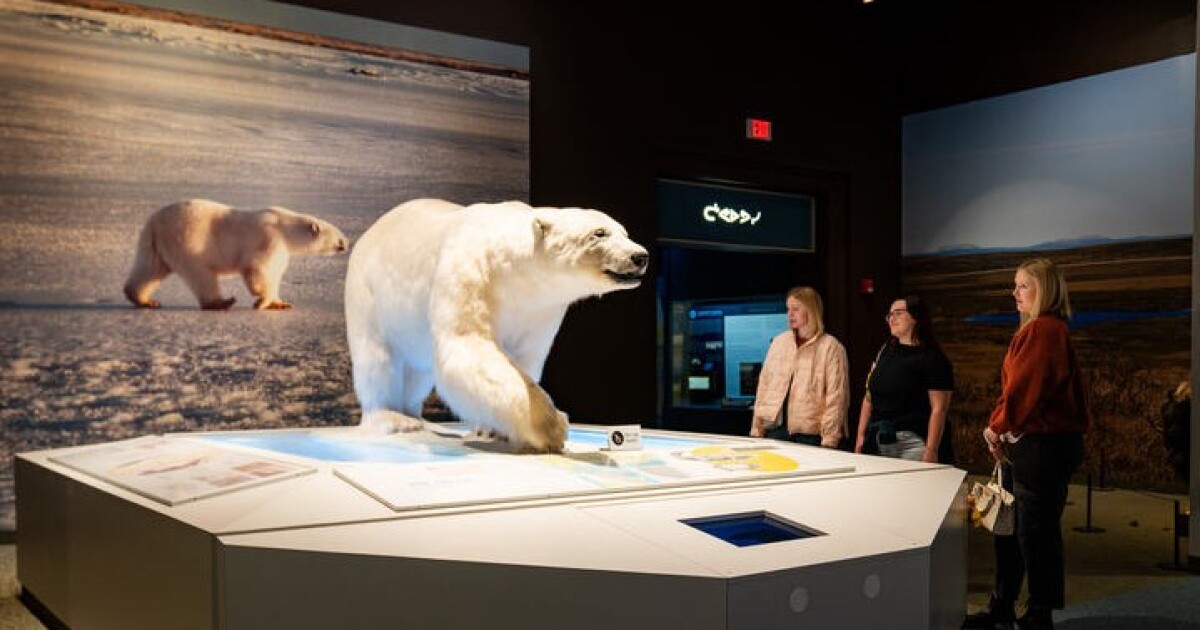
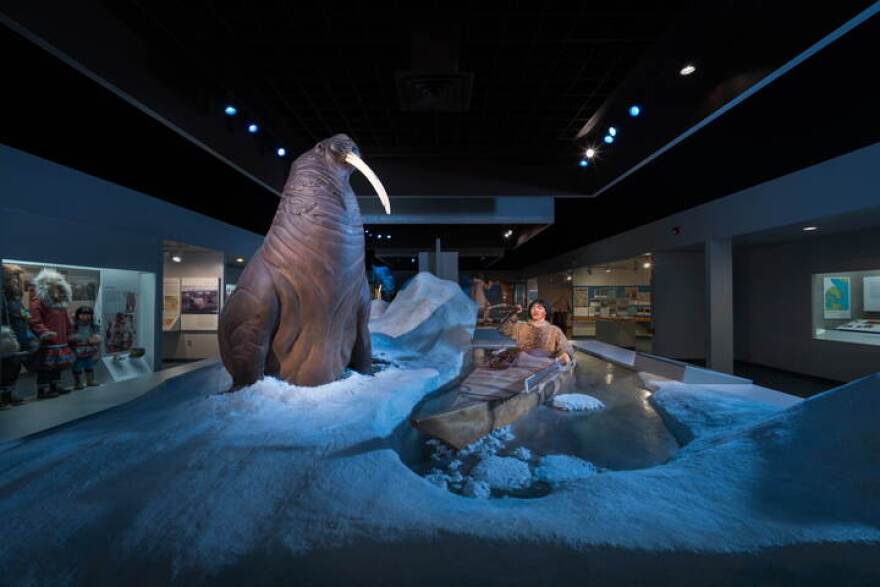
It’s last call for that fluffy white taxidermy polar bear. And it’s the final chance to see the model of an Inuit hunter kayaking beneath the gaze of a mountainous walrus.
This Sunday, June 28, marks the end of the Carnegie Museum of Natural History exhibit “Polar World: Wyckoff Hall of Arctic Life,” a museum fixture since 1983.
The Carnegie announced the closure May 7. Closing events include art-making, storytelling and other special activities this Friday through Sunday.
“We know that this has been an exhibition that’s been part of people’s lives a long time in Pittsburgh, so we really wanted to make sure we gave people time to come in and make some new memories before the exhibition leaves,” said Sarah Crawford, the museum’s senior director of museum experience.
Other visitor favorites at “Polar World” include the replica snow house, the diorama of an Inuit seal hunter, three taxidermy musk oxen, and a collection of Inuit art and artifacts.
Joshua Franzos
/
Carnegie Museum of Natural History
“Polar World” includes a diorama of an indigenous hunter and a walrus.
Crawford said when the exhibit debuted in 1983, it was “state of the art.” And it’s been augmented over the years — the polar bear and musk oxen, for instance, were ’90s additions.
But the display was showing its age. The map that accompanied the polar bear still features the U.S.S.R., which ceased to exist in 1991. The monitors showing films of Arctic life look quite small in the era of the big-screen TV.
“The biggest thing is just technology has changed, media has changed,” Crawford said. “Museum exhibits look different now than they did 40 years ago.”
In addition, the exhibition, developed in consultation with human members of the community it depicts, was meant to be contemporary. Some four decades later, Crawford said, that’s no longer the case.
In all, Crawford said, it was not feasible to update the exhibit. So after Sunday, its components will be packed into storage along with most of the other 22 million objects in the museum’s collection. Crawford said individual objects might resurface as part of future exhibitions.
In the meantime, there are plans for the soon-to-be-former Polar World gallery. Last week, the Carnegie announced the space would house “Egypt on the Nile,” the museum’s new exhibit on ancient Egypt, first announced a few years back (and teased with the behind-the-scenes 2024 exhibit “The Stories We Keep: Conserving Objects From Ancient Egypt”).
Lisa Haney, an assistant curator and the museum’s resident Egyptologist, said “Egypt on the Nile” — the successor to the Carnegie’s long-running Walton Hall of Ancient Egypt — will be the museum’s first new long-term exhibit in 20 years.
It will focus on the interdependence of natural history and human history and will include large-scale immersive media that will “make visitors feel transported to ancient Egypt.”
“Egypt on the Nile” is scheduled to open May 1, 2027.