
This is part five of our series, Designing Dignity. Check back tomorrow for part six. Parts one, two , three and four are here.
Tamon Miyake’s lab at Waseda University in the Shinjuku neighborhood of Tokyo looks almost like a trade show. Lifesize, humanoid robots are positioned at various stations dressed up as a bedroom, kitchen or office.
Miyake and his team are researching the future of caregiving in Japan. The lab is developing robots that can take over domestic chores from humans such as cooking, cleaning and lifting heavy objects. To do that, researchers are creating language-learning models for things most people don’t think about very often, such as the different textures of bodily fluids.
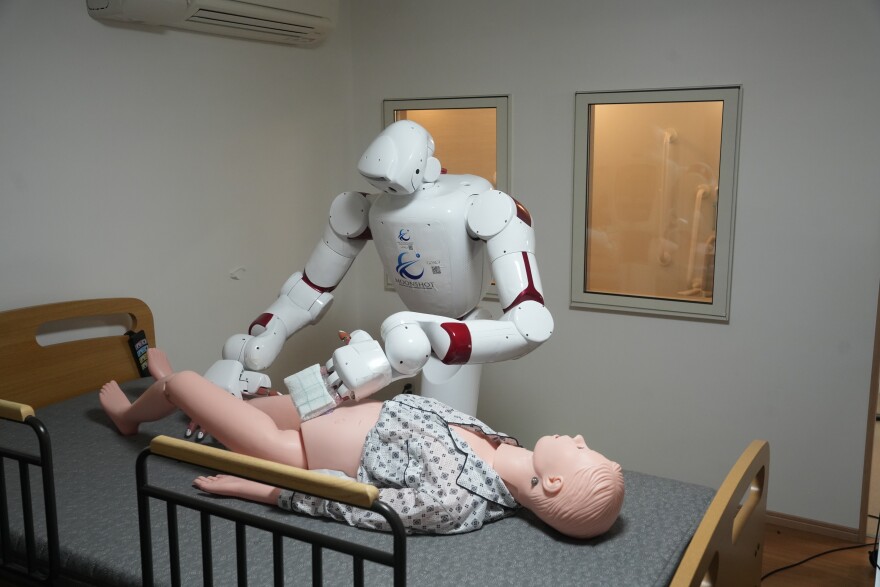
Misa Matsumura, a bioengineering PhD student, directs a care robot called AIREC to wipe a mannequin lying in a hospital bed. She uses a pair of Nintendo Switch controllers to guide the pressure as the robot’s arm scrubs the mannequin clean.
“We need to teach the robot how to deal with different textures of discharge,” Matsumara said.
The care robots are part of the Japanese government’s Moonshot Research and Development Program, which aims to integrate humanoid and autonomous robots into everyday life during the next 25 years.
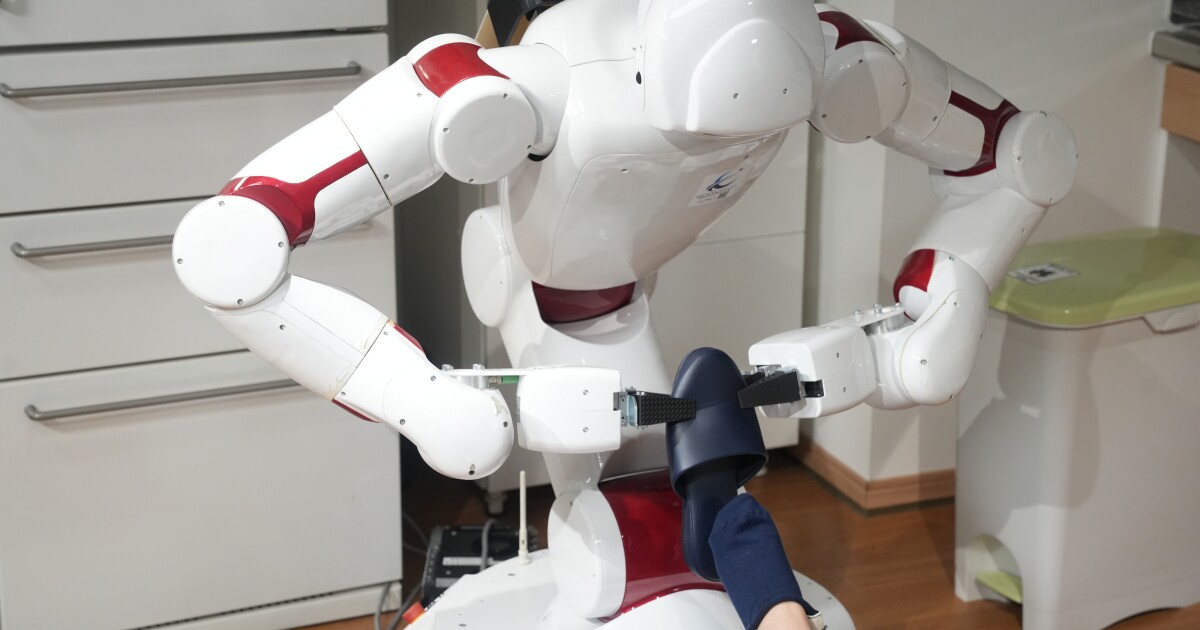
The lab is training another robot to dress people. During a demonstration, the robot successfully placed a sock on Matsumaura’s foot … after a couple of tries.
Miyake acknowledged that although these robots can turn mannequins over in bed and help put socks or slippers on a person, much work remains before this technology could be brought into a real home.
“It’s still challenging for the robot to be implemented in the real domestic environment,” he said.
Kiley Koscinski
/
90.5 WESA
Waseda University’s AIREC cleans a mannequin during a demonstration.
When most people picture Tokyo, they imagine a city pulled from the future: neon-lit skyscrapers, bullet trains whizzing by at 200 miles per hour and robots serving coffee in a corner cafe. It’s no surprise that the city is home to robotics labs tinkering away at tomorrow’s problems with technology being developed today.
Another, less flashy side of Tokyo exists, too. Many businesses, schools and municipal agencies are still using fax machines. Hand-stamped signatures, called hanko, remain a precious tradition. Some shops accept only cash.
As the country runs out of care workers to look after Japan’s super-aging society, could robots step in? Should they?
Miyake does not envision a future where humans play zero role in caregiving.
“Our philosophy is [that the] robot should not be alone … [it] should be with the human caregiver,” Miyake said.
Pittsburgh is not renowned as a cyberpunk mecca like Tokyo. But a similar dichotomy exists in Pittsburgh, as it, too, has a culture characterized by both tech innovation and hesitance to change. Most residents give directions based on landmarks that used to be there, and the city prides itself on its deep working-class roots. Still, Pittsburgh has tried hard to rebrand itself as a technology innovation hub, and even has birthright claims to new tech, including artificial intelligence.
Kiley Koscinski
/
90.5 WESA
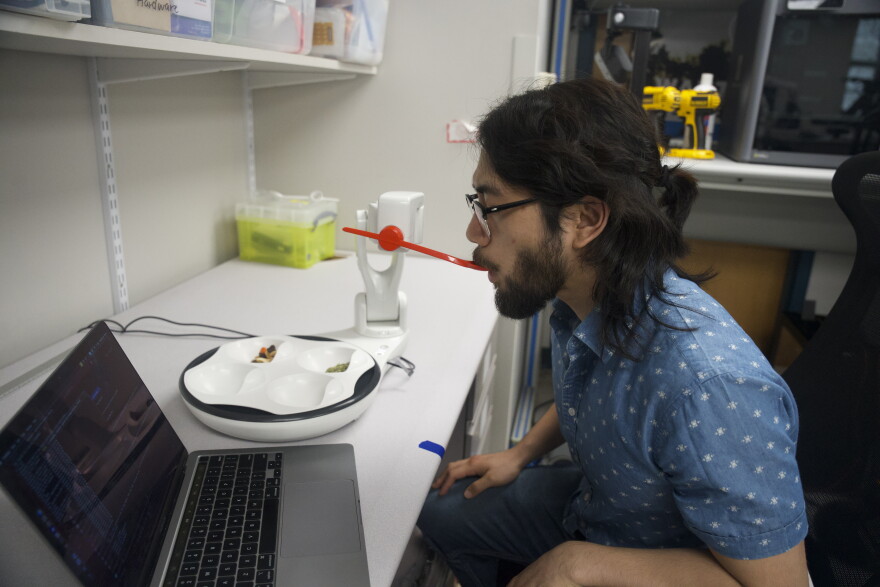
Carnegie Mellon University is developing the latest version of a feeding assistance robot called Obi.
That innovation is on display in a robotics lab at Carnegie Mellon University, where students are also calibrating robots that can feed users and bathe them. Pennsylvania’s aging society is running out of human care workers, too.
Kavya Puthuveetil, a PhD student at CMU, is running tests to update a feeding robot in the lab known as Obi. The robot looks like a cafeteria tray with an arm attached, designed to assist in feeding. Obi responds to voice commands and can scoop a mouthful of food from one of four compartments in the tray.
With a voice command, Puthuveetil asks Obi for a scoop of pumpkin seeds and trail mix. The robot uses ChatGPT to process the command before taking a scoop from one bowl and then the other. Then it brings its spoon to her mouth.
An earlier version of Obi is already on the market, Puthuveetil said. That version uses buttons instead of voice commands. The device costs $12,000 out-of-pocket. But for many people, Obi is covered by their insurance as a medical device, she said.
Zackory Erickson, a robotics professor and head of CMU’s Robotic Caregiving and Human Interaction Lab, sees robots like Obi as tools to ease the burden on family caregivers.
“ I don’t expect robots will be a replacement for human caregivers,” Erickson said. But he said he does see them as an important supplement, especially amid a human labor shortage.
Kiley Koscinski
/
90.5 WESA
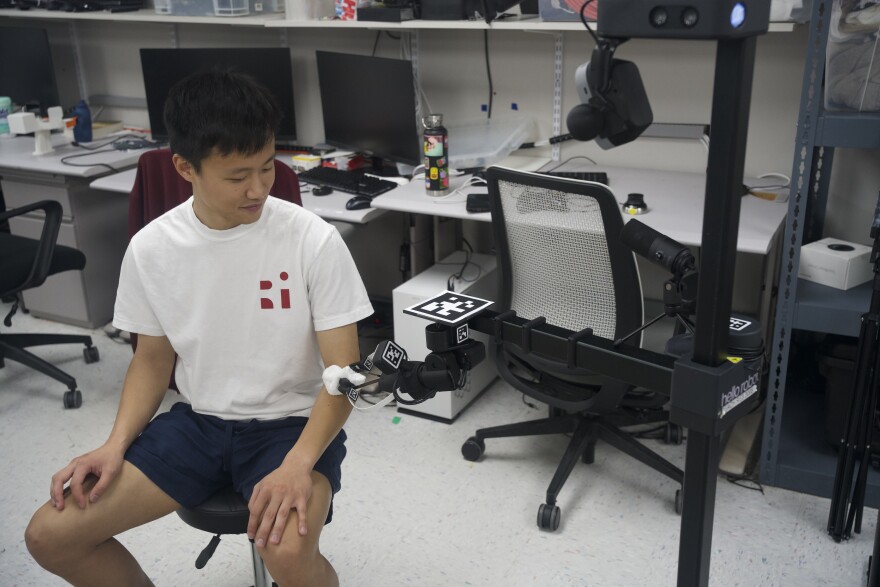
Carnegie Mellon University PhD student Junxiang Wang demonstrates a cleaning robot.
And as family members carry more of the burden of caregiving, some seniors are being cared for by their elderly spouses. Nearly 30% of unpaid caregivers in Pennsylvania are age 65 and older, according to federal data.
“Right now … a family member or friend or caregiver essentially does everything,” Erickson said. “If an individual can have a robot in their home … that would give family members the ability to leave … to go grocery shopping or anything that might be falling off to the side because they’re [otherwise] out of time.”
Across the lab, PhD student Junxiang Wang is working on a machine that cleans his arm with a towel. He orients the robot with what looks like an Xbox controller before giving commands. The robot is capable of interfacing with even vague commands.
“I’m not really feeling comfortable,” Wang tells the robot.
“Can you clarify what you’d like me to change?” it asks.
“Can you go slower?” he responds.
This nuance is important because it captures the many different ways someone might ask for the same thing, Wang said.
These Pittsburgh researchers are optimistic about the supportive role robots could play in caring for humans as the global population ages. But like Miyake, they argue that some aspects of caregiving can be done only by a human.
“Being able to meet the person’s needs is a constant moving target,” Puthuveetil said. “And [it] requires a very high level of skill and training and empathy from people to provide that kind of care. I think robots are still a very long way from getting there.”
This story is part of a reporting fellowship sponsored by the Association of Health Care Journalists and supported by The Commonwealth Fund.