
The developer behind seven proposed data centers sued Olyphant on Monday to avoid hearings where the public could challenge its plans.
ERCOR Triboro asks a Lackawanna County Court of Common Pleas judge to compel Olyphant to issue a zoning permit for its Project Triboro data center campus. If a judge agrees, it would bypass the public hearing process mandated by Olyphant’s data center zoning ordinance. ERCOR Attorney Matthew J. McHugh argues that process would unnecessarily delay construction.
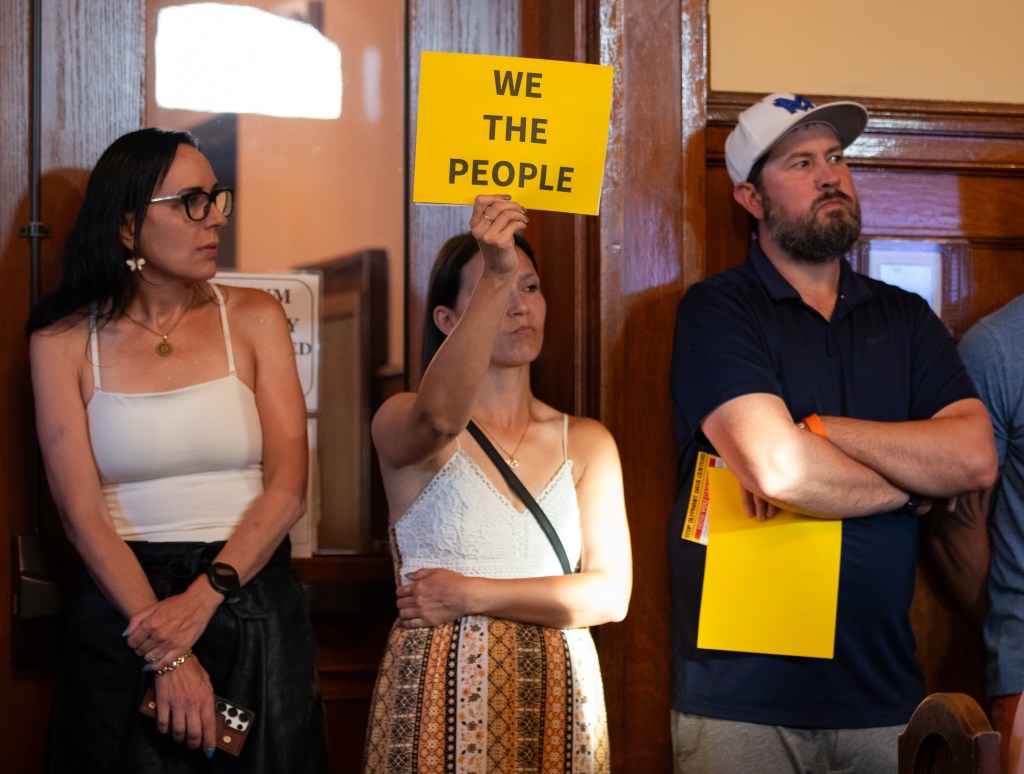
A core member of Olyphant’s burgeoning Stop Olyphant Data Centers movement criticized the lawsuit Wednesday for trying to avoid public hearings. Eva Rappenglueck said the lawsuit only furthers her group’s stance the companies want to take advantage of their town.
“I am disgusted by the level of not only cowardice, but also entitlement that these companies are showing,” Rappenglueck said. “Suing our borough in an effort to avoid a public hearing, which we as citizens have a legal right to, because they don’t want to face the public.”
ERCOR Triboro is a limited liability company operating under St. Louis-based Sansone Group. Sansone pivoted to data centers from previous plans for the Triboro Industrial Park consisting of four 1-million-plus-square-foot warehouses across nearly 471 acres surrounded by the Casey Highway, Route 247 and Marshwood Road.
Project Triboro’s data center plans depict seven buildings and a substation occupying the same footprints as the previously proposed warehouses. There would be two side-by-side data centers per warehouse footprint. The fourth footprint has one data center and an adjacent customer substation. The seven buildings are each two stories tall with 204,500-square-foot footprints, making them some of the largest individual data centers proposed in Lackawanna County.
The site is on the east side of a roughly 1,000-acre area zoned to allow data centers conditionally. Triboro Commerce Park, a firm managed by Charles DeNaples, applied for and withdrew plans for seven data centers on the west half of the property. Sansone bought its land from DeNaples last year for $80 million. DeNaples is the son of Keystone Sanitary Landfill co-owner Dominick DeNaples.
Critical of public hearings
ERCOR’s lawsuit argues that it should be exempt from data center requirements because its original plans predate Olyphant’s legislation regulating the industry, despite changing from warehouses to data centers.
The conditional use process governing data centers in Olyphant requires developers to attend public hearings where they have to testify about their plans and how their project meets conditions established by the borough. Affected residents and attorneys have the opportunity to cross-examine data center representatives, and then present their own case. When testimony concludes, council votes to approve or deny a project.
Impacted parties then have a window to appeal the decision in court, which ERCOR asserts would excessively delay or otherwise harm its project’s construction.
The lawsuit characterizes critics of using public hearings to try to show that data centers are more harmful than they really are.
“Opponents to the conditional use application would then have the opportunity to present evidence and testimony in an attempt to demonstrate that the proposed uses would have some detrimental impact beyond what is normally expected from a data center use,” wrote McHugh, of Philadelphia-based Klehr Harrison Harvey Branzburg.
Olyphant initially gave the project final land development approval in 2022 for a 4.5-million-square-foot warehousing/distribution park.
McHugh argues land development approval is tied to the ordinances in effect at the time of its filing and protected against subsequent changes.
That means an ordinance the borough adopted in April amending its zoning to include data centers has no effect on the land development approval or zoning permit application, according to the lawsuit.
Because Olyphant’s prior zoning did not include data centers, ERCOR contends its data centers should be permitted by right, skipping the conditional use process. The filing compares data centers to other permitted uses in the zoning district.
‘These companies are predatory’
Olyphant residents have raised more than $5,400 to fund their legal defense against data centers, modeling a nearby opposition group in Archbald.
The Archbald group used its fundraising to pay for an attorney to represent them at public hearings, cross-examining data center witnesses and eventually presenting their case about why Archbald should reject various data center campuses. Group members also obtain their own party status to participate in hearings.

Attorney Justin Richards, representing Archbald residents opposing data centers, questions Essential Energy LLC’s sound expert during a conditional hearing on Monday, June 22, 2026, at the Valley View High School in Archbald. (FRANK WILKES LESNEFSKY / STAFF PHOTO)

Stop Archbald Data Centers co-founder Tamara Misewicz-Healey cross-examines a data center representative during a conditional use hearing at the Valley View High School auditorium in Archbald on Thursday, June 18, 2026. (FRANK WILKES LESNEFSKY / STAFF PHOTO)
Show Caption
1 of 2
Attorney Justin Richards, representing Archbald residents opposing data centers, questions Essential Energy LLC’s sound expert during a conditional hearing on Monday, June 22, 2026, at the Valley View High School in Archbald. (FRANK WILKES LESNEFSKY / STAFF PHOTO)
If Project Triboro is successful in court, Olyphant residents won’t have that opportunity.
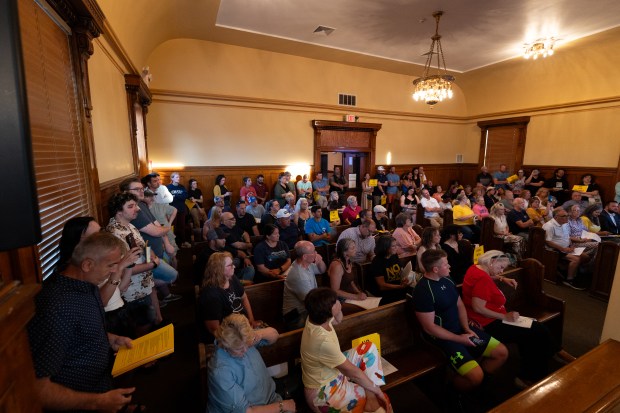 Residents pack Olyphant’s council chambers for a meeting on Tuesday, June 9, 2026. (FRANK WILKES LESNEFSKY / STAFF PHOTO)
Rappenglueck criticized developers for acting “as though they are entitled to take and use our entire mountain and our resources without any semblance of effort put back into our community.”
“This only furthers our stance that these companies are predatory and looking to take advantage of our town. They have absolutely nothing of value to offer us in exchange for the incalculable health, environmental and financial hazards they will bring us,” Rappenglueck said. “Now more than ever, we, as a community, need to rally together, show up to these meetings, and let them know they are not welcome here.”
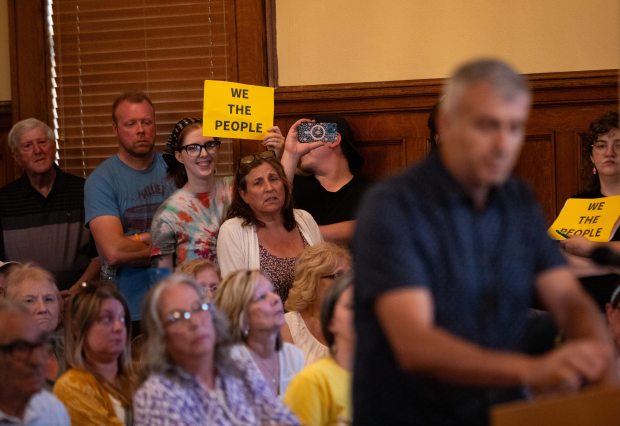 Olyphant resident Eva Rappenglueck, a core member of the Stop Olyphant Data Center movement, holds a “We the People” sign and reacts to public comment during a council meeting in the Municipal Building in Olyphant on Tuesday, June 9, 2026. (FRANK WILKES LESNEFSKY / STAFF PHOTO)
Lawsuits reference botched vote
Olyphant Borough Council unanimously voted June 9 to settle a lawsuit with DeNaples’ Triboro Commerce Park. Both that lawsuit and ERCOR Triboro’s involve borough council’s bungled attempts to amend its zoning to regulate data centers.
Municipalities in Pennsylvania must allow for every lawful land use somewhere within their boundaries. Olyphant’s zoning did not include data centers, which exposed it to legal challenges for excluding the use.
Council considered adopting a data center zoning ordinance during an April 14 meeting, voting on it twice with different outcomes. The ordinance designates data centers as conditional uses, requiring public hearings for any proposal.
Council initially voted 4-3 to adopt the ordinance. Amid noise and confusion, council voted a second time, but one member changed her vote, denying the ordinance. Council then voted to declare its own ordinance invalid for excluding data centers in an attempt to give itself a six-month window to further refine its data center regulations in response to community opposition.
Triboro Commerce Park’s lawsuit asked a judge to honor council’s initial vote to amend its zoning. Olyphant settled the lawsuit by confirming data centers as conditional uses subject to public hearings.
ERCOR does not want those standards applied to its property.
It submitted a zoning permit application for Project Triboro on April 22. Because of the uncertainty surrounding council’s April 14 decision, zoning officer William Shigo, who is named as a defendant in the lawsuit, sent ERCOR a letter May 21 citing the borough’s decision to invalidate its zoning for excluding data centers.
If a land use is not included in Olyphant’s zoning ordinance, the zoning officer has discretion to determine whether there is a materially similar use that could apply. Shigo concluded there were no other uses that applied to data centers. The developer disagrees.
Shigo told the developer he would present their application to Olyphant’s zoning hearing board to consider it as a special exception. Hearings for special exceptions follow the same process as conditional uses, but the zoning hearing board has the final say, rather than borough council.
A week after council settled the DeNaples lawsuit, Shigo sent ERCOR a second letter withdrawing his previous determination. The new letter recognized that the data center zoning amendment was in effect, which meant Project Triboro would have to comply with all applicable ordinance requirements, including receiving conditional use approval.
Mid Valley School District joins data center battle
As Olyphant navigates its first legal challenges surrounding data centers, the Mid Valley School District unanimously voted Monday to join the data center fight in Olyphant and Throop, Director Gerald Luchansky said.
“(Olyphant) made a mistake when they made that footprint so big for those data centers,” said Luchansky, who is also a member of Olyphant’s planning commission. “They decided that they’re going to open the whole rest of that mountain up almost from Jessup to Throop.”
The resolution describes the proximity of an industrial-scale data center to Mid Valley’s elementary and secondary centers in Throop, which house about 2,200 students and faculty. It defines the school board’s role to provide children with a safe, healthy and conducive environment for their education.
The document lists the large number of cooling systems needed to cool data centers, which can produce “unrelenting, low-frequency acoustic noise” exceeding 65 to 90 dBA. It also references peer-reviewed studies showing the health impacts of continuous low-frequency noise on children, as well as the health impacts on kids if they breathe the emissions from the fleets of backup diesel generators at data center campuses. One campus alone can have hundreds of bus-sized generators that require regular testing and maintenance.
The resolutions sent to Olyphant and Throop include various demands and stances, including:
• Designating all district properties, buildings, athletic fields and playgrounds as sensitive receptors, requiring the highest tier of protections.
• Strict municipal performance standards, like mandatory minimum setbacks from school property lines; a strict noise limit capping data centers at 50 dBA at school property lines, verified by an independent, continuous third-party monitoring system paid for by the developer; and limiting backup diesel generators to the strictest emissions standards available, or mandating zero-emission battery storage.
• Authorizing Mid Valley to legally intervene in all planning commission, zoning hearing board and conditional use hearings for data centers; the district plans to retain independent acoustic engineers and pediatric health experts to cross-examine developers.
• Opposing any state-level preemption programs or incentives, including Gov. Josh Shapiro’s recently released Governor’s Responsible Infrastructure Development (GRID) Standards, unless the developer enters into a community benefits agreement directly with the district that fully abates all acoustic and environmental health risks.
Directors moved to send letters to officials in both Olyphant and Throop notifying them of their stance, Luchansky said. Throop is currently in the midst of amending its own zoning to regulate data centers as conditional uses across 440 acres of environmental conservation-zoned land directly across the Casey Highway from the Keystone Sanitary Landfill. The legislation would apply a slew of restrictions to the industry.
Although Dickson City is navigating proposals for four data centers and three power plants, Luchansky said the district has less of a connection with the borough because its schools are in Throop. Olyphant’s data centers would also be closer to Mid Valley’s schools than those proposed in Dickson City.
Luchansky said he’s been closely watching the Valley View School District, whose directors similarly voted to oppose data centers in their district on June 1. In just over three weeks, Valley View’s attorneys at the Joyce, Carmody & Moran PC law firm have filed multiple legal challenges against data centers in county court. The attorneys also gained legal standing at multiple conditional use hearings for data center campuses and a related power plant in Archbald, using the standing to press data center developers on how their projects will impact students.
Luchansky expects to follow suit with Valley View.
He worried about the impacts of data centers on students and quality of life.
“You’re putting kids, a couple generations of kids, plus all that entire staff, possibly in harm’s way,” he said.
— FRANK WILKES LESNEFSKY