
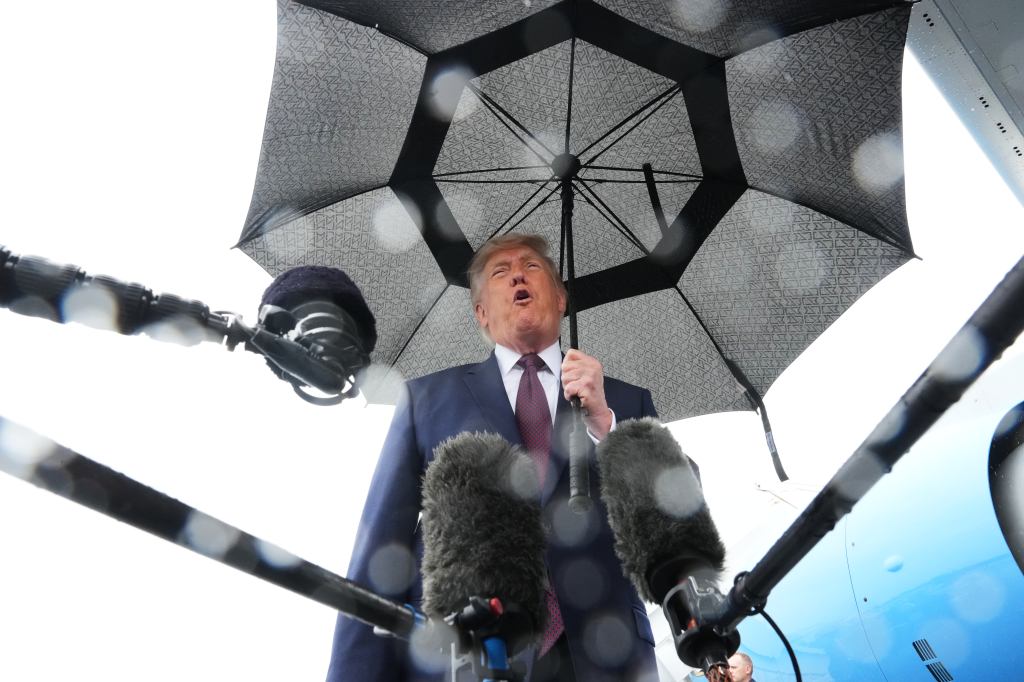
Since the beginning of the nuclear age, the Bulletin of the Atomic Scientists has set a symbolic Doomsday Clock representing how close humanity is to self-destruction. I believe it should be set back a couple of minutes. President Donald Trump stopped a fanatical group in Iran from building a nuclear weapon; he prevented the potential annihilation of hundreds of thousands, or even millions, of people.
Regardless of whether one likes or dislikes the president, he saved lives. Let’s recognize his accomplishment.
— Roberto L. Garcia, Chicago
Don’t rush to judge Iran deal
One has to wonder why there is such a rush to judgment regarding the terms of the Iranian peace deal. Wasn’t virtually everyone clamoring for an end to the war?
I am very skeptical of Iran’s willingness to abide by the terms of any agreement; however, I am willing to wait until the final terms are settled before casting judgment. I would urge all parties to stop the political posturing and to save their criticism until the agreement is finalized.
I for one do give President Donald Trump credit for dealing with a dangerous adversary. Perhaps we should wait to judge and hope for the best.
— Dan Schuchardt, Wheaton
Memorandum is not peace
The memorandum of understanding signed by the U.S. and Iran is full of holes like Swiss cheese, which Iran can use to evade sanctions, to slow-walk the ultimate fate of its enriched uranium, and then hem and haw on more substantive later negotiations. It is President Donald Trump’s capitulation to Iran as he tries to dig himself out of the hole he blundered into because of the monumental intelligence failure by the U.S. and Israel.
Now Trump’s imperative is to improve the public’s perception of his leadership in advance of the midterm elections. The agreement is a truce, which means the end of shooting and bombing. But it is not the same as peace.
Iran will remain the one country in the region that has been stirring the pot of conflict for decades. The agreement is like the phony “peace for our time” declaration of British Prime Minister Neville Chamberlain after meeting with Adolf Hitler in 1938, which did nothing to prevent the cataclysm of World War II.
— Ronald Kallen, Highland Park,
Trump has created a swamp
President Donald Trump came to Washington to drain the swamp, and now he has created one of his own, the reflecting pool on the National Mall, easily seen by President Abraham Lincoln, the nation and the world.
— William Cragg, Oak Park
Flooding on Southwest Side
The denial of Federal Emergency Management Agency assistance for last summer’s flooding feels deeply unfair to residents of Garfield Ridge and other hard-hit Southwest Side neighborhoods.
Many of us are city employees who are required to live in Chicago because of residency requirements. We cannot simply move to suburbs with newer infrastructure or areas less prone to sewer backups. Yet we are expected to absorb the financial consequences of a failing system over and over again.
In the past decade, countless homeowners have had to completely gut and rebuild their basements two or even three times. Who has the money for that? And that doesn’t even begin to account for the loss of irreplaceable personal property, the cost of mold remediation and the emotional toll of living with constant uncertainty.
We are repeatedly told that homeowners should install backflow valves, disconnect gutters and take other preventive measures. Many of us have done exactly that. But even people who invested in a costly backflow valve had it still fail during last July’s storm because the water pressure was simply too extreme. When floodwaters are powerful enough to blow manhole covers and massive deep-tunnel grates out of the ground along 59th Street, it is time to admit that individual homeowner solutions are not enough.
The problem is also compounded by decades of development patterns in neighborhoods such as Garfield Ridge. Many properties have concrete backyards that prevent water from being absorbed naturally into the ground. Instead, stormwater is funneled directly into an already-overwhelmed sewer system, making severe backups even more likely during heavy rain events.
These homes remain vulnerable because the infrastructure cannot handle increasingly intense storms. Residents now experience anxiety during even moderate rainfall, wondering if raw sewage will once again back up into their homes.
If these neighborhoods are destined to flood repeatedly despite every precaution, then government leaders need to consider larger solutions. One option would be to buy out the most vulnerable properties and convert the land to wetlands or marshland that can absorb stormwater and reduce future flooding.
This is not a one-time disaster. It is a recurring crisis. Garfield Ridge residents do not have unlimited resources to gut and remodel their basements every few years. We pay our taxes, follow residency requirements and do our part.
We deserve meaningful action from the city and, especially, not another FEMA denial.
— Jeannie Adair, Chicago
Real celebration was June 18
The editorial “How to enjoy America’s 250th birthday” (June 21) sums up what a lot of folks are feeling this year (and have been for a while). We are fed up with the temper tantrums of the 47th president and his constant attempts to inflate himself by denigrating others. We are sick and tired of the three branches of government dismissing or outright ignoring the Constitution. So forget the UFC-on-the-White-House-lawn debacle. Ignore the rallies by President Donald Trump coming up that are supposed to celebrate the U.S.
But the Tribune Editorial Board fails to make note of what was, in effect, an actual celebration of what makes this country worthy of celebration.
All the real patriots realize that the event on June 18 was the true celebration of what this nation is (and should be) all about. It’s about supporting all the people who live here, lifting up those who need to be lifted up and taking care of our neighbors (and they’re all our neighbors!).
The Obama Presidential Center celebration brought tears to many — and hope of who we can truly become!
— Barbara Wahler, Chicago
Questions for 250th birthday
In a June 21 editorial, there is one line that could have easily been glossed over. Gerald Ford as president is quoted as saying, “It is fitting that we ask ourselves hard questions even on a glorious day like today,” referring to July 4, 1976, our country’s bicentennial celebration.
And now, 50 years later, I have been pondering that exact same question, asking myself hard questions about our country’s 250th birthday. Advertising campaigns are noting “250 years of freedom.” And I have to ask myself: Freedom for whom? Freedom from what?
For the First Nations people and all Indigenous peoples who lived and prospered on this land long before invaders from Europe arrived, what has 250 years of freedom looked like?
Men, women and children were kidnapped from their homes in Western Africa and enslaved in the United States of America to feed the burgeoning desires of a growing country. Has there actually been 250 years of freedom for enslaved people and their descendants?
For the men, women and children who continue today to be victimized by racial, religious, ethnic and cultural domestic terrorism and hate crimes, what does 250 years of freedom feel like?
I believe that this July 4 should be a day for celebrating that we continue the daily struggle to form a more perfect union. We should champion the discoveries made by enslaved people, Indigenous people and immigrants who have helped make this country great. And we should continue asking ourselves hard questions to reckon and reconcile with our own challenging history so that we can continue to build a country based on welcoming and belonging in order to form that more perfect union.
— Patricia Kluzik Stauch, Elgin
Note to readers
Bike lanes in Chicago inspire a lot of passion. We’d like to hear your thoughts. Do you support bike lanes? Or are you opposed? Whether you’re for or against, do you have advice for the city on its approach? Send a letter of no more than 400 words to letters@chicagotribune.com by Wednesday, July 1. Include your full name and city/town.
Submit a letter, of no more than 400 words, to the editor here or email letters@chicagotribune.com.