
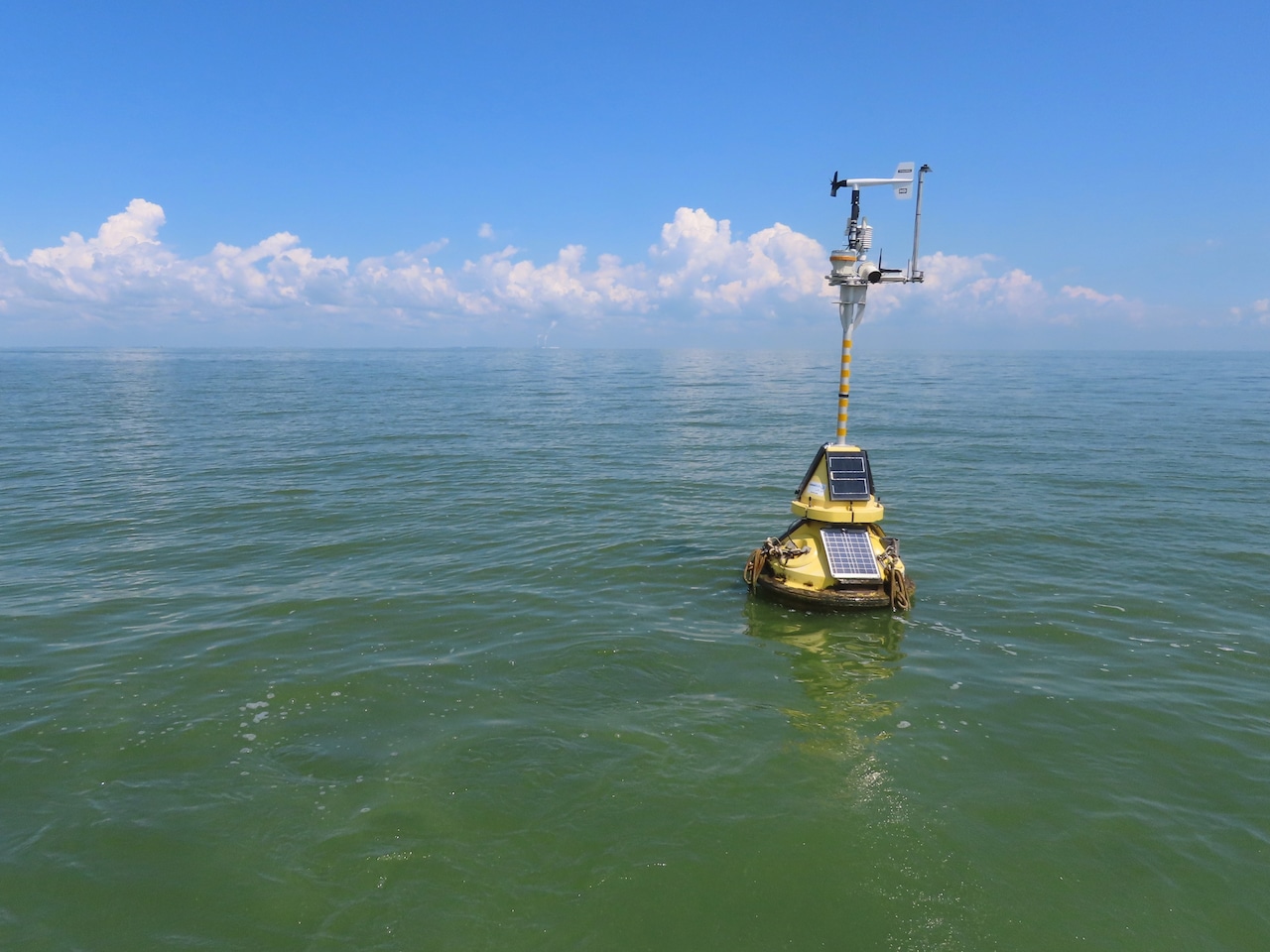
PUT-IN-BAY, OH — Scientists say western Lake Erie narrowly avoided a much larger surge of nutrient runoff this spring after the heaviest spring rains missed the Maumee River watershed, likely holding harmful algae to moderate levels this summer.
On Thursday, June 25, federal forecasters predicted that western Lake Erie will experience a moderate harmful algal bloom this summer, assigning it a projected severity of 3.5 on a 10-point severity index.
The projection has a likely range between 3 and 4.5. If that forecast holds true, it would make the annual bloom stronger than last year’s unusually mild bloom, but roughly comparable to conditions seen in 2024.
But the lake nearly faced a far worse scenario.
A single early April storm delivered about 60 percent of this spring’s bloom-fueling phosphorus load, scientists said. But the lake nearly faced another major hit in May, when heavy rains that caused flooding elsewhere in Ohio largely missed the Maumee River watershed. Had that precipitation tracked further north, the amount of phosphorus runoff would have severely worsened the algae outlook.
“This area missed something that would have been historically bad. We are very fortunate by that,” said Rick Stumpf, an oceanographer who leads Lake Erie algae forecasting at the National Oceanic and Atmospheric Administration (NOAA).
“We really did dodge something up here in May,” he said.
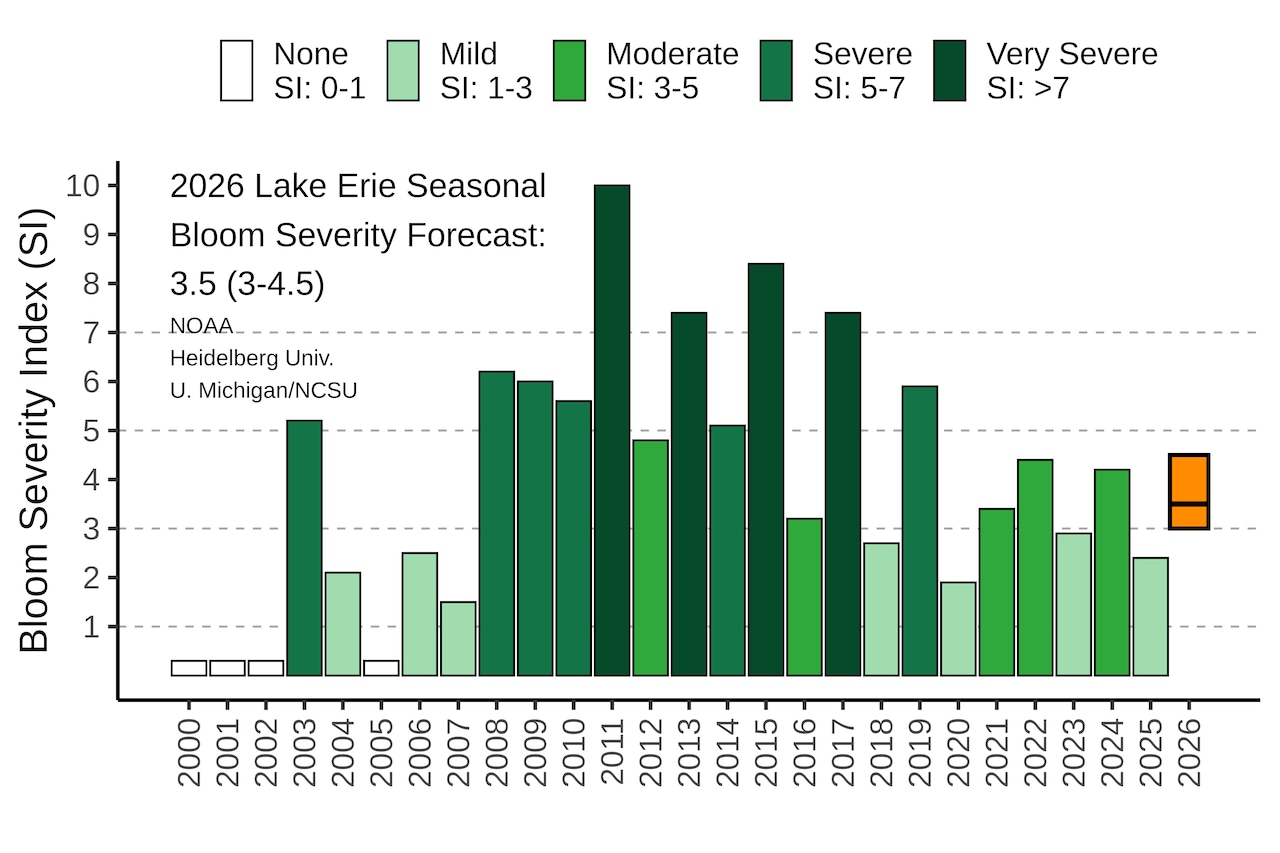 A “moderate” bloom is expected this summer.NOAA/Heidelberg Univ./Univ. of Michigan/NCSU/)
Environmental groups say another moderate bloom is not evidence of meaningful progress — and that one storm delivering most of the phosphorus needed to fuel the bloom underscores how heavily Lake Erie remains dependent on short-term weather patterns.
The Alliance for the Great Lakes on Thursday argued the region’s bloom reduction strategy remains fundamentally flawed because states continue emphasizing voluntary conservation programs without stronger regulatory and accountability requirements.
Thursday’s forecast comes months after Ohio, Ontario and Michigan missed a 2025 deadline set under the 2015 binational Great Lakes Water Quality Agreement calling for a 40 percent reduction in phosphorus pollution entering Lake Erie.
More: Michigan algae report shows no turning point
It also follows Ohio lawmakers approving a new two-year state budget this month that cuts funding for the state’s flagship water quality initiative, H2Ohio, by roughly 39 percent — reducing from about $270 million proposed by Gov. Mike DeWine to roughly $165 million.
“We simply cannot accept harmful algal blooms as the new normal in Lake Erie,” said Joel Brammeier, president and CEO of the Alliance for the Great Lakes. “It’s time to get serious about stopping the pollution that causes blooms at the source.”
A moderate bloom this summer would follow one of the mildest bloom seasons in a decade, when the severity only reached 2.4 last year.
Mild conditions and a downward trend in dissolved reactive phosphorus (DRP) — the bioavailable form most readily used by cyanobacteria — have fueled optimism among farmers who have attributed the improved lake conditions to subsidized efforts to reduce nutrient loss by using cover crops and changing tillage practices.
But researchers warn that bloom severity still tracks closely with spring weather and river discharge even as some nutrient indicators show tentative improvement from conservation farming.
Algae forecasters began warning in May that a wet spring had the potential to elevate algae risk after heavy rains soaked northwest Ohio and northeastern Indiana.
According to the Midwest Regional Climate Center at Purdue, precipitation across much of the Midwest during the first week of April was 300- to 400 percent above normal, with some areas over 500 percent. That erased drought conditions in northwest Ohio.
The Maumee River, which drains heavily agricultural land in northwest Ohio, northeast Indiana and southeast Michigan, contributes roughly half of the phosphorus entering western Lake Erie — making it the dominant driver of annual bloom formation.
According to scientists at Heidelberg University, most of the phosphorus expected to fuel this summer’s algae bloom came from one storm.
Nate Manning, director of water quality research at Heidelberg, about 60 percent of this spring’s total bioavailable phosphorus load came from an April 2-4 storm. That was enough to push the lake back toward a moderate algae season after last year’s mild reprieve.
Had major spring rains pushed further north, Manning said nutrient loading would have tracked closer to 2019 levels, which produced the fifth most severe bloom since 2000.
“We did, in that sense, dodge a bullet,” he said.
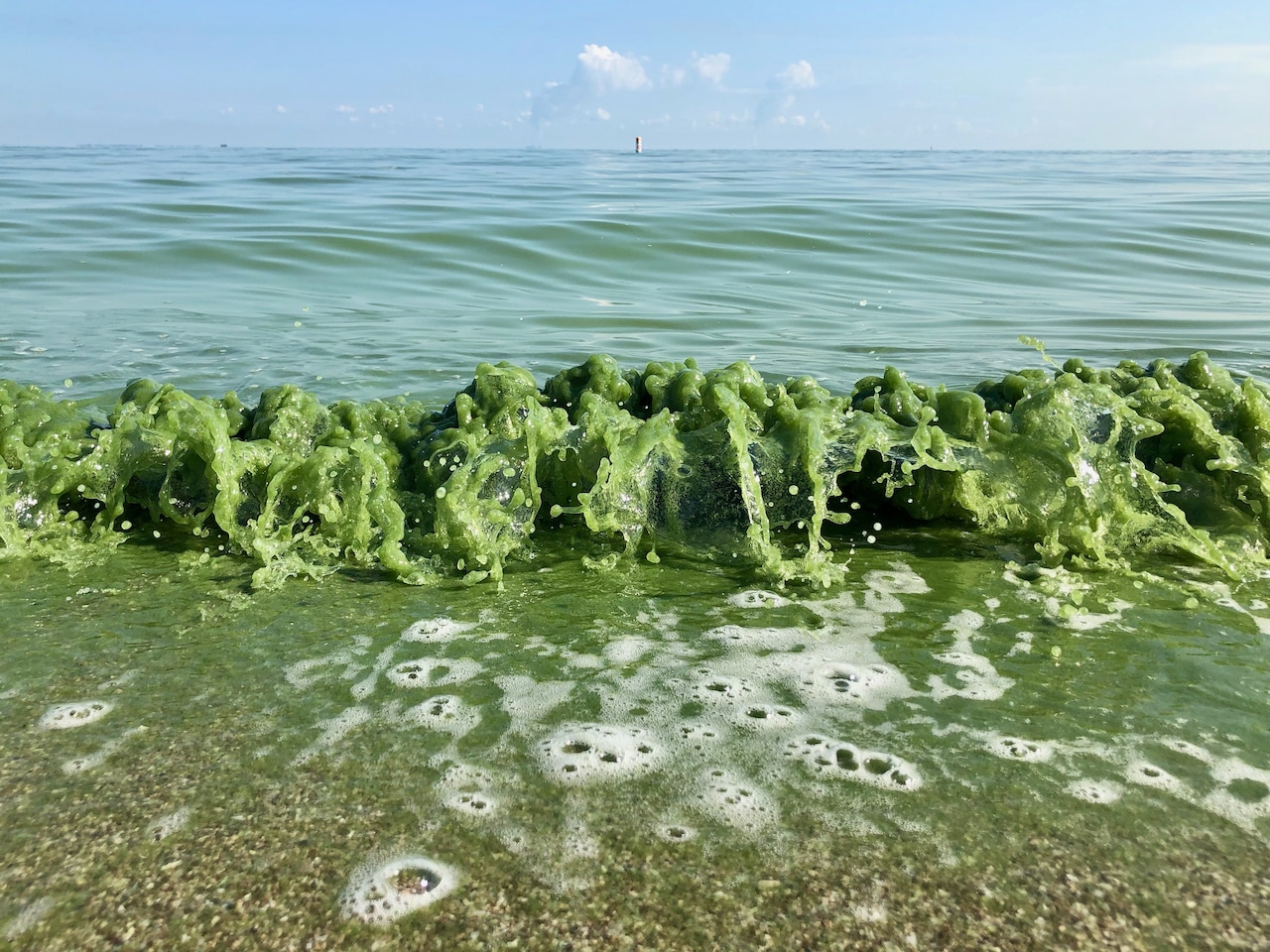 Toxic cyanobacteria from a harmful algal bloom (HAB) turn western Lake Erie water green at the Maumee Bay State Park beach in Oregon, Ohio on Aug. 7, 2019.
The bloom is filled each year with microcystin, a liver toxin that can sicken humans and animals — particularly dogs, which are sometimes killed by swimming in scum-covered water.
The algal toxins pose a risk to drinking water systems such as Toledo, which draws water from an intake in Lake Erie. Research shows that algal toxins deposited by waves can concentrate on the beach and persist for almost a month. Waves and wind can also aerosolize cyanotoxins, creating an exposure route for people who aren’t exposed to lake water.
According to Stumpf, the bloom should begin in July, intensify in August, stay mostly in the western basin and continue into September with a duration depending on weather fronts.
He stressed that bloom location changes with wind. In 2022, the peak was pushed closer to the Michigan coast while in 2024 it was more along Ohio and farther into the basin.
Officials warned that bloom severity measures biomass, not toxicity. Cyanobacterial toxins can become highly concentrated in surface scum that forms during calm weather.
Stumpf warned people to keep pets and children away from green water.
“I can’t emphasize enough — the scum has phenomenally high toxin levels,” he said. “It can be concentrated 100- to 1,000-fold.”
“Keep your kids, your pets, your dogs out of scum,” he said,
“People think their dogs are indestructible,” he said. “They do die from this.”
Forecasters cautioned that the modeled outlook assumes relatively normal rainfall through July and warned that heavier summer storms could still worsen bloom conditions before algae reaches peak growth.