
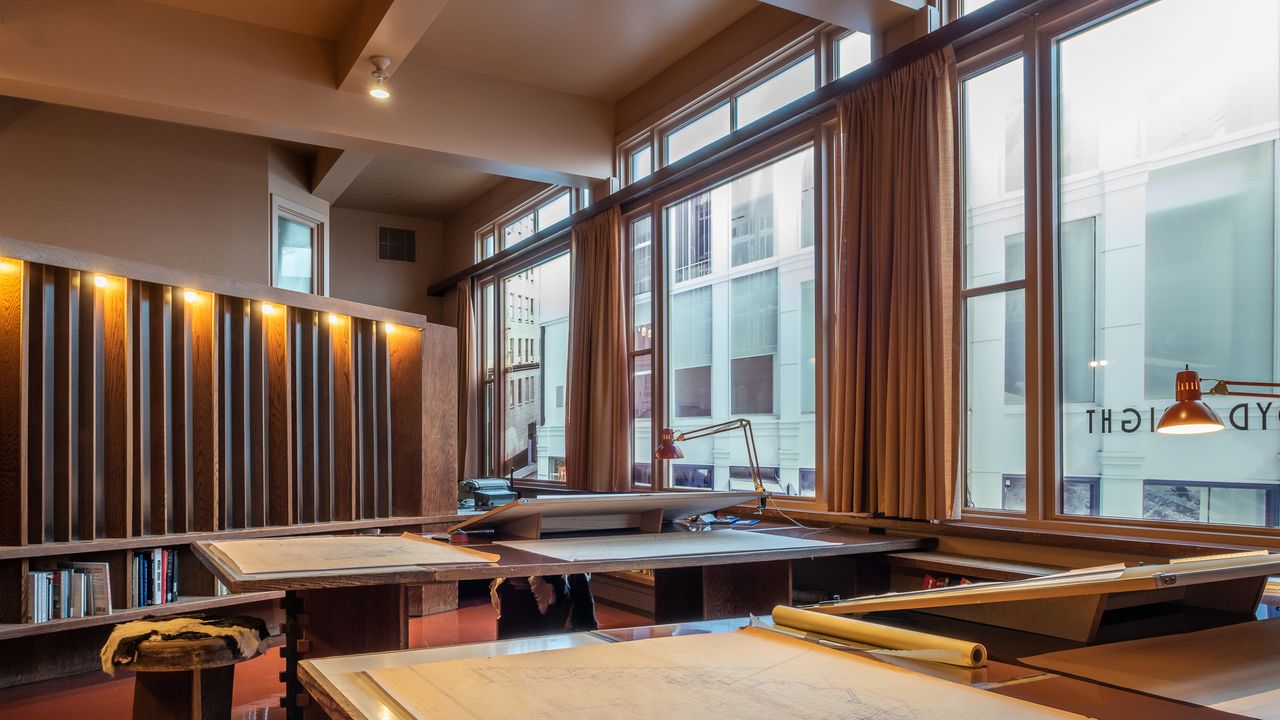
The Frank Lloyd Wright San Francisco Field Office arrived at the Hagen History Center in Erie, Pennsylvania, much like flat-pack furniture: as plywood planks in boxes. It was 2020, and what was once the workspace of America’s most famous architect had spent the past 30 years tucked away in a Buffalo, New York, storage space. “The office has this long circuitous path of how it ends up in Erie, Pennsylvania,” says Caleb Pifer, the president and CEO of the Hagen History Center. “But the spoiler is we saved it.”
Today, the history center is opening the Frank Lloyd Wright Field Office Museum, a 3,000-square-foot immersive education center with Wright’s former field office, reconstructed in a purpose-built space designed by Kidder Architects, at the heart of the structure.
In 1951, Wright, busy with California commissions, decided to open a workspace in the state with one of his associates, Aaron Green. “He took the second floor of a building that existed in San Francisco, and with redwood plywood designed one of the most beautiful spaces you’ve ever been in,” explains Mark Schmitz, a member of the Board of Trustees for Taliesin Preservation and founder of design firm Zebradog, which worked on the field museum. “The office is largely self-supporting, as it sits on the original floor plate without needing to be structurally supported by the walls of the room.”
Wright worked in the office throughout the 1950s—his only formal workspace outside of his own homes, Taliesin, Taliesin West, and his Chicago residence. It was often a private space for the architect, though he likely hosted clients there occasionally. Following Wright’s death in 1959, Green continued to use the space for another two decades until closing it in 1988.
.jpg)
A soundscape with a ringing phone and talking voices plays while visitors tour the office. “It’s as if all of the draftsmen had just gotten up and went to lunch and you walked in,” Schmitz says.
Photo: Courtesy of the Frank Lloyd Wright Field Office Museum
“Aaron Green knew the star power of the office, so he had it taken apart, board by board. Everything was tagged, cataloged, and crated so that it could be saved,” Pifer explains. The office spent the next decades between museums and private collections, only briefly on display to the public in the ’90s at Heinz Architectural Center at the Carnegie Museum in Pittsburgh, Pennsylvania.
During its stint in the public eye, the workspace was rebuilt behind glass. So when it was acquired by the Hagen History Center, the team was eager to create something visitors could fully experience. In 2021, they finished reconstructing the office, and now, the space is reopening with additional experiential exhibitions designed by Zebradog. “We took the actual artifact and brought it to life by designing an entire story around it and soundscape inside of it,” Schmitz says. Guests will hear the shuffle of San Francisco outside the windows, phones ringing, and the lingering voices of apprentices or other clients.