
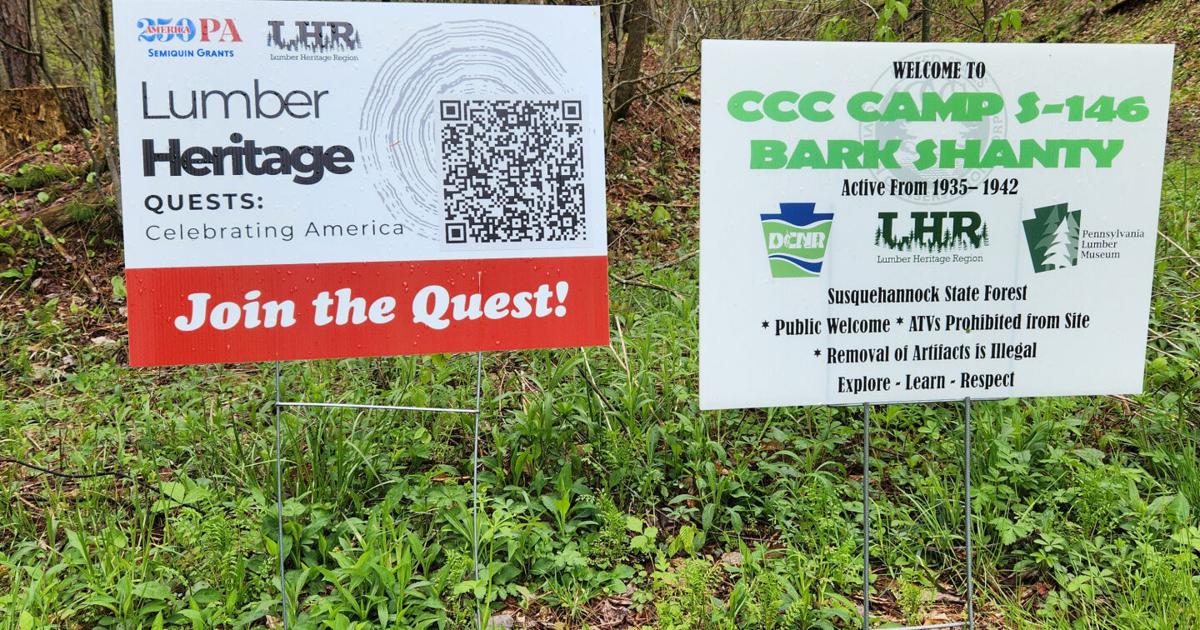
Pennsylvania’s Northern Tier is home to the Lumber Heritage Region. Fifteen counties make up the area which covers 4.2 million acres of forested land, streams and rivers, and primarily small towns that dot the landscape. The forested areas have a rich history of supporting a sustainable logging and timbering industry.
By the 1920s, most of the old growth forest had been harvested and conservation efforts leading to reforestation began. As a result, the hills and valleys across the region are being harvested with sustainable harvest practices applied.
Today, visitors are drawn to the area for a number of reasons. State parks and seasonal camps draw in anglers and hunters alike, providing accommodations nearly year-round. Couple that with casual visitors and the area becomes a hotspot for those who enjoy the outdoors.
But there’s more.
The area provides a variety of exceptional hiking trails. The PA Lumbering Museum is another favorite. This facility is built around exhibits of logging history, complete with a logging town and mill pond.
The Kinzua Bridge State Park is home to a museum and skywalk overlooking a historic viaduct. Add to the experience Pine Creek Gorge, Cook Forest State Park, and breathtaking overlooks that provide beautiful vistas and views. With so much to choose from, where do you start?
To celebrate America’s 250th anniversary, the Lumber Heritage Region is offering a really neat Recreational Quest Program.
The Lumber Heritage Quest provides points of interest to be explored. Along the way you will uncover fascinating facts and connect with the people, places, and events that left their mark on the Lumber Heritage Region.
OK, so where do you start? First, log onto: lumberheritage.org/celebrating-america/
The online information provides a starting point for adventure. Areas of interest can be easily located.
For those who are not computer savvy, my suggestion is to visit the PA Lumbering Museum. Their facility is located off Route 6 east of Coudersport. Ask for the Lumber Heritage Quest’s pamphlet.
On your excursion you’ll find several site locations of CCC Camps.
The Civilian Conservation Corps was a public work program for unemployed and unmarried men between the ages of 18-25.
The program was part of Franklin D. Roosevelt’s New Deal program.
During the time of the CCC, work on lands owned by federal, state, and local governments was done by CCC volunteers. They planted nearly three billion trees to help re-forest America. Also, a number of national parks were upgraded. Within Pennsylvania, most state parks were updated and improved. Also, forest fire suppression methods were improved, and a number of public roadways were built to access remote areas.
Interestingly, going back several decades, Bob Clark hunted out of our camp in Potter County. While driving to one of our hunting spots, Bob noted that a CCC Camp was located in the area. And within a portion of that camp, German POWs were housed.
Bob has recently passed away; however, that conversation never left me. Later I learned his statement was true while I was taking part in a tour of the Bark Shanty CCC Camp.
While on site, the question of POWs housed at the site was posed to the leader of the tour, and he confirmed Bob’s account.
Today the night sky at the Bark Shanty site becomes really dark. Our guide noted records indicate that on occasion only a few POWs would walk away. But due to the area being sparsely populated and the dark skies at night, those who “escaped” did not stay away too long and made their way back to confines of the camp.
Over the past several months a number of groups have volunteered to clean up the area where the camp once stood. It’s a neat place to visit, and one of many waiting to be explored.
q q q
Charlie Burchfield is a past president of the Pennsylvania Outdoor Writers Association an active member of the Professional Outdoor Media Association and the Mason Dixon Outdoor Writers Association. To contact Gateway Outdoors the e-mail address is gwoutdoors@comcast.