
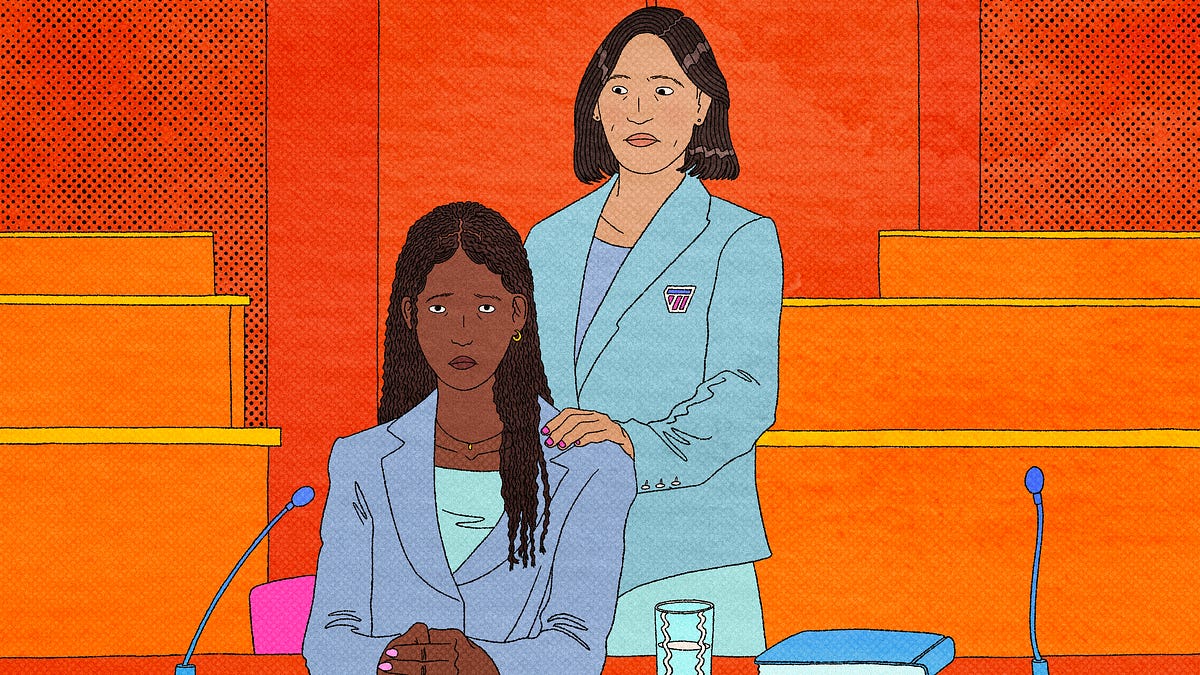
 Illustration by Casey Beifuss
Minors are the canaries in the coal mine: their rights—to abortion, to gender-affirming care—are always the first on the chopping block, often under the guise of warped ‘parental rights’ concerns. In too many states, minors must obtain parental consent to access abortion. But what about when the minor seeking care already is a parent, themselves?
Christine Castro, a Pennsylvania-based reproductive justice attorney, specializes in judicial bypass—the dehumanizing legal procedure through which minors seek permission from a judge to access abortion by proving they’re ‘mature’ enough. In Pennsylvania, minors must receive parental consent or a judge’s permission for care. But paradoxically, Castro tells Abortion, Every Day, her clients, who are most often ages 16 to 17, sometimes already have a baby. Despite being parents themselves, they still, inexplicably, need either a parent or judge’s permission to access health care.
“That’s how badly the law is written—they’ve already gone through pregnancy and childbirth, they can make medical decisions for their children, but not themselves.”
The premise of judicial bypass, itself, is downright puzzling, entirely rooted in stigma rather than logic. If someone isn’t ‘mature’ enough for an abortion, how do you argue they’re ‘mature’ enough to parent? In 2022, one Florida judge denied a teen abortion access over her C-average grades.
In other cases, when parents do support their child’s abortion or try to help them access care, Child Protective Services might investigate and separate them, or the parents might be accused of ‘coercion’ and criminalized, as we’ve seen in Louisiana.
Minors systematically face a convalescence of specific, devastating barriers to care, lacking money or literacy in navigating complex health and legal systems. Many of Castro’s clients are juggling all kinds of extracurriculars, jobs, classwork, babysitting their siblings, or even household abuse; some aren’t in contact with their parents at all, and some have parents who are incarcerated or dead.
Yet, all too often, Castro says she’s watched as reproductive rights advocates make concession after concession on young people’s rights to anti-abortion and ‘parental rights’ groups. “What we need is to center those at the margins. What we need is to center young people,” she tells AED.
Here’s AED’s conversation with Castro on what an average judicial bypass case entails, her clients’ stories, what’s bringing her joy through this work, and more.
AED: How did you get involved in abortion / reproductive justice?
CC: I’m a senior staff attorney at the Women’s Law Project where I’ve been for 10 years. Before that, I’ve worked with New Voices for Reproductive Justice and If/When/How. I always knew I wanted to use my legal career for social justice. Being raised in Pennsylvania, I’ve always seen the clever ways our state overregulates abortion in a way that, on the surface, looks reasonable. I was drawn to youth access because they’re this group at the margins, and there are these concessions that are often made on their behalf that don’t actually reflect their real needs. And, all too often, this can come down to which county you live in in this state and the judge there.
AED: Where were you when Roe was overturned? How did that affect the kind of work you wanted to do?
CC: I was in Pennsylvania. I was helping someone under 18 from another state, in Ohio, where we didn’t know a six-week ban was immediately going to go into effect. This young person was already past six weeks pregnant, due to all this chaos, these delays and confusion. Youth access work has become even more important, because we’re getting more and more young people from out-of-state.
AED: What does a typical case helping a minor seek abortion look like? How did Dobbs affect this?
CC: Ever since Dobbs, young people will call and not know if abortion is legal. There’s such poor access to clear, accessible information, and logistical barriers. We’ve started to see an increase in patients from Ohio, West Virginia, Kentucky, and others, which can delay care for young people who live in Pennsylvania. When you’re trying to keep your pregnancy private and already navigating a lot of logistical barriers like transportation, raising the funds, or maybe you need child care—many of our clients are already parents—any delay can be a real problem.
For our many clients who already have kids, it shows how poorly written this law is. They’ve already gone through pregnancy and childbirth, but they’re still required to go through judicial bypass or parental permission for abortion.
Typically a case comes in when a provider tells us their patient needs judicial bypass. Our youth access coordinator will then connect with the patient, connect them with an attorney. Many of our attorneys are volunteers. We talk the patient through the process. It can be difficult for them to make the time for the phone call if they fear an adult find out, or they have scheduling conflicts because they have a job or after school sports or take care of their younger sibling.
Then we prepare them for their hearing. We try to minimize the amount of invasive questions the judge asks them. We prepare our clients on how to present what we think of as the traditional markers of maturity—if they’re the volleyball captain who has a scholarship to a state school and wants to become a nurse, or a young person with aspirations of this or that. We’ve represented over 300 petitioners since 2018. We prepare them a lot, but the hearing winds up being very short, compared to all the time it takes to navigate.
AED: Can you tell us about the clients you typically serve? What are their stories? What are we not hearing about them?
CC: Our clients are so resilient. I’ve worked with someone who couldn’t get parental consent because one parent passed and the other was incarcerated. We usually represent young people who come from lower socioeconomic backgrounds, and maybe they live with a supportive grandparent, but the grandparent can’t consent for them under Pennsylvania’s laws. And it’s not uncommon they already have one or two kids. Most of our clients are 16 or 17 but they come from all ages. A majority of our clients are young women of color, young Black women. Communities of color are most targeted by these laws, if the young person comes from a household that doesn’t look like the traditional family structure that this law is based on.
AED: Can you tell us about the clients you typically serve? What are their stories? What are we not hearing about them?
CC: We really just need to center the experience of those that are the most marginalized, which is young people, and do the work of tearing down restrictions that impede young people’s access to the full spectrum of care. I’m proud of WLP because we look at care as a spectrum, as young people’s access to abortion, to gender-affirming care, to raising their existing children with dignity, not being pushed out of school. Any type of legislation or proposal that carve outs young people is something that we strongly oppose.
AED: What are some of the biggest challenges you face helping young people with judicial bypass?
CC: Something that can be hard is knowing we’re participating in this mechanism that was created to cause harm. We envision a state where Pennsylvanians under 18 can get care without forced parental involvement. We support our clients through this judicial bypass process, but we can also feel there’s this harm of, are we helping this system to continue? Yet, we still very much recognize we need to help young people exercise their rights to control their reproductive future and this is the system that’s available to us. So, it’s a double-edged sword.
AED: I can imagine that this is exhausting, emotionally difficult work. How do you unwind? What brings you joy as you do this work?
CC: I find joy in being able to discuss wins with my team. Outside of that, I have a golden retriever and a baby. I’m a first-time mom now, so I try to find moments of joy with my family.