
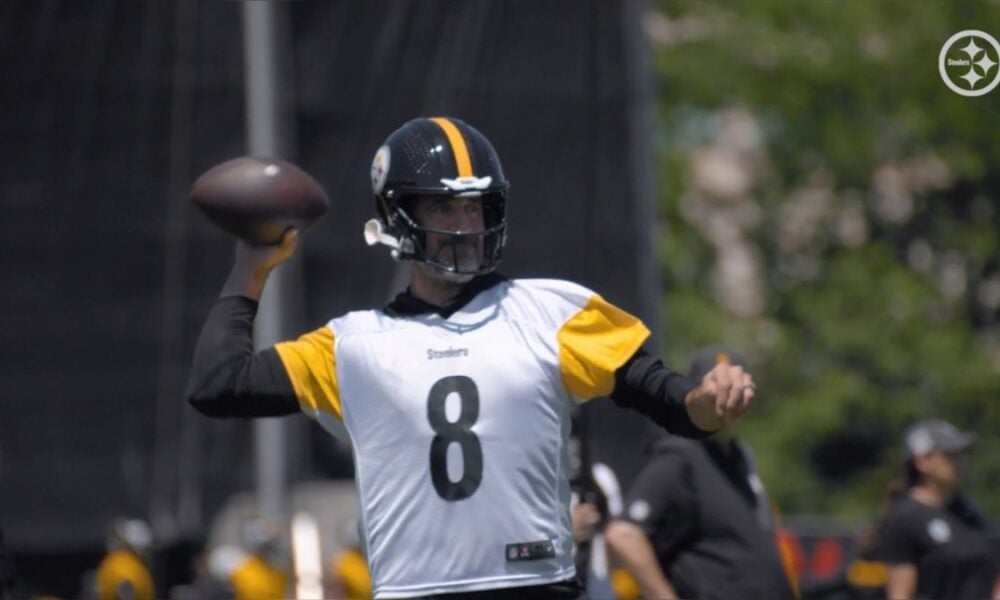
Recently, I Introduced A New QB Sacks Allowed Stat. It revealed that Steelers QB Aaron Rodgers was below the line compared to his peers in terms of their responsibility for how sacks occurred. Holding onto the ball increases the likelihood of a sack, which inspired a follow-up article – seeing how quarterbacks performed with more or less time to throw (TTT).
Here is a visual of Pro Football Focus (PFF) grades in those situations. Less time to throw is defined as less than 2.5 seconds, and more is greater than or equal to 2.5 seconds:
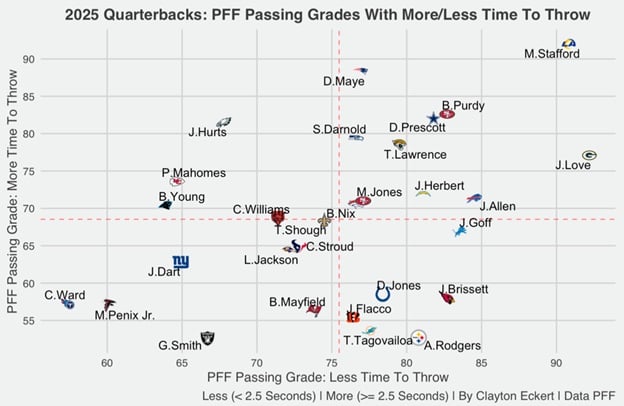
We clearly see a stark difference for Rodgers. He was a top-ten graded passer with an 80.8 less time to throw passing grade (ninth) out of 29 qualifiers with a minimum of 300 total dropbacks. With more time to throw, that grade plummeted to 52.7, the second-worst of the group.
Many probably assume that is the case for many quarterbacks, but we see that it was particularly poor results for Rodgers last season. Grades can be suggestive, though, so let’s get into some other stats to further illustrate this.
Less TTT: 301 attempts (first), 74.4-percent completion rate (15th), 2,055 yards (second), 15 TDs (fifth), four INTs (T-19th), 3.8 big time throw percent (second), 0.9 turnover worthy play percent (seventh), two sacks (T-sixth), 93 first downs (fifth), 103.6 passer rating (T-13th).
More TTT: 195 attempts (T-21st), 52.8-percent completion rate (25th), 1,267 yards (T-23rd), nine TDs (22nd), three INTs (T-fourth), 5.8 big time throw percent (18th), 4.4 turnover worthy play percent (22nd), 27 sacks (14th), 54 first downs (T-26th), 82.1 passer rating (T-19th).
Virtually every stat ranked worse when Rodgers had more time to throw, with the lone exception being interceptions, which he limited overall. But there were more than I anticipated with less TTT, his worst ranking in that category. Otherwise, Rodgers had seven top-ten rankings out of the ten stats I looked at with less time to throw.
On the flip side, six of the ten stats with more time to throw were in the bottom ten of the rankings. The worst two were first downs and completion rate, which paints a pretty bleak picture, along with attempts, yards, TDs, and turnover-worthy plays. Specific context to the struggles last season when holding onto the ball longer.
Despite a slightly above-average sack total with more TTT, along with being pressured eighth least in the situation, Rodgers clearly struggled more than the majority of high-volume quarterbacks. Of course, the hope is that the offensive line will trend upward in 2026. As I stated in the link at the beginning of the article, though, there are many moving parts and factors that could take some time.
Hence, Pittsburgh would be wise to continue leaning on quick time to throw situations, where Aaron Rodgers has proven successful. But to take this offense to another level, he needs to step up and improve when he has the ball longer. Hopefully, a more offensive-minded head coach aids the cause, along with the big investments in personnel on that side of the ball this offseason.