
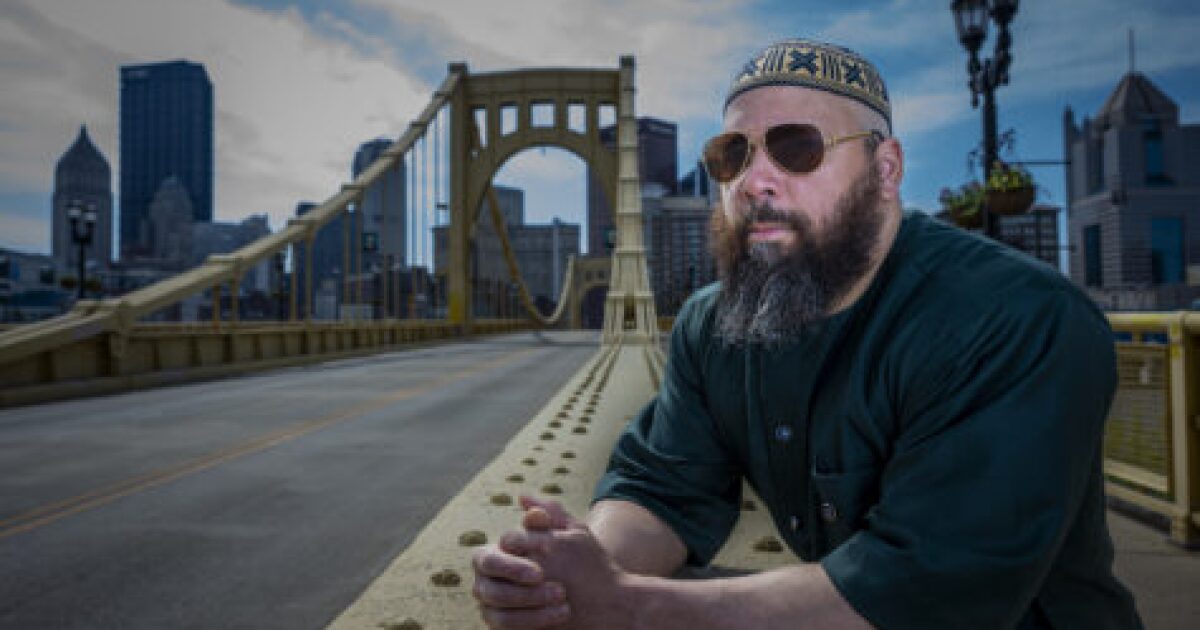
The connections between noted sculptor Sharif Bey, fellow Pittsburgh-born artist Andy Warhol and legendary neo-expressionist painter Jean-Michel Basquiat might not be obvious. They were not all that plain to Bey himself, at least at first.
But Bey says the links are real. And they’re a theme of “Sharif Bey: Homecoming,” the new exhibit at The Andy Warhol Museum that announces Bey’s impending move back to his hometown, some 25 years after he left. The show opened this past Friday and runs through Oct. 12.
Adam Reich
/
Courtesy of the artist and albertz benda NY | LA
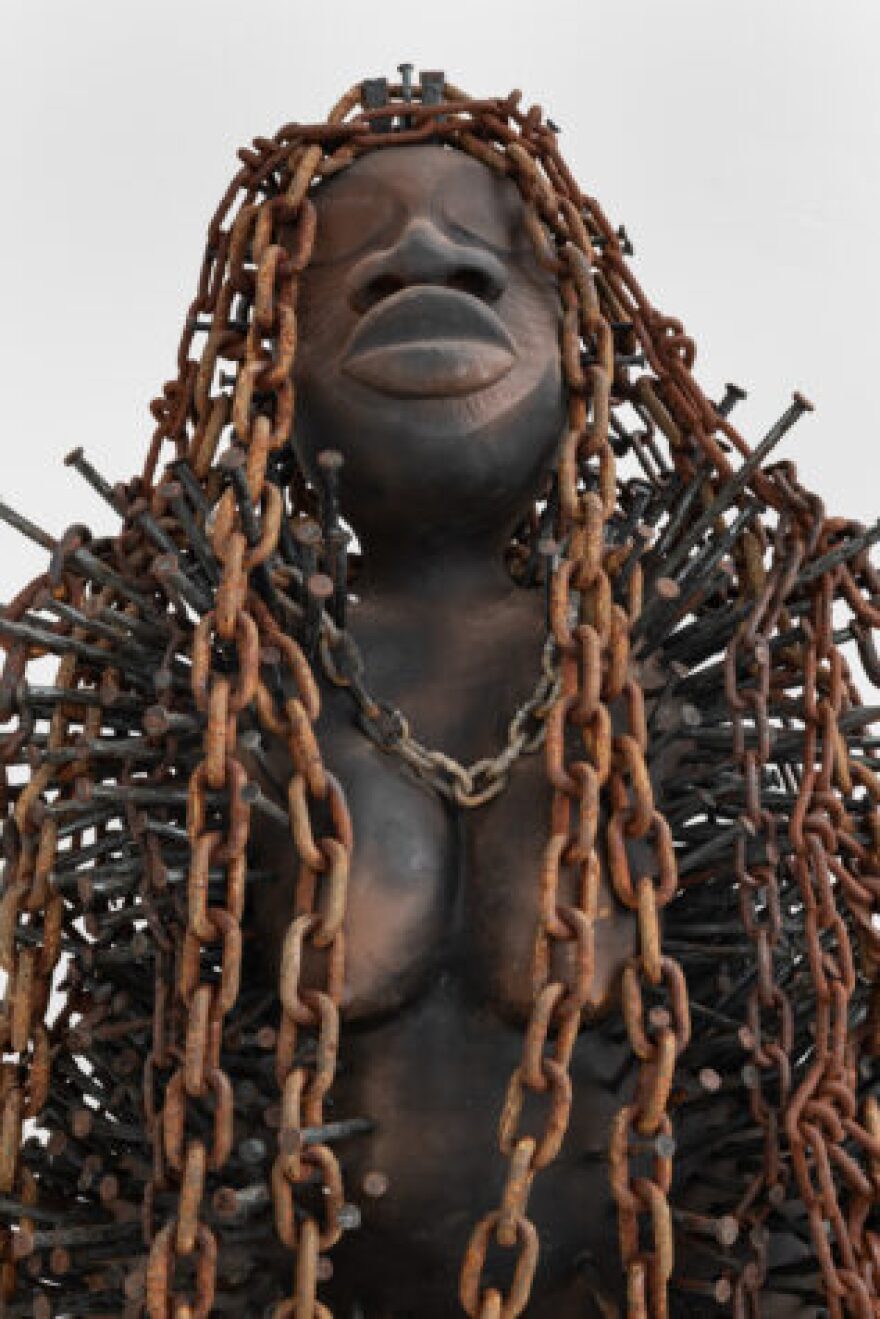
Sharif Bey’s 2023 sculpture “Guardian Series: Blink”
“This is me coming back to Pittsburgh,” Bey said during a press preview at the museum last week. “I really want to make a big splash. So my homecoming coinciding with this time in my career when I’m making monumental scaled work, it’s really important but it’s also really impactful.”
The exhibit features 17 mostly recent works by Bey, many of them striking, oversized human heads with steel nails, chains and even large ceramic beads for hair.
The works are partly inspired by the West African nkisi “power figures” that have fascinated Bey since he first saw them as a child more than four decades ago at the Carnegie Museum of Art, where he took Saturday-morning art classes — just as Warhol himself had done more than four decades before that.
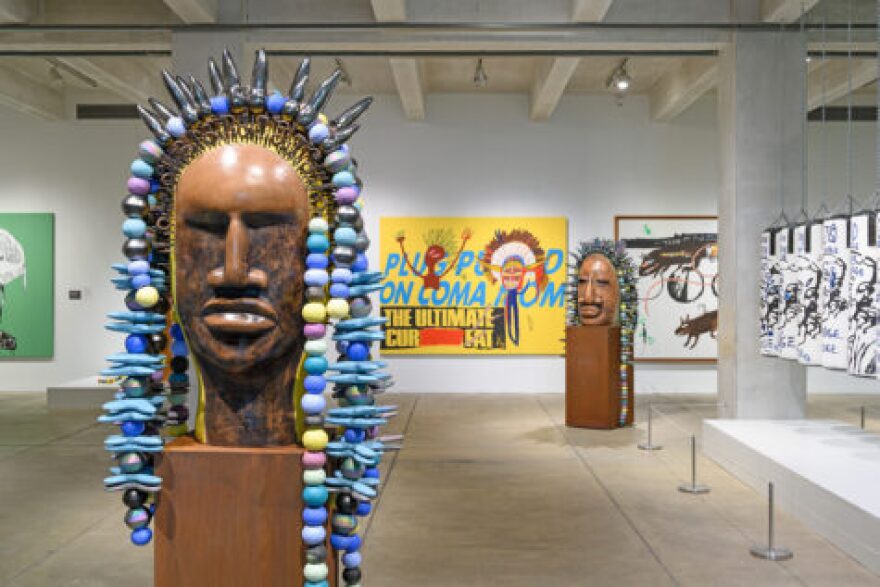
Bey’s works are displayed alongside pieces by Warhol and Basquiat, including large-scale acrylic paintings that were collaborations between the two men in the 1980s.
Going monumental
Bey, 52, grew up in Beltzhoover, the son of a boilermaker. In addition to the classes at the Carnegie, the Brashear High School graduate later studied ceramics at Manchester Craftsmen’s Guild. He studied ceramics at Slippery Rock University, earned his MFA at the University of North Carolina at Greensboro, and his doctorate at Penn State.
His resume includes exhibitions as far afield as Indonesia, Uganda, and Sudan, along with solo exhibitions and group shows all around the U.S. Since 2009, he’s been an art professor at Syracuse University in New York.
Bryan Conley
/
The Andy Warhol Museum, Pittsburgh
Exhibition view of “Sharif Bey: Homecoming”
In 2021, Bey returned for “Sharif Bey: Excavations,” a solo show at the Carnegie Museum of Art. He credited that exhibit with further boosting his career: His works have since been acquired for the collections of museums including the New Orleans Museum of Art, the Museum of Fine Arts, Houston, and the Hirschorn Museum and Sculpture Garden in Washington, D.C.
It was also around that time that his works began to lean monumental.
The pieces in “Excavations” were all wall-mounted works and small tabletop pieces, and many took the form of functional pottery. The works in “Homecoming” are, by contrast, huge.
The sculptures “J5” and “Guard 4: Caesar” are heads, each 4 feet tall, mounted on oxidized steel pedestals of similar height. Many of his other works in the show are of comparable scale, and hold their own alongside big Warhol/Basquiat collaborations like the two nearly mural-sized “Collaboration” paintings and “Ten Punching Bags (The Last Supper),” an installation consisting of 10 full-sized heavy bags, each inscribed with an iconic head of Christ and iterations of the word “judge.”
Bringing it all back home
The idea for “Homecoming” came from the Warhol’s director of learning and public engagement, Nicole Dezelon, who’d first met Bey when they were both instructors at MCG more than a quarter-century ago.
In 2023, at the opening of an exhibit of his work in New York City, Bey told Dezelon he was moving back to Pittsburgh, and she thought juxtaposing his work with Warhol’s would be a great way to reinterpret the museum’s collection.
She noted how Bey’s oxidized pedestals echo Warhol’s use of oxidation in one series of his paintings, which are included in “Homecoming.”
She added that, like Warhol, Bey keeps trying new materials, as he did during his residency at Pittsburgh Glass Center that led him to incorporate handmade glass objects into his larger sculptures.
“This willingness to experiment really does lead to artistic growth and new and innovative works,” she said.
For his part, Bey said, he had to ponder what connection he had with Warhol. He decided that just as Pop art recontextualized familiar symbols — Campbell’s Soup cans, for example — so does his work.
“Things have different meaning through different times,” he said.
He cited the oversized glass spoons hung from the head of his sculpture “Domestic Queen,” replicas of mass-marketed wooden implements carved with African imagery. In one context, he said, they are a symbol of household work. In another, they would be considered kitsch.
His sculpture provides yet another reading.
“There is a reclamation when you take an object that might be mundane and translate it into a new material,” then incorporate it into a work of museum-quality art, he said.
Bey, on sabbatical from Syracuse, said he is already making art part-time in Pittsburgh, and planning to settle in the Knoxville/Mount Oliver area, not far from where he grew up.
He said he’s moving back mostly for family and the cultural scene here.
“This city is kind of emerging in a way that it hasn’t, and it’s emerging at a time in my life when I feel like I want more access to it,” he said. “So I’m excited to fully become a Pittsburgh artist again after 25 years.”