
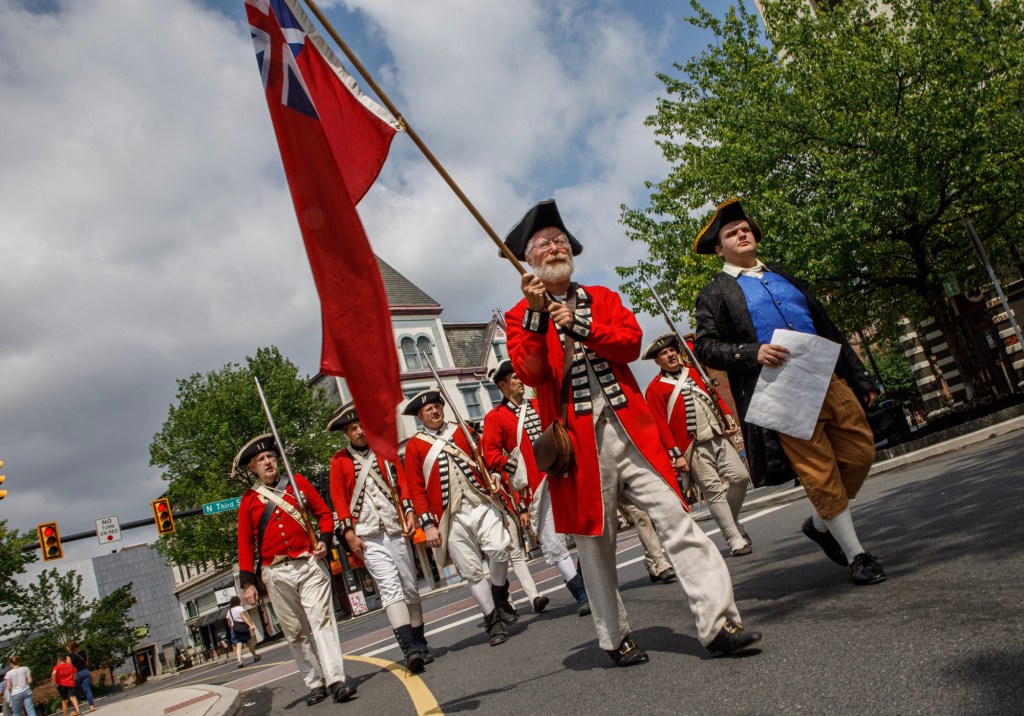
Amid the sound of fifes and drums, spectators waited at the steps of Northampton County Courthouse in Easton’s Centre Square to hear history: one of the first public readings of the Declaration of Independence, delivered by Robert Levers, chair of the Committee of Safety for Northampton County.
It was July 8, 1776, just days after the document was signed by 56 men — including one from the Lehigh Valley. In a recount of the reading that was published a few days later, the Pennsylvania Evening Post wrote that spectators “gave their hearty assent with three loud huzzas, and cried out may God long preserve and unite the free and independent States of America.”
In the years following this reading, the ripples of revolution spread across the Lehigh Valley, including in Allentown, where the Liberty Bell — simply the State House Bell, at the time — was hidden under the floorboard of a church, and Nazareth, where Moravians resisted joining the fight but hosted soldiers in their communities.
On the road to independence, Lehigh Valley colonists played a pivotal role as leaders of the revolution in the Committee of Observation and Inspection and as soldiers in the Northampton County Militia and the Pennsylvania Line. Men were compelled to enlist in the local militia and pledge allegiance to the new state of Pennsylvania through the Test Act and Militia Act of 1777. Not taking the oath led to consequences including fines and inability to elect or be elected.
The Lehigh Valley looked very different 250 years ago — Lehigh County did not exist and many of today’s municipalities were established after the country declared its independence.
In honor of the country’s 250th anniversary, this is a noncomprehensive glimpse into the role people in each of the Lehigh Valley’s 62 municipalities played in the American Revolution.
Northampton County (Established 1752)
Allen Township (established 1748): Allen Township contained a village known as Siegfried’s Ferry, which was the only location for crossing the Lehigh River north of what is now Allentown after 1750. The village was named after Revolutionary War Col. John Siegfried, who was also a friend of George Washington.
The man for whom Kreidersville is named, Conrad Kreider, was from Allen Township; he served as a “wagon master” during the war.
Bangor (incorporated 1875): Bangor was part of Washington Township during the Revolutionary War. While the borough’s better-known slate industry lay decades in the future, settlers had already begun establishing homesteads in the area.
One settler was Philip Shuck, who built a log house and barn in present-day Bangor. The foundations of the barn are still visible today, according to Slate Belt Town Topics. The house was later sold to Robert M. Jones, the Welsh immigrant credited with founding modern Bangor and helping develop the region’s slate industry.
For more of the area’s story, see Washington Township.
Bath (incorporated 1856): The borough was named after its English counterpart through Margaret DeLancey, the daughter of William Allen. Allen was a member of the Pennsylvania Assembly and chief justice of Pennsylvania, having lobbied against the Stamp Act. He and his family initially showed support for the colonial cause. But, he could not back leaving England for good. After the signing of the Declaration of Independence, he left the cause and went back to England, where he studied law.
In 1776, Allen transferred his land in the largely Scotch-Irish area that would become Bath to his son, Andrew Allen. Accused of treason by Pennsylvania for “having adhered to and knowingly and willingly aided and assisted the Enemies of this State and the United States by having joined their Armies,” according to The Morning Call, Andrew Allen’s property was confiscated by the state. This interfered with a transfer of ownership and led to a 30-year-long legal battle.
Bethlehem (incorporated 1746): The city hosted several military hospitals, about which William Shippen — who served as a director general of hospitals and later founded the first American maternity hospital — wrote to Congress as a plea for greater support in letters still preserved by the American Philosophical Society.
The city’s main hospital, Single Brethren’s House, housed Marquis de Lafayette while he recovered from being injured during the Battle of Brandywine. The house was owned by the Moravian Church, whose members were desperate to remain out of the war, but were eventually forced to participate through medical care, though they refused to enlist.
At times, like when the army suffered a great defeat in Philadelphia in 1777, the hospital was desperately overcrowded. Just a quarter mile away, one of the largest Revolutionary War burial grounds in the commonwealth was developing; more than 500 Continental soldiers are believed to be buried in the area, some in mass graves. Today, the site is marked as the Tomb of the Unknown Soldier.
Bethlehem is also home to the Sun Inn, which was built by Moravians in 1758 and is believed to have hosted “many notable patriots and military leaders,” according to the Pennsylvania Historical and Museum Commission. Leaders often named in stories of the inn include George Washington, Benjamin Franklin, John Adams, Alexander Hamilton and Lafayette.
Bethlehem Township (established 1746): Bethlehem Township was significantly larger during the colonial period, encompassing its current territory in addition to the present-day city of Bethlehem, and Upper and Lower Nazareth townships.
Its population in 1780 was 1,375, according to one account of county history, though numbers dipped down to 950 the following decade, after the split of Nazareth Township.
For more of the area’s story, see Bethlehem.
Bushkill Township (incorporated 1813): Bushkill Township — an agricultural community — was a part of Plainfield Township and was called “the plains.” A pivotal landowner in modern-day Bushkill Township, Jacob Hubler, was a part of the Northampton County Committee of Observation. He later named his land acquisition Jacobsburg.
Chapman (incorporated 1865): Previously part of Moore Township, what is now Chapman was named after a family of, well, Chapmans. Several descendants — all named John Chapman — ended up owning the John Chapman House in Upper Makefield Township, Bucks County, better known as the London Purchase Farm, where it served as a Continental Army headquarters before the Battle of Trenton and is known as a site from which Washington’s army crossed the Delaware.
East Allen Township (Incorporated 1845): East Allen Township was part of Allen Township until 1842. With the split, much of East Allen is the modern-day site of the first permanent settlement in Northampton County: Thomas Craig’s Scotch-Irish Settlement, often called simply “the Irish Settlement.”
Founded in 1728, the settlement would supply Northampton County with civic leaders, county officials, a legislator and delegates to Pennsylvania’s revolutionary conventions. Its residents also served in the Northampton County militia, and many Revolutionary War veterans — including soldier Robert Brown, who was captured during the 1776 fall of Fort Washington, the last American stronghold on Manhattan — were later buried in Horner’s Cemetery, the oldest in the county. The cemetery is named for Jane Horner, who was killed by Native Americans in 1763.
Within East Allen’s Weaversville once stood Haye’s Tavern, a social gathering spot and post office where Benjamin Franklin is rumored to have once stayed.
East Bangor (incorporated 1884): What is now East Bangor was in Old Mount Bethel Township during the American Revolution. When that township was broken up in 1787 after population increases, East Bangor became part of Upper Mount Bethel Township. See the Upper Mount Bethel section for details on its role in the revolution.
Easton (founded 1752, incorporated 1887): The first large meeting to take place in Easton’s courthouse was in 1774, in which a very angry county committee pressed Congress to pressure Britain to respond to colonial requests. The committee recruited and armed the county militia.
In 1776, a ferry from Easton carried around 1,500 men from Pennsylvania to New York to join George Washington’s forces against the British invasion. Within days, half of these men were reported as fatalities, casualties or captured/missing with the defeat of the Continental Army in battle.
Forks Township (incorporated 1754): During the revolutionary era, Forks Township was a small farming community that had been incorporated only a few decades earlier.
A glimpse of that period survives in the Frace Log Cabin, which the township historical society believes was built around 1766 by Michael Frace (also written as Fraes or Fress), the son of a German immigrant. Frace leased and later purchased the land from the Penn family, and he and his wife, Gertrude, raised eight children under the cabin’s hand-split shingles.
Threatened with demolition by development in 1990, the cabin was relocated to Forks Township Community Park, where it remains today.
Frace’s brother, Henry, was drafted into the Northampton County Militia in 1778 and ordered to march with his company under the command of his father-in-law, the company captain, according to county muster rolls.
Freemansburg (incorporated 1856): Freemansburg was previously a part of Bethlehem Township. Some of the town’s earliest settlers, the Bachmans and the Freemans, arrived in the decade before the American Revolution. Before the Lehigh Canal was opened, 50 years after the signing of the Declaration of Independence, it was a small hamlet with few residents, according to The Morning Call.
Glendon (incorporated 1867): Glendon was originally part of Williams Township, which had an enthusiastic role in the Pennsylvania militia units.
Hanover Township (incorporated 1798): The Hanover townships of Northampton and Lehigh counties were a single municipality until 1812, when the creation of Lehigh County divided them. Before 1798, the area was part of Allen Township.
Though later known for its farms, 18th-century Hanover had a less flattering reputation. Several historical accounts say the area was nicknamed the “Drylands” because of its poor soil.
For more of the area’s story, see Allen Township.
Hellertown (incorporated 1872): The main connective road between Bethlehem and Philadelphia, King’s Road, ran through Hellertown, meaning many revolutionaries, Founding Fathers and the Liberty Bell went through the borough during the war. This included the Marquis de Lafayette, who stayed a night just outside of Hellertown after getting injured during the Battle of Brandywine in 1777.
The borough is named for the Heller family. Johann Christoph Heller’s sons were very involved in war efforts. Michael Heller, a sergeant, was the first farmer from the Saucon Valley to deliver flour to George Washington’s troops at Valley Forge. Daniel Heller made wagons for the Continental Army, which he also served in. Johann Dieter Heller transported cannonballs and served as a sergeant. Ludwig and Simon Heller both had sons who were captured by the British during service to the colonial cause. Georg Christoph and his sons were privates in the Northampton County Militia.
Lehigh Township (incorporated 1752): Jost Dreisbach of Germany served as a captain for a militia unit from Lehigh Township in 1775 and later as a colonel for the Third Battalion. He was allegedly friends with Conrad Kreider, the wagon master.
Lower and Upper Mount Bethel townships (Incorporated 1746 and 1787, respectively): During the Revolutionary War, Mount Bethel Township — which Upper and Lower Mount Bethel derive from — was facing a civil conflict of its own. A large swath of German immigrants landed in Pennsylvania, including in the township, which caused tension between them and the now-minority Ulster-Scots, or Scotch-Irish. This resulted in a small exodus of Ulster-Scot families to other regions of Pennsylvania and Tennessee.
In 1775, the Mount Bethel company of the county militia is recorded as having 124 rank and file men led by Capt. John Neilson (or Nelson), according to county muster rolls. A year later, several Mount Bethel men are recorded as having joined George Washington’s “flying camp,” a 10,000-man mobile reserve force authorized by the Continental Congress in June 1776.
The township was divided in two in 1787.
Lower and Upper Nazareth townships (both incorporated 1807): Both Upper and Lower Nazareth townships were part of Bethlehem Township at the time of the Revolutionary War. Nazareth was carved out of Bethlehem in 1788, then later split into Upper and Lower Nazareth.
Lower Nazareth Township was home to the historic Newburg Inn until it was demolished in 2021. The inn was built in the mid-1700s and sat at an intersection connecting Bethlehem to Nazareth and Bath to Easton. One of its owners, Jonas Hartzell, served as an officer in the Northampton County militia.
Lower Saucon Township (incorporated 1743): Saucon, now split into Upper and Lower Saucon townships, holds the title for the oldest municipality in the region. During the American Revolution, several Mennonites in Lower Saucon refused the required oath to bear arms and pledge allegiance to the state of Pennsylvania, resulting in their imprisonment.
Moore Township (incorporated 1765): Incorporated a decade before the Revolutionary War began, Moore Township was home to 500 people by 1770, according to one account of Northampton County. The town contained three grist mills and two saw mills at the time.
The residents of Moore and Bushkill townships united to build a small log church, called Salem’s Lutheran and Reformed Church, in 1772. The structure was later dismantled and moved to Danielsville in 1829.
In 1775, 106 men from Moore Township joined the local company of the county militia.
The township is also home to the remains of Peter Doll’s Blockhouse in the Klecknersville area. During the French and Indian War, the building was used as a provincial military post on the mountain frontier. By 1758, a small group of provincial troops was stationed there as part of the region’s defensive line against frontier raids.
Nazareth (incorporated 1863): Like other Moravian communities, the people of Nazareth were pacifists and largely objected to participating in the war. Burdensome fines for not joining the militia worked well on Moravians, who had just moved from a communal economic system to private wealth in the decade prior to the war.
During the war, Nazareth Moravians would host soldiers in their large communal buildings, providing shelter, clothing, food, religious services and music. Diary entries from that time show this to be an imposition. In one instance, they needed to postpone a festival when 150 infantry of Gen. Casimir Pulaski’s troops visited in 1779. After the war, some soldiers returned and expressed appreciation for the Moravians’ hospitality.
Two miles southwest of Nazareth was Christian’s Spring, a community that was home to the Moravian gunshop run by Johann Christian Oerter, who entered a contract to produce 500 muskets for the Continental Army.
North Catasauqua (incorporated 1907): North Catasauqua was part of Allen Township at the time of the American Revolution. For more of the area’s story, see Allen.
Northampton (incorporated 1901): The American Revolution history of this borough is synonymous with that of Allen Township, as it was part of it in 1776. At the time, the township was partially composed of three villages that grew and joined to become its own part.
Palmer Township (incorporated 1857): While the land that is now Palmer Township was used by the Penn family as hunting grounds, by the mid-18th century, the area was settled by colonists. The Penns agreed to sell the land to the settlers in 1795, almost a decade after the war ended. John Penn — the last royal governor of Pennsylvania — had long before taken an oath of loyalty to the Commonwealth of Pennsylvania.
The township was named after George Palmer, a deputy surveyor of Northampton County who had his office in Bath. Shortly before the start of the war, Palmer was a member of the Commission that established the northern border of Pennsylvania.
Pen Argyl (incorporated 1882): Before Pen Argyl became the reason behind the region’s “Slate Belt” moniker, it was part of Plainfield Township. Shortly before the American Revolution, near modern-day Pen Argyl, a family was reportedly caught in the midst of the French-Indian War in what is referred to as the 1757 Keller massacre.
Plainfield Township (established 1762): The Plainfield area was settled by colonists in the 1740s, and the township was officially established in 1762, just over a decade before the war would begin. One 19th-century account of the commonwealth connected the township’s name to its face, “almost entirely devoid of timber.”
In 1775, the Plainfield company of the county militia is recorded as having 88 rank and file men led by Capt. Casper Dull, according to county muster rolls. Dull’s gravestone, in Mifflin County, indicates he may have been stationed at Valley Forge.
In March 1777, the Northampton County Standing Committee in Easton heard a complaint from a Continental Army captain that a Plainfield Township resident, Adam Butz, had exchanged rifles with one of his soldiers, including a weapon that belonged to the captain. The rifle Butz received in the exchange was noted as damaged, with a bullet hole in the butt end, and Butz did not appear when summoned to respond to the charge, according to county militia records.
Portland (Incorporated 1876): Portland was a part of Upper Mount Bethel Township, previously known as Old Mount Bethel Township. See Upper Mount Bethel for details on its role in the revolution.
Roseto (incorporated 1910): Known for being the first fully Italian borough in the country, Roseto was a former part of Washington Township.
Stockertown (incorporated 1900): Named for the Swiss-immigrant Stocker family, Stockertown is believed to have been established in the early 1770s. Andreas Stocker, credited with laying out the town, was drawn to the area in search of rich farmland.
The community, which would not be formally incorporated until much later, took shape in the shadow of the Revolutionary War. Stocker served in the Northampton County militia, while his brothers, George and Adam, are recorded in surviving militia rolls from the same period.
Many Stocker descendants remain in the Lehigh Valley.
Tatamy (incorporated 1893): Shortly before the start of the war, in 1771, Michael Messinger Sr. purchased 500 acres of land, including modern-day Tatamy. A “Michael Messinger” is listed as an elected member of the Northampton County Committee of Observation and Inspection.
Walnutport (incorporated 1909): A part of Lehigh Township at the time, Walnutport was settled by German immigrants in the decades leading up to the Revolutionary War. Lehigh Township’s population grew in the decades leading up to the war, with the 30 residents in 1740 jumping to 350 by 1770. See Lehigh Township for more information.
Washington Township (incorporated 1871): This township’s first mill was built halfway through the American Revolution in 1778.
West Easton (incorporated 1898): West Easton was part of Forks Township during the American Revolution. Within this area were the early village clusters of Odenweldertown and Mutchlertown, formed around 18th-century farmsteads and landholdings.
Odenweldertown traces to John Philip Odenwelder Sr., who purchased roughly 200 acres in the area in the early 1770s. At least two of Odenwelder’s children served in the Northampton County militia, according to county muster rolls and family records.
Williams Township (established 1750): John Arndt of Williams Township — inspired by the reading of the Declaration of Independence in Easton — rallied men into a rifle company that marched with George Washington’s “Flying Camp” in the disastrous Battle of Long Island. Arndt and others from the township were wounded, and Arndt’s company was discharged in December 1776. Arndt’s father, Jacob Arndt, was a member of Pennsylvania’s first General Assembly. He also served as a member of the Committee of Safety and the county’s Standing Committee.
Some historians say that people from the township aided in Washington’s crossing of the Delaware River, including assembling boats for the trip.
Wilson (incorporated 1920): Not to be confused with Fort Wilson in Philadelphia, which was the location of a 1779 riot, this borough neighbors present-day Easton.
Wind Gap (incorporated 1893): After setting off from Easton just that morning, more than 2,000 Continental soldiers spent a June night in 1779 camped out at Heller’s Tavern in Wind Gap. The army — which departed by 4:30 a.m. the next day, according to one account — was marching north on the Sullivan Campaign, a major Revolutionary War expedition ordered to destroy villages and food supplies of the British-allied Iroquois.
It is not known when the tavern was built, though the Heller family acquired the property in 1763 after it was sold to Simon Heller by his father-in-law, Adam Dietz. Dietz was an important figure in the town. During the French and Indian War, his farmhouse was used as a frontier outpost near one of the region’s most important mountain passes. Benjamin Franklin noted 12 men stationed at the blockhouse in 1756.
Lehigh County (established 1812, previously part of Northampton)
Alburtis (incorporated 1913): At the tail end of the Revolutionary War, an inn was built in what is now Alburtis. Patrons can still visit the Colonial building, now home to Maple Grove Pub & Grill and, supposedly, a ghost or two.
Allentown (Founded 1762): The largest city in the Lehigh Valley was most known for being the Liberty Bell’s hiding spot during the Revolutionary War. Several church bells — including the very famous one — were stowed away from Philadelphia for a few months following the British taking of Philadelphia in 1777. The bells were kept under the floorboards of Zion’s Reformed Church, now owned by Resurrected Life Church, on West Hamilton Street.
The church also served as a military hospital from September 1777 to April 1779, and a nearby historical marker commemorates soldiers who died there.
The city, then a town, was known as “Northampton Town” during this period; Allentown wouldn’t be given its current name until 1838, more than 75 years after William Allen formalized its layout.
Catasauqua (established 1853): George Taylor, a signer of the Declaration of Independence, built a county home in Catasauqua in 1768. Taylor — whose primary residence was in Easton — was sent to the Continental Congress to replace delegates who refused to sign the Declaration of Independence. He produced grapeshot, cannonballs and cannons for the Continental Army.
His home, which became a National Historic Landmark in 1971, has been restored and tours are offered.
Coopersburg (incorporated 1879): This suburb of Allentown played a crucial transportation role in the American Revolution, according to the Coopersburg Historical Society’s Nathan Diehl. The borough, previously called Fryburg or Saucon, was used by the Continental Army in several ways. As a stop on the Bethlehem Pike, the army passed through frequently, including once with the Liberty Bell. Livestock for the revolutionaries was also quartered in the area.
Coplay (incorporated 1869): Coplay, not officially called its present name until its 1869 secession from Whitehall Township, was part of the 400 acres purchased in 1740 by John Jacob Schreiber from the heirs of William Penn.
Nineteenth-century county histories describe the area’s name as derived from “Kolapechka” or “Kolapecha,” the son of Shawnee chief Paxinosa, who is said to have lived along the creek that now bears the Coplay name. These accounts also describe Kolapechka as serving at times as an interpreter and messenger between Indigenous residents and colonial authorities.
See more at the Whitehall Township section.
Emmaus (incorporated 1859): The Moravians of Emmaus, pacifists who largely did not support the Revolutionary War, treated over 100 wounded and sick soldiers throughout 1777 (willingly, though they were not given a choice). The Moravians also housed traveling soldiers, with around 500 soldiers occupying the village on an April 1777 evening. The adult population of Emmaus at the time was under 100.
One member of the Moravian congregation of Emmaus, Johannes “John” Wetzel, became lieutenant of Northampton County and was responsible for the arrests of a dozen Emmaus men in 1778 who did not join the militia. These men spent one month in jail, with most of them taking an oath of allegiance for fear of further consequences. Those who did join the army — 12 Moravians — were not recognized for their service until 1930, due to its incompatibility with the Moravian way of life.
The Knauss Homestead — built in 1777 by Heinrich Knauss, a soldier in the Revolutionary War — is preserved in Emmaus and tours are offered.
Fountain Hill (incorporated 1893): In 1775, the area now known as Fountain Hill was owned by Moravians, who infamously denied being drafted in the war, adhering to their pacifist beliefs.
Hanover Township (incorporated 1798): The Hanover townships of Northampton and Lehigh counties were a single municipality until 1812, when the creation of Lehigh County divided them in two. Before 1798, the area was part of Allen Township.
Though later known for its farms, 18th-century Hanover had a less flattering reputation. Several historical accounts say the area was nicknamed the “Drylands” because of its poor soil.
For more of the area’s story, see Allen Township.
Heidelberg Township (incorporated 1752): Heidelberg scarcely had new settlers, and most land was transferred among family until the 19th century. One man who served under George Washington, Martin Wachter, got his land from his father and gave it to his son, who then gave it to his son. Multiple men served as soldiers in the Revolutionary War, though many names have been lost to time, according to one report.
Lower and Upper Macungie townships (both incorporated 1832): Macungie Township, founded around 1730, was cleaved in two in 1832.
The development of Breinigsville and Trexlertown, both in present-day Upper Macungie, are closely tied to Revolutionary War patriots.
Breinigsville was named for German immigrant George Ludwig Breinig, who served as one of the officials overseeing the July 8, 1776, election in Allentown that selected delegates for Pennsylvania’s revolutionary-era constitutional convention. During the war, Breinig served as colonel of the Second Battalion of the county militia.
Trexlertown’s founding Trexler family not only appeared on Northampton County militia rolls during the American Revolution, but also operated the tavern that became a center of local activity.
Peter Trexler’s Tavern in Trexlertown was one of the earliest Colonial taverns along the Reading-Philadelphia road, operating on land associated with the Trexler family as early as the 1730s. During the revolution, taverns functioned as gathering places for militia activity, political discussion and the circulation of news.
The site has hosted a tavern ever since; today it is occupied by the 1760 Pub N Grill.
One Macungie man of record tried to bypass a Colonial law used to keep the British from buying cattle and bread from Pennsylvania and was jailed with a bail of 1,000 pounds, which would be around $31,500 today.
Lower and Upper Milford townships (incorporated 1853, Upper Milford founded 1738): At the time the United States sought independence, Lower Milford and Upper Milford were one.
Upper Milford Township, founded in 1737, was a well-established farming community by the time of the American Revolution. A 1762 tax record lists 184 taxable residents, and by 1776 the township supported three churches, with Mennonite, Lutheran and Reformed congregations. The King’s Highway and the Great Philadelphia Road ran through the township, connecting it to regional trade, while inns, stores and mills in places like Shimerville and Vera Cruz supported both local residents and travelers.
In 1774, resident Andrew Engelmen was elected as a member of the Committee of Observation and Inspection, and in 1776, 64 men joined the Upper Milford military company, led by Capt. Christian Fisher, according to township historian Neil Moser.
By 1790, the townships had a combined population under 1,200. There were multiple establishments developed in the second half of the 18th century, including taverns, churches and mills.
Lowhill Township (established 1753): A pre-revolution tavern that was also maintained during the war, called the Leather-Corner Post in the township, is remembered by a hotel of the same name today in what is now Orefield.
Lynn Township (organized 1752): This township was founded by a German man who fought in the French and Indian War; all five of his sons fought in the American Revolution. Part of the township, Kilster Valley, is named after the family.
Lynn was the home of Fredrick Leaser, a German farmer who helped transport the Liberty Bell on the last leg of its journey to Allentown when its wagon broke down in Bethlehem. The 18th-century log cabin that Leaser shared with his wife, Catherine, was passed down through family members until 1998; today, the structure is on the National Register of Historic Places, though it is in poor condition.
Macungie (incorporated 1857): The borough, known as “Millerstown” for nearly the entirety of its first century, was founded by Peter Miller in 1776.
Described by the Lower Macungie Township Historical Society as an “unkempt village of log houses, located along a muddy main street,” society President Sarajane Williams said the town was home to a tannery and likely a sawmill during the Colonial period.
North Whitehall Township (established 1810): One of the men from North Whitehall Township who fought for independence was Michael Laury, a Scottish immigrant, who joined the army at 60 years old after becoming lonely following his sons’ enlistment. He died in service near Mount Bethel, New Jersey. Another resident, Stephen Balliet, commanded a regiment during the Battle of Brandywine.
Salisbury Township (established 1753): Salisbury, previously Elk Lick, was founded as a township in 1753, the same year the Liberty Bell was completed and hung. A man named David Deshler from Salisbury was appointed a “sub-lieutenant” of Northampton County and was, notably, in charge of repairing the thousands of muskets used by the Continental Army.
Slatington (incorporated 1864): Slatington, believed to have been first settled in the 1730s, was not heavily populated during the American Revolution. The sawmill of German farmer Nicholas Kern, the first European settler of the area, is believed to have housed troops during the French and Indian War.
The Kerns made up much of the borough’s residents until the area’s slate supply was discovered. The community was called various names in its early days, like Kern’s Mills or Kernsport, according to the National Register of Historic Places.
South Whitehall Township (established 1810): In May 1776, 900 men of the second battalion gathered in what is now South Whitehall Township. The group decided they were not being properly represented by the Colonial Assembly and called for a new state constitution. Similar meetings occurred across the colony, and a month later, delegates met to declare Pennsylvania’s independence.
South Whitehall Township was also once home to the Rev. Abraham Blumer, a chaplain with the Northampton County militia who was the pastor of the Allentown church that hid the Liberty Bell. Blumer’s former South Whitehall bank barn was standing as of March.
Upper Saucon Township (established 1743, split from Lower Saucon Township in 1753): Upper Saucon Township was home to Squire Jacob Morry, the son of a German immigrant who settled in the township shortly before Morry was born. Commissioned by the king to serve as a justice of peace just two years before the Declaration of Independence was signed, Morry joined the army at 50 years old with his sons to help the fight for independence. In June 1777, he was reappointed as a justice, this time by Benjamin Franklin.
Washington Township (organized 1847): Formerly a section of Lower Mount Bethel Township, the first mill of the township was built during the Revolutionary War to manufacture lumber.
Weisenberg Township (established 1753): One of Weisenberg’s “local founding fathers” (as the historical society calls them) is Michael Bobst, a tavern keeper who became a prominent military figure in the war.
In 1775, Bobst (sometimes spelled “Probst” or “Pobst”) was captain of the Weisenberg company of the county militia, joined by 32 rank and file men, according to county records. He was later promoted to major and, in 1776, he and his troops joined the Northampton County battalion in Washington’s “Flying Camp.” These troops were among the Pennsylvanians engaged in the disastrous New York campaign, including the Battle of Long Island, where militia units suffered heavy strain in the retreat and subsequent fighting across Brooklyn and Manhattan.
After the defeat, Bobst was tried for a court-martial under an accusation of misbehavior as well as “cowardice and shamefully abandoning his post.” Acquitted of the cowardice charge, though said to be convicted of misbehavior, later records show continued militia service, with Bobst returning as lieutenant colonel in 1777 and remaining active through the end of the war, according to local historian David Hunsicker.
Whitehall Township (incorporated 1867, established 1752): Covered in manure and the dark of night, the Liberty Bell left Philadelphia in 1777, nestled in the wagon of John Jacob Mickley, whose family was settled in what was at the time Whitehall Township and is now a part of North Whitehall. The bell was one of several moved out of fear that they would be taken by British forces and melted into cannonballs. The wagon transporting the Liberty Bell broke down in Bethlehem, just a few miles shy of the bell’s destination.
Sources: Discover Lehigh Valley, Forks Township Historical Society, Historical Marker Database, Historic Catasauqua Preservation Association, Horner Cemetery Historical Society, Jacobsburg Historical Society, Journal of the American Revolution, Lehigh Township Historical Society, Local Geohistory Project, Lower Milford Historical Society, Moravian Historical Society, Morning Call archives, National Canal Museum, National Constitution Center, Orange County California Genealogical Society, Slate Belt Town Topics, township websites, University of Pennsylvania’s Penn Libraries, WFMZ;
Mark Connar, historian; Melissa Dewey, Stockertown events committee; Jeanne Harakal, past president of Emmaus Historical Society; Andrew McLeod, Moravian Historical Society curator of collections and exhibitions; Dennis Scholl, Hellertown Historical Society education committee chair;
“A History of Lehigh County Pennsylvania: From the Earliest Settlements to the Present Time including much Valuable Information for the use of Schools, Families, Libraries” by James J. Hauser; “An Illustrated History of the Commonwealth of Pennsylvania,” by William Henry Egle; “A Red Rose from the Olden Time” by William Cornelius Reichel; “Bicentennial History of Williams Township” by Williams Township History Commission; “Forts on the Pennsylvania Frontier, 1753-1758” by William Hunter; “History of Lehigh County, Pennsylvania and a Genealogical and Biographical Record of its Families”; “History of Northampton County”; “History of Tatamy Pennsylvania, 100th Anniversary” courtesy of Tatamy Historical Society; “History of the Borough of Stockertown” by Virginia Lopresti; “History of the Counties of Lehigh and Carbon, in the Commonwealth of Pennsylvania” by Alfred Mathews; muster rolls for the Northampton County militia; Report of the commission to locate the site of the frontier forts of Pennsylvania; “The History of Easton, Penn’a from the Earliest Times to the Present, 1739-1885” by by Uzal W. Condit; “The Genealogy of the Mickley Family of America” by Minnie Fogel Mickley; “Upper Saucon: A Bicentennial Tribute, 1743-1976” by Upper Saucon Bicentennial Committee
Isabella Gaglione, Selma O’Malley and Elisabeth Seidel are freelance writers.