
LOWER MERION — Lower Merion School District officials say they expect to finalize and implement their new computer policies by August so that they will be in place before the start of the upcoming school year.
At its most recent board business meeting, the Lower Merion Board of School Directors repealed two longstanding policies on technology use and, according to comments from the board president, put a new policy in place as a temporary placeholder that cannot be finalized until later this summer.
The board voted to repeal policies 134 and 137, which relate to the student-issued computers in the district. But they were unable to give final approval to the replacement policy because it must be presented at two meetings. In those meetings, the policy is labeled a “first read” at the first meeting and a “second read” at the second meeting. Only when a policy is up for its second read can the board vote on it.
At the time of the board’s meeting, the new policy was labeled “xxx” since it didn’t yet have a policy number.
Under the new policy, students in kindergarten through second grade will not be assigned individual devices, and technology will be limited.
Third and fourth grade students would have access to devices during school, but they would be used only under teacher supervision and with concrete objectives. Devices would be kept in carts, and they would not go home with the students.
The policy for fifth and sixth grade students reads that they would continue to use school-issued computers but would not be required to use them at home. The devices would remain at school unless families sign up to take them home. They will not be used during downtime, such as between classes or at lunch.
For students in seventh and eighth grades, the policy reads, “Students shall have supervised, purposeful access to technology resources. Students will be assigned individual devices for instructional use during the school day and may take such devices to and from school. Devices shall be used only for approved instructional purposes and school-related work in accordance with teacher direction and District expectations. District-issued devices and technology resources shall support the transition to increased academic responsibility, including regular use for assigned work, organization, collaboration, and guided research. Their use shall help students build responsible digital habits and increasing independence while remaining subject to clear limits, supervision, and expectations for appropriate use and digital citizenship aligned with curriculum, standards, and instructional goals.”
High school students will continue to be assigned individual devices that they can carry throughout the school day to and from school. Devices may only be used for approved instructional purposes and school-related work in accordance with district expectations.
Normally, the board’s policy committee does not meet in June, July or August, but due to the discussion over the computers, they added one in early June and anticipate holding additional meetings later in the summer.
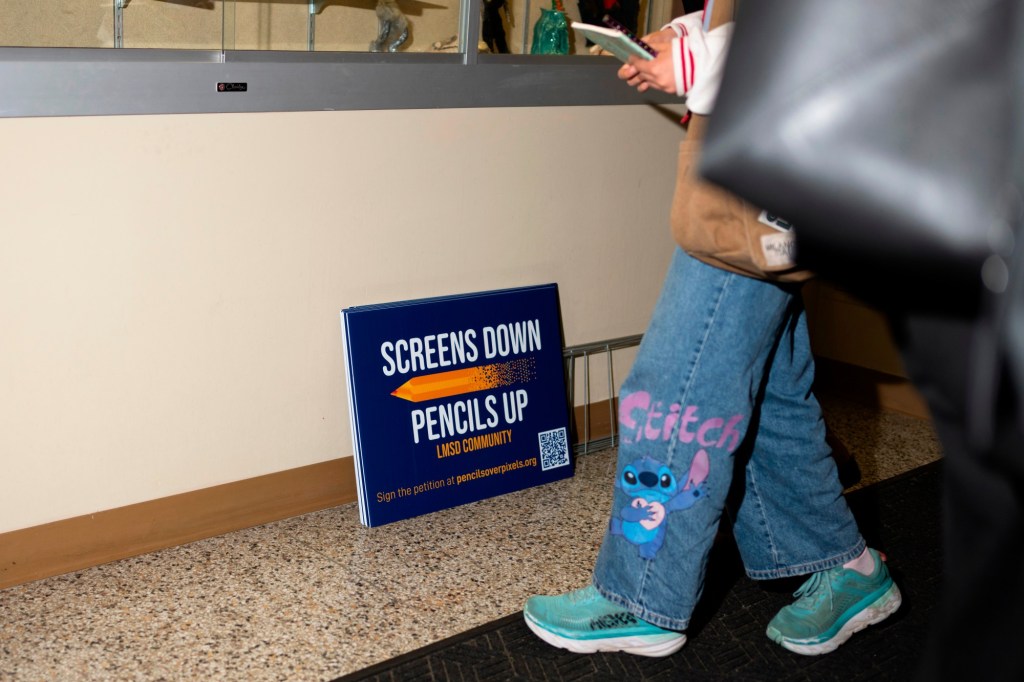
Nearly 20 years ago, the district celebrated its new one-on-one computer program. But a couple of decades later, many parents and some students have started raising concerns over the reliance on technology. Their concerns related to the negative effects of too much screentime on young minds.
Ben Prusky of Bryn Mawr was one of dozens of residents speaking at the meetings this month. He advocated for parents being able to opt their kids out of being a part of the district’s computer program.
“I really want you guys to really rethink the entire conversation,” Prusky said at the policy committee meeting. “None of you are going to lose reelection if you shift it from an opt-out to an opt-in.”
Prusky, who described himself as a business owner, indicated that the people really making the decisions are the ones who are selling the computer systems to school districts. They are the ones, he said, who are getting commissions by selling those systems and then celebrating by having drinks at expensive restaurants in San Francisco.
“We’ve got to stop calling it ed-tech,” Prusky said. “It’s a bunch of account managers in San Francisco wearing clothing like mine that are trying to sell to districts to get their commissions.”
He added that it is not educational technology. It’s instead a scam, and the district’s classrooms should not be viewed as startups.
David Smyth of Merion also spoke at this month’s policy committee meeting.
“Let’s face it, you know that ed-tech is failing. It is suboptimal, and you don’t want to be embarrassed,” Smyth said. “That is why there is no data on efficacy. No transparency on the basis for the decision for ed-tech. That is why there is no feedback from teachers and principals. They are intimidated. Shame on all of you. Shame on you, Dr. [Frank] Ranelli. I don’t trust you.”
With the vote to repeal policies 134 and 137 and the first reading of the new unnamed policy, they expect to have the second reading at an August meeting, where it can be voted on.