
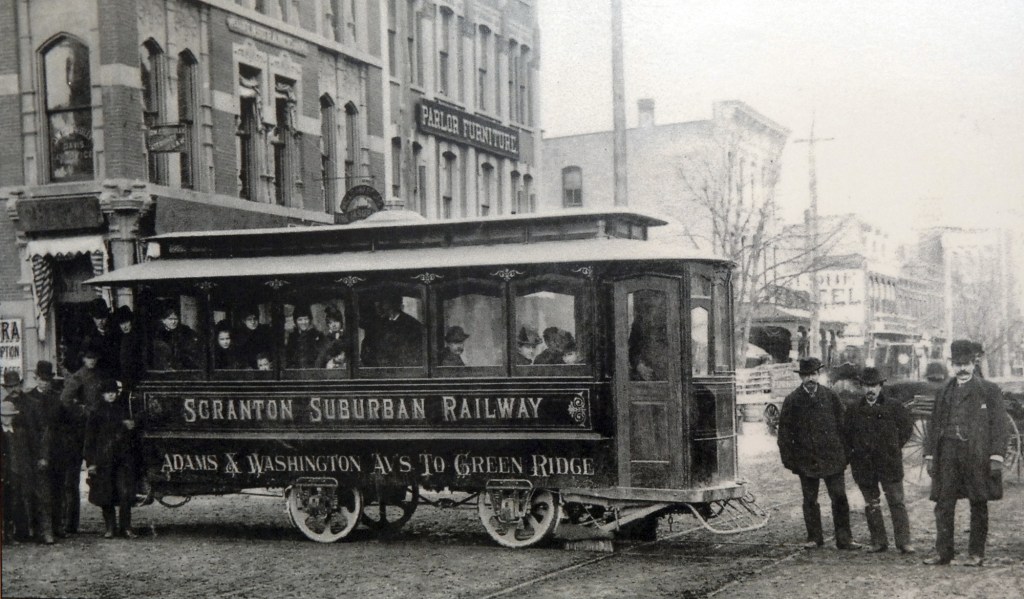
On Nov. 30, 1886, the British-American Henry M. Stanley visited Scranton to deliver a speech to a crowd of gatherers at the Academy of Music on Wyoming Avenue. Fifteen years earlier, he found the pioneering Christian missionary and martyr Dr. David Livingstone during an exploration in modern-day Tanzania. He greeted the legendary man with a phrase still famous today — “Dr. Livingstone, I presume?” — that took on worldwide notoriety in the late 19th Century.
His appearance turned out to be a mere historical sidebar to how the people of Scranton traveled to the Academy of Music that night.
Stanley’s arrival coincided with the maiden voyage of the Scranton Suburban Electric Railway, the first commercially successful electric streetcar system in the United States. Many attendees took the opportunity to catch the innovative train home from the downtown event.
With that first ride, Scranton paved the way for a reshaped system of urban transit nationwide. The trolleys ended the halcyon days for horse-drawn carriages, linking major cities to outlying areas, drastically reducing commute times, encouraging population shifts and making mass transit an expectation for developing cities nationwide.

Edward B Sturges


CHRISTOPHER DOLAN / STAFF PHOTOGRAPHERPresident Joe Biden speaks outside the Electric City Trolley Museum in Scranton on Oct. 20.


Wayne Hiller, trolley museum director, left, and Mike Drumsta, restoration shop manager, talk about the restoration of Scranton Transit Co.’s No. 324 trolley. Jason Farmer / Staff Photographer

SUNDAY TIMES ARCHIVES Above, the Scranton Trolley rolls down Lackawanna Avenue in Scranton in 1952. Below, a Scranton police officer directs traffic on Courthouse Square during a snowstorm in 1926.

SUNDAY TIMES ARCHIVES A Dunmore-bound Scranton trolley carries military recruitment messages as it rolls down Lackawanna Avenue during World War II.

The “Scranton The Electric City” sign atop the Board of Trade Building on Linden St. in Scranton, circa early 1900s

times-tribune fileA writer suggests novel ways to raise money to pay the $500 monthly bill to keep Scranton’s Electric City sign lit after the end of a bank’s pledge to pay the bill for a year.
Show Caption
1 of 9
Edward B Sturges
Expand
The national ripple
The need to get around more efficiently was increasing in America in the late 1800s, and horse rides were becoming frustrating. What are considered short trips to neighboring towns now regularly took hours by carriage then, especially during the harsh winter months in Northeast Pennsylvania.
In early 1886, Scranton attorney Edward Sturges hired renowned inventor Charles Van Depoele — the inventor of the first trolley pole just a year earlier — to design a street railway that would operate exclusively on electric power. While other cities tried to improve transit within city streets, Van Depoele’s system proved it could work reliably, and cheaply, thanks to overhead lines.
For a nickel, Scrantonians could get across town in 15 minutes, in the comfort of a lit streetcar. And they traversed the area that way for nearly 70 decades until the automobile became commonplace.
The system’s success led to an influx of trains and routs. By 1900, it carried more than 10 million passengers each year. More than 100 miles of track connecting downtown Scranton to Dunmore, Carbondale, Forest City, and Pittston. It served as a model for mass transit across the country.
The living legacy
On a Nov. 16, 2006 episode of NBC’s classic Scranton-based mockumentary “The Office,” two characters — regional manager Michael Scott and salesman Dwight Schrute — performed a song as part of an orientation video for new employees at the fictional Dunder Mifflin Paper Company.
“They call it Scranton. What? The Electric City,” they sang.
The lyrics helped cement the city’s nickname — and attract its history — to a worldwide audience.
The Electric City sign that originally was illuminated atop the Board of Trade Building on Linden Street became perhaps the best-known marker of the Scranton skyline, as well. But the area’s electric street car history is best told at the Electric City Trolley Museum on Cliff Street, where several trolleys from the area are on display to thousands of visitors year-round.
Sidelight
We honor Sturges, Van Depoele and all who made the Scranton Suburban Electric Railway possible. Their foresight and ingenuity helped solve an issue that set the tone for passenger travel nationwide, making a vast land smaller and creating a thirst for innovation.
About the series
No. 5: As the nation approaches America250, we are counting down ways NEPA has powered American history. Missed a day? Read the full countdown as it unfolds at citizensvoice.com.