
In 1846, George Scranton traveled to New York City, hoping to strike a deal with the New York and Erie Railroad. For both sides, it was a meeting born of utter desperation.
Battling constant delays in its efforts to create an “iron highway” connecting the Hudson River just north of New York City to Lake Erie, the railroad was facing bankruptcy. To get a promised $3 million claim to the railway, it needed to hit a deadline to complete a service to Binghamton, New York, seemingly impossible considering that iron “T-rails” had to be imported from England.
Scranton’s ironworks business in the village of Slocum Hollow also was flirting with financial ruin. It hadn’t turned a profit, despite easy access to coal and iron deposits and a stone blast furnace built six years earlier. But the railroad contracted with Scranton to produce 12,000 tons of T-rails at $65 per ton — even though his company had never successfully produced a T-rail before.
A gamble for both sides, it ultimately helped drive U.S. industry and commerce for decades.
The national ripple
Through no small feats of engineering from what became renowned nationally as the Lackawanna Iron and Coal Company, the New York and Erie hit their deadline. Those T-rails connected New York City to the Great Lakes by rail, making commerce from the East Coast to the Midwest a reality.
With the use of its blast furnace and a newly constructed rolling mill, the company rolled out some of the first T-rails in the nation by July 1847. Over rugged mountains and through dense wilderness, T-rails were hauled by horse-drawn carriage from what is now downtown Scranton to New York state’s southern tier.
Over the next several decades, the ironworks expanded to five blast furnaces and two rolling mills, giving it the largest iron production capacity in the United States by 1865. Nearly one-sixth of the nation’s T-rails were made there during its production peak.
The living legacy
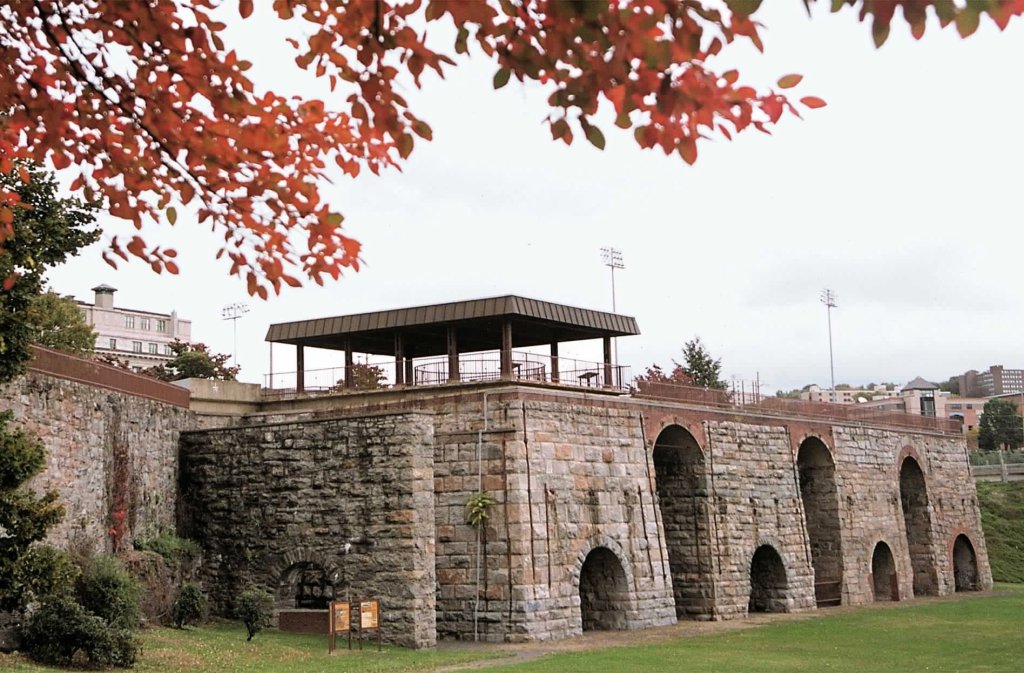
Today, Northeast Pennsylvania’s largest city exists primarily because of the ironworks’ success. Incorporated as a city in 1866, the iron furnaces stood at the time as the center of a rapidly growing, industrial Scranton. At its peak, the furnaces employed more than 5,000 people. They still stand as a tourist attraction off Cedar Avenue in the city, as a reminder of the city’s origins and contributions to the railroad industry.
Sidelight
We honor Scranton’s iron industry and the furnaces not just because they put Northeast Pennsylvania’s natural resources on display, but as examples of how human ingenuity and determination could cut a path to the Midwest.
About the series
No. 4: As the nation approaches America250, we are counting down ways NEPA has powered American history. Missed a day? Read the full countdown as it unfolds at citizensvoice.com.

Scranton Iron Furnaces (FILE)

The blast furnace plant of Lackawanna Iron and Steel Co., which operated in Scranton from 1840 to 1902, was part of a vast complex that covered 60 acres of ground laced by a network of rail lines. At peak of operation, 4,000 workmen produced 500,000 tons of steel ingots annually, the bulk of which were rolled into railroad tracks. In front of the plant is Roaring Brook, which flowed past the site in the vicinity of the Spruce Street Bridge. (FILE)

Historical marker on Cedar Avenue in Scranton at Iron Furnaces, looking south. JIM LOCKWOOD/STAFF PHOTO

John Bibalo, a preservation specialist from Steamtown National Historic Site, conducts a “Ring of Fire” demonstration at the Scranton Iron Furnaces in October 2021. (FILE)

Undated image of children swimming in the Scranton Iron Furnace Boom in South Scranton. (FILE)
Show Caption
1 of 5
Scranton Iron Furnaces (FILE)