
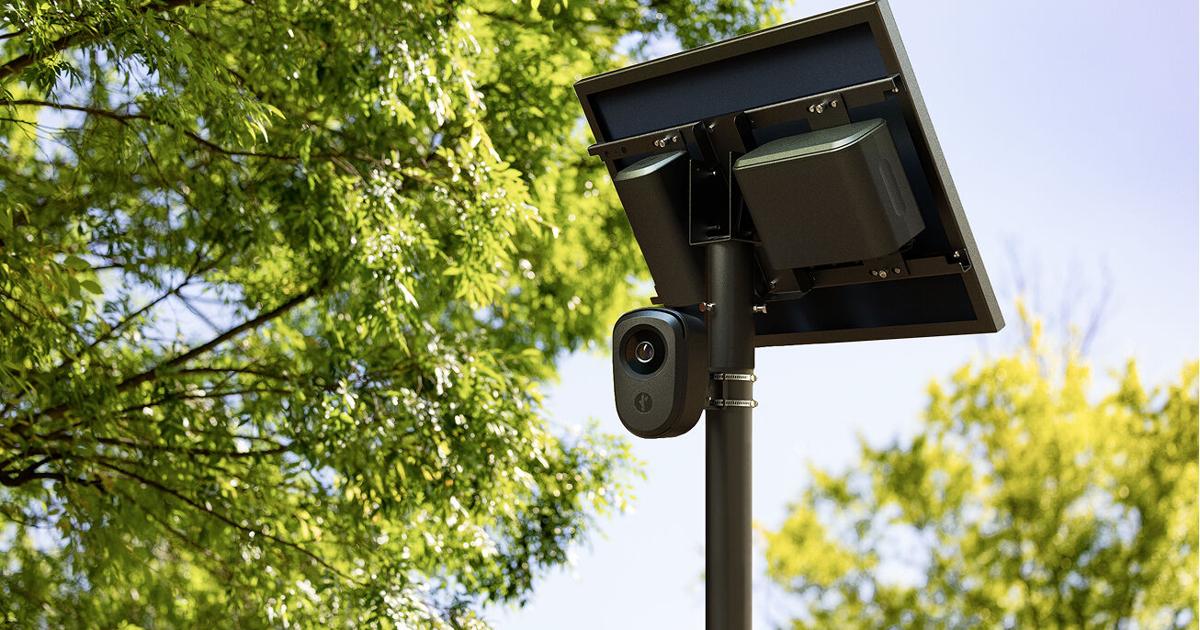
The use of Flock cameras and concerns about the Google Data Center dominated the June 16 Fort Wayne City Council meeting.
A presentation by Flock Safety representative Holly Beilin gave council an overview of the license plate readers (LPRs) that the Fort Wayne Police Department (FWPD) currently use.
According to a Facebook post, Beilin serves as chief of staff to the chief communications officer at Flock Safety.
The 411 on LPRs
License plate readers (LPRs) focus on the back of vehicles and the license plates. They compare the license plate to those in national and state crime databases using realtime alerts, Beilin said. For example, the National Crime Information Center (NCIC) has a list of known wanted vehicles. It alerts local law enforcement if a vehicle is detected as stolen, associated with a known wanted offender or a missing person, she said.
Software on LPRs categorize certain vehicle characteristics like the make, model, color, and certain aftermarket effects such as the addition of a roof rack.
“That’s all really helpful for law enforcement who are investigating crime,” Beilin said.
For example, it could help when a detective has a hit-and-run case where the victim doesn’t remember the entire license plate but remembers the vehicle was a silver sedan with a roofrack.
Law enforcement can access the system looking for silver sedans with a roof rack that were in the area at the time. That information and actual images can hopefully identify the vehicle in question, she said.
Every search requires a case number and a standardized offense type such as homicide or hit and run.
“That’s really important because every search conducted in the system is saved in an immutable, unchangeable audit record … Regular audits make sure that the system is being used for what it is intended to be used for,” Beilin said.
Beilin cited widespread collaboration with the Flock system.
Roughly three out of four agencies conduct regional collaboration using the Flock Safety system, she said.
FWPD Flock overview
The FWPD Transparency Portal outlines Flock policies and usage. This includes:
• Using the Flock Safety Operating System to capture objective evidence without compromising individual privacy.
• Using retroactive searches to solve crimes
• Using real time alerts of hotlist vehiclesThe portal also lists a network of law enforcement agencies where information is bothshared and received.FWPD Flock policies include:
• Only license plates and vehicles are detected
• Facial recognition, people, gender, and race are not detected
• Data is used for law enforcement purposes only
• Data is owned by FWPD and is never sold to third parties.
• Prohibited uses include immigration enforcement, speed enforcement, harassment, orintimidation based solely on a protected class such as race, sex, and religion
• Personal use is also prohibited.
• Hotlist hits require human verification prior to action.
FWPD usage statistics include:
• Data is retained for 180 days
• The number of LPR cameras is 44
Besides Flock cameras specific to Fort Wayne, Beilin shared that other Flock hardware and software that is available nationwide.
Flock overview
Flock is a suite of hardware and software. It includes:
• License plate recognition cameras (LPRs)
• Audio crime detection sensors
• Traditional video surveillance cameras
• Drones as first responders (DFR)“Communities can have one of these tools. They can have two, three or all of these tools,” Beilin said.
For example, some communities may have a gun violence problem and really need the audio crime sensors that help detect gunshots, she said.
Meanwhile, other communities may have a problem in their parks and need traditional video cameras, she said.
“It’s really customizable based on what each individual community wants,” Beilin said.
In other matters
Council voted 8-0 to hold G-26-06-31.pdf. This is a general resolution creating a DataCenter & Community Quality of Life+ Task Force for the City of Fort Wayne.
According to Russ Jehl, R-2nd, the purpose of the task force is to provide recommendations to the mayor, city council, and city departments on quality of life and environmental issues from local data center developments.
Jehl expressed concerns over unanswered questions that prompted him to draft this resolution and two other related resolutions.
“I just want something … where we no longer ignore the questions, but that we address them,” Jehl said.
Additionally, language in the proposed resolution includes “the task force … acting as a point of contact for residents to receive information regarding their data center related questions.”
“There’s a high likelihood that at some point another data center might want to come here.
The existing data center might even want to expand past its existing footprint. We should have a group that is vigilant and active in shaping this policy,” he said.
Jehl cited three reasons for introducing the resolution.
These include:
• Addressing concerns some people have about “forever chemicals” Google might be putting in the city’s water, as well as, getting answers to other frequently asked questions
• Growing skepticism about Project Zodiac and the data center
• The impact one of the largest economic development projects in the community has on other businesses considering locating in Fort Wayne
“When it’s something this large, it has the ability to shape our community’s reputation for other businesses as they look to locate here,” Jehl said.
At the conclusion of Jehl’s presentation, Jonathan Leist, director of Community Development, responded to what he called, “some factual errors” in the resolutions.
No ‘forever chemicals’
Leist addressed Jehl’s concern about “forever chemicals” entering city water.
“The answer is, ‘no.’ I want to just make that super clear… they’re not putting “forever chemicals” back into our waters,” Leist said. Adding, “City Utilities will be testing on that, like they do any other wastewater entering their stream.”
Additionally, Jehl introduced two other resolutions regarding the Google Data Center.
• R-26-06-32.pdf is a resolution requesting information concerning the Google abatement and the Economic Development Agreement.
Council voted 8-0 to table R-26-06-32.pdf. Jehl also presented R-26-06-33.pdf. The resolution requests the director of Community Development to report the use of funds accrued by the sale of land for ProjectZodiac/Google.
Council voted 4-4 to table R-26-06-33.pdf. Because it was a tie vote the motion to table failed, and Jehl then withdrew the resolution.
To view the FWPD Transparency Portal on Flock policies and usage go to https://transparency.flocksafety.com/fort-wayne-in-pd-.
To view Fort Wayne City Council meetings go to https://afw.viebit.com.
The next Fort Wayne City Council meeting is scheduled for July 7 at 5:30 p.m. at Citizens Square, 200 E. Berry St, in Room 035.