
From Philly and the Pa. suburbs to South Jersey and Delaware, what would you like WHYY News to cover? Let us know!
Philadelphia likes to get into a tussle. As the country celebrates its 250th anniversary, Philly is locking horns with Boston.
“There is 100% a rivalry between Boston and Philadelphia,” said Emily Sneff, author of “When the Declaration of Independence was News.” “It is sure to come up at almost any historical conference or any sort of event where you’re talking about, ‘Where did the Revolution really happen? Where was Ben Franklin really from?’ Those kinds of questions.”
A question for the nation’s semiquincentennial: Which city has the most historic copies of the Declaration of Independence? In Boston, four institutions have collaborated on an online map showing the curious how to take the subway to six exhibits of Declarations.
“They have a whole Declaration Trail linking different institutions together, so you can see different copies in different places,” Sneff said. “But I think in terms of raw numbers, Philadelphia wins out.”
There are at least 15 historic Declarations of Independence on view in Philadelphia this summer, according to a count done by the National Constitution Center. They are all within a few blocks of each other: At the NCC, the Historical Society of Pennsylvania, the Museum of the American Revolution, the American Philosophical Society and the Weitzman Museum of American Jewish History.
The original Declaration did not stand the test of time
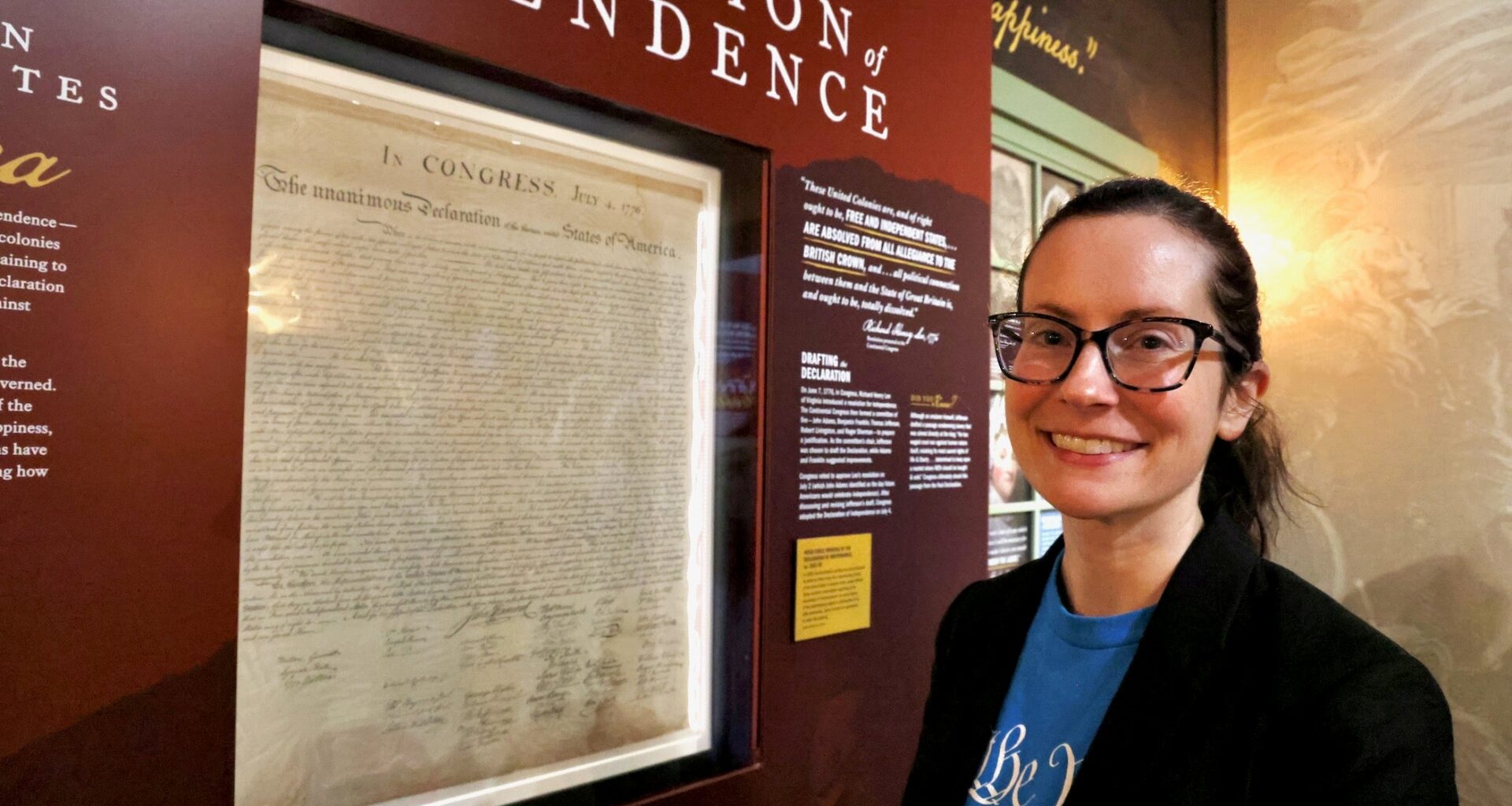
The NCC has a copy of the Declaration of Independence in its exhibition “America’s Founding.” An 1833 copy published by Washington, D.C., printer Peter Force is on display in a gallery modeled after an 18th century Boston tavern.
The Force printing looks remarkably similar to the original hand-written version, down to the familiar swoop of John Hancock’s signature. It is a meticulously copied version because, by the 1820s, the original, which is held at the National Archive in Washington, was already badly deteriorated. It was, and still is, indecipherable.
“It was put on display in less-than-ideal conditions,” said Elena Popchock, NCC senior manager of exhibit content. “There was lots of light. Light is not friendly to paper documents, particularly ink. So, it ultimately is very illegible. This is already happening several decades after 1776.”
To preserve the image of the original document on its 50th anniversary, Congress commissioned printer William Stone to engrave an exact copy onto a copper plate. The 1833 print was taken from that plate, for retail. It would have been folded into quadrants and added into a packet of facsimiles of founding documents that consumers in the early 19th century could buy and keep at home.