
The sky above The Golden Triangle will go full technicolor this weekend as part of what organizers are touting as one of the most massive logistical undertakings Pittsburgh’s Fourth of July fireworks have ever known.
To celebrate the 250th anniversary of America, Pittsburgh and Carrolltown, Pa., based fireworks company Starfire Corporation have tapped five barges on the Three Rivers and the Wyndham Grand Hotel rooftop to play host to 6,000 individual cues. Each cue corresponds to different intensity levels and numbers of vibrant booms over a 25-minute show.
That’s 4,800 more than the city used to electrify the night in 2025.
“If you’re sitting on the shore of the Allegheny looking towards Point State Park, it’s going to just spread the sky. And if you’re over on the South Side or even on this side of the Mon side of the Point, you’re going to see a whole scene,” Starfire Corporation vice president Vince Terrizzi Jr. said.
“It’s not just two little points. It’s going to be almost a panorama type of effect.”
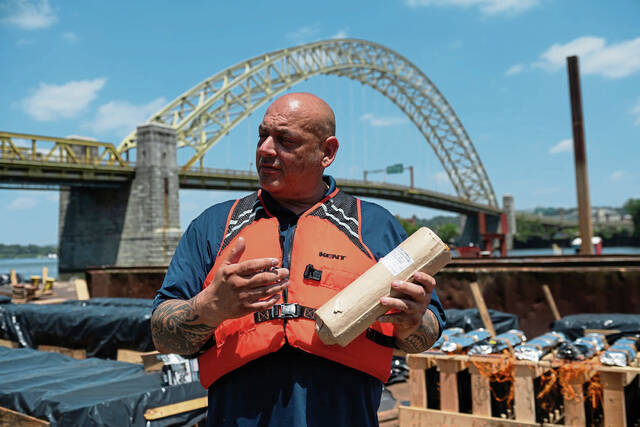
Many of those 6,000 cues currently sit on five 120-to-135-foot barges awaiting the show on the Ohio River’s South Shore opposite Rivers Casino, the Pittsburgh skyline looming large in the background.
Each cue is represented by a tangle of orange wire leading to a numbered hookup. Each represents its own logistical challenge and a cog in a show requiring tight, digitally coordinated timing. On the other end of the wires are bricklike explosives wrapped in shining silver foil and covered with black tarps. It’s all held together in groups by wooden racks carefully spaced for safety purposes in case of an explosion.
“[The wires are] attached to multiple different devices, so some might shoot 10, some might shoot 100, some might shoot 20,” said Terrizzi.
From two river launch points 600 feet from the Ft. Duquesne and Ft. Pitt bridges, Starfire will top out at 4-inch explosives. A thousand feet from shore, where the Three Rivers meet, six-inch explosives will be fired from three barges.
Each will fire off projectiles made in countries including Italy, China and Spain as well as by Starfire and Little Big Shots in Pennsylvania.
It’s all part of the show designed by Armstrong’s restaurant co-owner Ralph Piacquadio and David Hunter, both of whom have long designed for Starfire.
“He’s been doing fireworks forever,” said Terrizzi of Piacquadio. “His loves are cooking and fireworks, cooking up amazing shows.”
With “Pyro Crew” emblazoned on his sleeve, Terrizzi held up a large cylindrical explosive called a lampare made by Little Big Shots.
“This is a heavy salute [type of firework] down on the bottom. And then up here is a liquid that they use, so when it gives you that heavy boom, it gives you a big orange fireball in the sky at the same time. So it’s something unique. It’s very old school,” explained Terrizzi. “It’s not something that people use in a lot of shows, but we’re pulling out all the stops here.”
The lampare is just one of “dozens upon dozens” effects with assorted names — including crossettes, crackles, two-and-three color-changers, chrysanthemums, peonies, salutes, seven-shots from Spain and more — that will be on display. Each carries its own unique chemical mechanism and properties.
“For every inch in diameter is how big the shell breaks, and that’s how many 100 feet it goes up,” he said. “So, a three-inch technically should go about 300 feet, break about 300 feet in diameter. Six hundred feet [should be] 600 feet in diameter. It depends on what the effect is, how it’s lifted, manufactured.”
“[It will be] somewhere close to 300 miles an hour by the time it reaches the mouth of the pipe. And then once it gets up there, the time fuse is cut so that it hits a certain apex and then it detonates to get to where you want it to.”
Since last Wednesday, 18 of Starfire’s 28 full-time employees have been putting in 12-hour days to prepare for the main event — and rearranging things on the fly once they realized the barges they received were collectively 85 feet shorter than the space requested.
They test each connection with a special plug-in device that lights up corresponding LED lights, one by one, to make sure they’ll fire properly.
“We’ll be watching these things like a hawk to make sure we’re ready to go on the Fourth and there’s no issues,” said Terrizzi. “But technically, if we really had to, we could shoot this tonight.”
They will control things digitally from strategically placed “shooter shacks,” each overseeing one of four separate show components.
Timing is key.
“The computer will find what we drop in that position [of the show. It’s called a pre-fire, so they’ll pre-lift that shell so many seconds before. If they wanted a cymbal crash at two minutes in a song and [the firework] takes three seconds to leave, the three seconds before that cymbal crash, it’ll find that shell out here and fire it so that it’s right on time.”
Terrizzi will be stationed atop the Wyndham.
Somewhere a little below him in a room with a river view, his 80-year-old father, Vince Terrizzi Sr. — who has been in the fireworks business since the 1960s — and his mother, Jean, will have arguably the best seats in the house.
Terrizzi Sr. is taking a break from his 30-year annual gig orchestrating Brentwood’s fireworks due to stenosis of the back and heart that limits his mobility. Instead, he’ll watch his son’s handiwork.
“I love my mom and dad. I went and worked other jobs when [the company was] smaller and regional. And every job I worked always gave me off on the Fourth of July to be with my parents,” said Terrizzi Jr. “Because they know that they mean the world to me.”
The second-generation fireworks professional can still remember looking toward the heavens at 3 years old in 1975 to watch his dad light up the night with a Liberty Bell shape. He’ll be keeping his dad’s old adage of “It’s just another firework show, but it’s just more” in mind to keep under control.
“Our goal is to take people’s breath away,” said Terrizzi Jr. “My mom said she’s going to smack me if I crack any of those windows. So we’ll see what happens. We’re definitely going to push it to the limit.”