
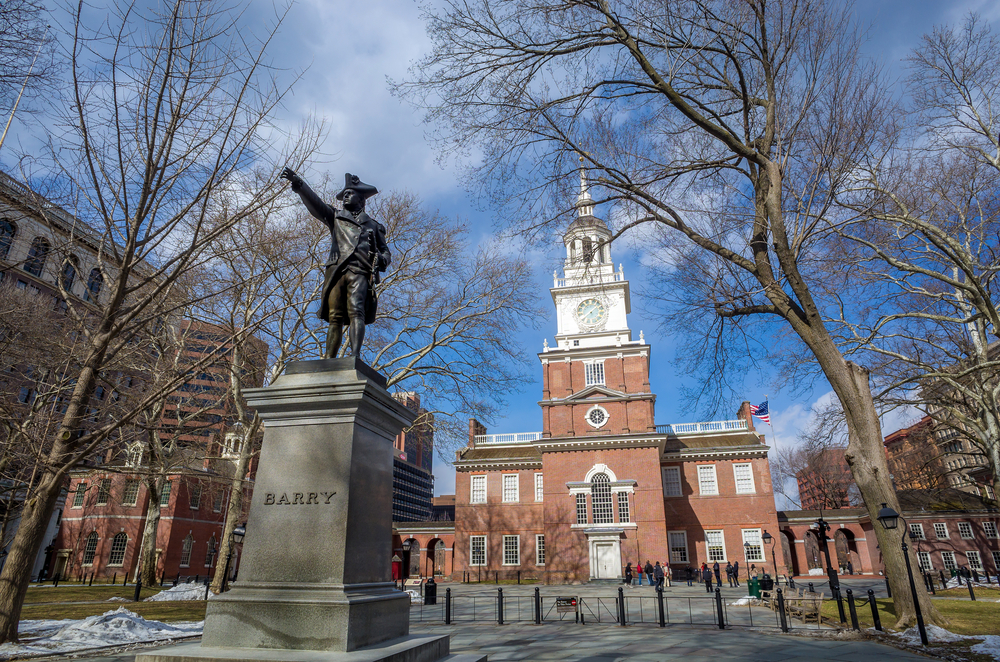
It’s been 250 years since the Continental Congress meeting in Philadelphia declared on July 4, 1776, that all men have “certain unalienable Rights, that among these are Life, Liberty and the pursuit of Happiness.” With that anniversary in mind, we asked our readers what those words mean to them and what it means to be an American two and a half centuries later. Here are their responses.
America’s anniversary can bring us together
Recently I attended a meeting to gather community input for a proposed grant-funded 250th anniversary mural in Bethlehem. I attended because I live near the proposed mural site. The artist professionally presented his concept and then listened to concerns and suggestions. He answered all our questions. Perhaps because I am exhausted from the national rancor, my heart “grew and grew,” as Dr. Seuss would say, as I watched this small democracy event unfold. Yes, we can communicate civilly and respectfully.
I will celebrate our 250th by doing my very best to ignore the national pandemonium and will concentrate instead on all the local folks and organizations who devote their time and effort to make our lives better, most invisibly behind the scenes.
The icing on the cake for me was walking home past the grand strip of blooming summer flowers on Walnut Street next to the Sun Inn Courtyard. The flowers were being watered by a volunteer who for years had laboriously hand watered this gorgeous urban surprise but now has an outside water connection and a hose. People like Bill, the volunteer, are what I will celebrate for the 250th. Those and the geniuses who wrote the Federalist Papers are my 250th Anniversary heroes.
— Linda F. Brown, Bethlehem
We must guard against losing our freedoms
I often think about the state of our country and wonder what the Founding Fathers might think of America today. I wonder if they would be proud of our progress or concerned by our direction, having penned the words “life, liberty and the pursuit of happiness” 250 years ago.
I remember our ancestors who fled communism in Poland and Czechoslovakia as teenagers, arriving alone at Ellis Island. They were resilient, learned a new language to survive, and worked tirelessly for a better life for future generations. I believe they instilled that same spirit in us, and it’s our responsibility to carry it forward.
I feel we are beginning to lose our national identity. Our Founding Fathers were clear about their beliefs and the future they were building. Many today sometimes seem to take our freedoms for granted. Freedom is not free; it is easy to lose and difficult to regain. We must remember that it was never intended for us to simply sit back and ask for more, but rather to protect what was built.
I believe we must hold on to our values and our freedom tightly, whatever it takes.
— Mary Wozniak, East Allen Township
America’s commitment to democracy endures
Benjamin Franklin famously said after the constitutional convention in 1787 that the delegates had given our new nation “a republic, if you can keep it.” Eleven years earlier, on July 4, 1776, the Declaration of Independence set forth America’s foundational principles that “all men are created equal, that they are endowed by their Creator with certain unalienable Rights, that among these are Life, Liberty and the pursuit of Happiness.”
I have no doubt Franklin, and our other founders, would admire the economic prosperity, military might and broad respect for individual freedom that exists in America 250 years after their bold experiment in self-government. Each new generation of Americans has made our nation stronger, striving for a more perfect union even during war and societal change. There have been mistakes and stumbles along the way, but holding fast to our foundational principles and constitutionally protected rights has kept us a prosperous country and beacon of liberty to the world.
America today is more diverse in many ways than it was in 1776, but our citizens’ overriding commitment to democracy, civic engagement and pursuing the American dream endures in 2026.
We each need to continue doing our part to keep the republic.
— Jarrett Coleman, state senator, R-Lehigh
Americans may disagree but still support each other
America’s 250th birthday should feel like a family reunion: loud, messy, hopeful and full of people who disagree about the potato salad and politics but still show up for each other.
That is the America I believe in: not a place where we all think alike, but where we still see each other as neighbors. Here in Lehigh County, that spirit lives in our daily lives and in the history ordinary people made here.
When the revolution was in danger, ordinary people carried the Liberty Bell out of Philadelphia by wagon and hid it in Zion’s Reformed Church in Allentown, along with other bells.
The American dream has always depended on people like that, and people like us. I believe we owe something to one another: the patience to disagree, the courage to keep going, and the decency to show up when our neighbors need us.
This anniversary is also a good time to honor those who keep serving after they come home, such as Chad Butters, whose family owns Eight Oaks Farm Distillery in New Tripoli.
I hope to see you there, so we can honor the stories passed down to us and think about the stories future generations will tell about what we chose to build together.
— Mark Pinsley, Lehigh County controller
Our nation’s ideals will help us continue
Life, liberty and the pursuit of happiness are important, easy-to-understand words that possess enormous meaning. They have endured, provided our freedoms and strengthened our nation for 250 years.
Contained in what is the foundation (Declaration of Independence) of the strongest and most enduring republic the world has ever and will ever know, they will continue to provide the ideals and meaning to preserve our independence and self-reliance for generations to come.
The human sacrifice that ensured those words would stand as a cornerstone of our nation was tremendous and can never be forgotten.
Every day as I witness the vile barrage of attacks disparaging and attempting to destroy those words and their meaning, I remind myself however poisonous I find those ideas and those spewing them, they have the right to do so. Ironically protected by the document they despise.
Most importantly those words ensure my ability and the ability of the majority to neither follow nor accept attempts to destroy or counter our right to life, liberty and the pursuit of happiness as envisioned and memorialized by our forefathers 250 years ago.
— Mark Porcaro, Palmer Township
It’s a blessing to be a US citizen
Decades passed before I realized that one of my greatest blessings was being born and raised in the United States. Recently I began contemplating the Declaration of Independence’s profound meaning. Although 1,320 words long, 36 words seem to summarize it: “We hold these truths to be self-evident, that all men are created equal, that they are endowed by their Creator with certain unalienable Rights, that among these are Life, Liberty and the pursuit of Happiness.”
The declaration’s appearance in 1776 was a flashpoint: Slavery flourished almost everywhere, including the British colonies, making a mockery of equality among men, and one’s “rights” were dispensed by others, not inherent in humanity itself.
Following our Constitution (1787), the 10 amendments in the Bill of Rights (1791) expanded the rights implied by the declaration. Historian Joseph Ellis praises the founders of our republic established by those documents: “I come away from it still believing that the gathering of political talent at this historical moment is unlikely ever to be surpassed.”
Peggy Noonan’s June 11 Wall Street Journal op-ed uses the movie “Rocky” to describe the land of opportunity created by our founding documents: “Anyone from anywhere can become anything.”
— James Largay, Upper Saucon Township
Living up to America’s promise is essential
That “all men” are created equal has been America’s struggle for the length of its existence. Originally “all men” included a small percentage of the population, largely consisting of property-owning white men. America has struggled throughout its history to correct the understanding of “all men” to “all people,” regardless of their color, sex, ancestry, religion or lack of religion; in short every living human. We still work at that 250 years later.
That all people are “endowed by their Creator with certain unalienable Rights, that among these are Life, Liberty, and the pursuit of Happiness,” means that those in power and all fellow Americans shall not trample or infringe or in anyway curtail your rights to “Life,” to live without harm; to “Liberty,” to have freedom to make your own choices in the pursuit of Happiness” while chasing your own dreams. This holds true for all people independent of all the things that make one person different from another. This we struggle with today, but that is America throughout its history and founding. At 250 years, do we continue this struggle or acquiescence to any authority figure telling us what to do?
— Chris Letourneau, Bethlehem Township
Women played crucial roles in American Revolution
All men have certain unalienable rights, that among these are Life, Liberty and the pursuit of Happiness.
These remarkable words declared the independence of our nation, but there’s a problem with them — they excluded half of the population. In 1776, women were not allowed to vote, own property or control their own wages.
Despite that, many stepped up to fight for America’s freedom, but their contributions as nurses, diplomats, spies and soldiers were often diminished if not outright ignored.
Sybil Ludington rode 40 miles to alert the militia in Danbury, Connecticut, of an impending attack. Mercy Otis Warren wrote stirring essays, advocating for the revolutionary cause. Mary Ludwig Hays, aka “Molly Pitcher,” brought water to troops on the battlefield. When her husband fell, she took his place at the cannon, firing at British soldiers. Deborah Sampson disguised herself as a man and served in the army for three years under the name “Robert Shurtliff.”
Freedom’s siren call is powerful, inspiring great acts of courage even by those who may never achieve the benefits for themselves. On our 250th anniversary, please take a moment to remember the sacrifices women made to earn the liberty we all enjoy.
— Becky Bartlett, Upper Nazareth Township
A fair chance is the promise of America
The phrase “Life, Liberty, and the pursuit of Happiness” isn’t just something from a history book — it feels like a promise that still matters in everyday life. To me, it suggests that everyone should have a fair shot: the chance to live safely, make their own choices, and build a life that feels meaningful to them. Back in 1776, that idea was revolutionary. Today, it’s something we’re still trying to live up to. Being an American two and a half centuries later means having freedoms that people in many places still fight for, but also understanding those freedoms come with responsibility. It means speaking up when something isn’t fair, respecting different viewpoints and recognizing that not everyone experiences those rights equally. In a real sense, being American is about effort — trying, in small and big ways, to make things a little better, not just for yourself, but for others too.
— Donald Cease, Allentown
To the founders and We the People, happy birthday
There are government leaders today who think altering history by massaging facts, slow walking court rulings and stifling individual freedoms gives them the power to advance their agendas.
In philosopher John Locke’s theory state of nature: People have inherent rights, governments exist to protect those rights, and when government systematically violates them, the people can replace it. According to this social contract, we the people agree to relinquish some personal freedoms in exchange for protections by the state, and, will be “endowed with natural rights to life, liberty, and property.”
Thomas Jefferson and friends saw this as an awakening to write a declaration for colonists to rise up against a subjugating king and revolt. And Thomas Paine’s timely pamphlet, “Common Sense,” put into easy-to-understand language 27 grievances the colonists had. The pamphlet was distributed throughout the 13 colonies and helped ignite the fight for their freedom.
James Madison and others understood, for a fragile republic to survive, it would require a set of democratic principles, as described in the Constitution, and an independent press.
They foresaw a freedom of ideas that would shape and reshape American democracy for the next 250 years. Thank you, gentlemen, and happy birthday, America.
— John Schmoyer, North Whitehall Township
Thanks to Americans who paved the way
Recently, after updating my will, my lawyer announced I have now earned the right to freely do what I want to do. I was momentarily flattered. However, on reflection, I knew I didn’t earn this right on my own. I had lots of help.
My life’s journey has been done within a much larger system of laws, infrastructure, customs, education systems, social norms, safety nets and moral codes that gave me the freedom to choose my path. These enabling systems were created 250 years ago by America’s founders and have grown and been strengthened over many decades of good stewardship by our political leaders and citizen neighbors.
I have always felt a deep sense of gratitude for the work the many hundreds of my direct American ancestors put in over the past two centuries. They bequeathed to me a strong sense of duty.
America’s founders, stewards and my American-born ancestors created a safe, free, optimistic and thriving environment, which I leveraged to build something positive for my family over the seven decades of my life. I have a deep sense of gratitude for them all. I also have a duty to pass this rare legacy on. And I will.
— Jim Ludlow, Upper Macungie Township
Rights under attack in America
The 250th anniversary of America’s founding is a joyous occasion to commemorate the incomparable rights enjoyed by its citizens. The Declaration of Independence uses the term “unalienable” rights. But what does that mean today, 250 years later, and what does it mean for America’s next 250 years
When the Declaration of Independence was written, words had different meanings (all men are created equal). Not women, not Blacks. Just white men.
Today, it appears the right to liberty as mentioned in the Declaration of Independence is only for U.S. citizens, and even then, if you look different — say, brown or Black — your liberty may be infringed upon.
Following decisions by a conservative Supreme Court, other rights are in question, such as the right of a woman to end a dangerous or unwanted pregnancy.
The goals of our founding fathers were aspirational and, at that time, enforceable. Today, on our 250th anniversary, we need to hold the words of the Declaration of Independence close to our hearts and minds. We live in the greatest country in the world. Let us protect and foster those unalienable rights … for everyone.
— Rosalyn A. Metzger, Bethlehem
US has not lived up to all of its promise
America’s 250th anniversary is an obvious time to reflect on, measure and grade what the Founding Fathers laid out for this nation in comparison to where we are today. One of the cornerstones of the Declaration of Independence, the secular equivalent to “do unto others,” is “that all men are created equal.”
After 250 years, we have failed miserably to live up to that statement. For insight, one should read the Frederick Douglass speech, “What to the Slave is the 4th of July?”
Clearly we have come a long way since the Civil War but at a snail’s pace for our citizens of color. It took 100 years after the war for Congress to pass the Voting Rights Act of 1965 so Black citizens could vote without the threat of a bullet, torch or the end of a noose. In the meantime, legal segregation and institutional racism in housing, education, banking and employment remained dominant in our society. Those failures still echo today in the inability of minority families to build generational wealth on an equal scale to white citizens.
— Bob Aylward, South Whitehall Township
Protest is an American right
When Thomas Jefferson wrote the phrase “Life, Liberty and the Pursuit of Happiness” as unalienable rights in the Declaration of Independence in 1776, I believe he was declaring that “We the People” of this great nation of ours have the fundamental right to exist, to survive and to be secure in our homes and in our communities; the freedom to act, to think and to express ourselves without unjust interference or oppression by the government; and to seek personal joy, to fulfill one’s potential, and to make individual choices about our own destinies.
And since that time, those are the words that I, along with the many millions of patriotic Americans who have come before me, cherish; which is why I follow in the great American tradition of standing in protest, and of writing articles, letters to the editor and songs of protest, whenever I become aware of injustices being done by those in power, and by those who would do harm to those less fortunate than themselves.
Thomas Jefferson’s writing and I encourage everyone to do the same.
— Robert K. McFadden, Upper Macungie Township
The Morning Call publishes letters from readers online and in print several times a week. Submit a letter to the editor at letters@mcall.com. The views expressed in this piece are those of its individual authors and should not be interpreted as reflecting the views of this publication.