
Editor’s note: Pennsylvania and New Jersey have played a key role in the nation’s 250-year history. While most are familiar with the events that happened in Philadelphia, our region also played a pivotal role in the development of the fledgling nation. In honor of the country’s 250th anniversary celebration, we will feature some of the places, people and events in the region that helped shape America’s history.
The first president of the United States stepped down from his coach onto what is now Penn Square in Reading in the early autumn of 1794.
The fall colors had yet to tinge much of the surrounding Neversink Mountain and Pagoda-less Mount Penn, and the drone of the dog-day cicada that had been prevalent since August had begun to fade.
 USA 250 Anniversary Logo
The pungent smell of wood smoke from cooking fires mixed with that of horses and leather as Michael Wood, the proprietor of the Federal Inn on the northwest corner of what is now Fifth and Penn streets, greeted the commander in chief, who was in Reading leading a well-regulated militia to suppress a rebellion in the western Pennsylvania counties over the levy of a federal tax on whiskey.
After dining at the inn, the Father of Our Country retired to his room, as the chirping of crickets and katydids blended with the calls in German of the teamsters along Callowhill Street, now Fifth Street, with the creaking and groaning of wagons and the clopping of hooves wafting through the open window.
George Washington slept here.
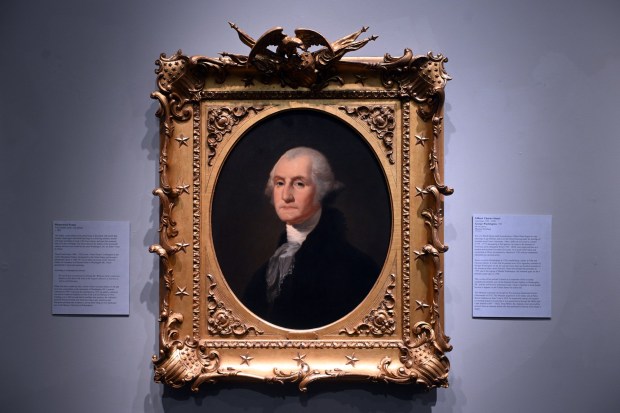 The Gilbert Charles Stuart circa 1795 painting of George Washington in the Reading Public Museum has received a frame recently purchased by the museum that is a stylistic fit with the original painting. (BILL UHRICH/READING EAGLE)
This low-key reception in Reading was unlike his previous Berks County visit a year earlier.
In the middle of November 1793, Washington had completed an inspection tour of the Union Canal in Lebanon County, a project that had cost the government a considerable sum of money.
On his return trip to Philadelphia, then the seat of government, he stayed the night of Nov. 13 in Womelsdorf at the Stouch Tavern.
The Readinger Unpartheyische Zeitung, a German newspaper — the first and only paper published in Berks at the time — covered the visit, noting a speech by the locals extolling “renewed veneration and love for you.”
The president replied, “The attention which you show me, and your approval of my efforts, afford me the greatest pleasure.”
A company of volunteers assembled at the tavern and fired volleys into the air exclaiming, “Lang lebe (Long live) George Washington! Lang lebe George Washington!”
After those rousing cheers, George Washington slept there.
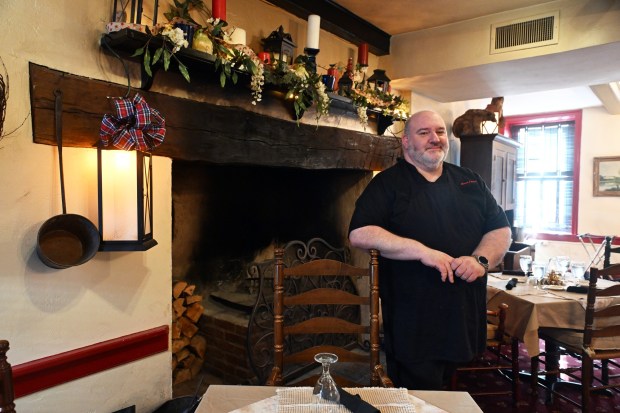 Matthew DeSantis, manager at the Stouch Tavern, stands by a fireplace in front of which George Washington may have warmed himself when he stayed overnight on Nov. 13, 1793, after inspecting locks on the Union Canal. (BILL UHRICH/READING EAGLE)
On his way to Reading from Womelsdorf, Washington stopped to pay his respects at the grave of Conrad Weiser and said, “Posterity will not forget his services.”
On his arrival in Reading, the Readinger Unpartheyische Zeitung reports:
“He was welcomed with a discharge of cannon, and after a stay of several hours and a satisfactory inspection of this place and its excellent situation and improvements, was accompanied with the quiet and unanimous well wishes of the inhabitants for his further journey.”
In contrast, Washington’s 1794 stay at the Federal Inn went unremarked in the German press.
“The citizens of Reading did not, as was the fashion of the times, and as was subsequently done at Harrisburg, Carlisle and other points of his progress, present General Washington on this occasion with an eulogistic address,” writes Louis Richards, historian and lawyer, whose account of Washington’s Berks visits was presented before the Historical Society of Berks County, now the Berks History Center, on the occasion of the 100th anniversary of Washington’s death on Dec. 12, 1899. Richards’ research into newly published Washington diaries form the basis of what is known about these visits.
“The probable reason for this was, I imagine,” Richards writes, “that Federalism was then, as it continued to be, the political faith of the few, and not of the masses of the town and country.”
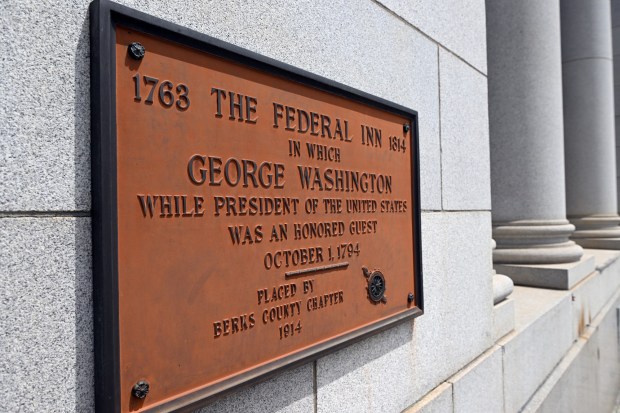 A plaque at Fifth and Penn streets indicates that George Washington slept at the Federal Inn on Oct. 1, 1794, on his way to suppress the Whiskey Rebellion. (BILL UHRICH/READING EAGLE)
Richards cites the journal entries of Capt. David Ford, commander of a New Jersey Troop of Horse then passing through Reading.
“Large numbers of the people were unfriendly toward the object of the Expedition,” Richards writes, “in which Federal laws were about to be enforced with Federal bayonets.”
Washington departed Reading on Oct. 2, later than he had hoped due to “an accident to one of my horses,” he writes, and then journeyed west to review again the progress of the canal.
“I got off in time however to make a halt (to bait my horses) at Womelsdorf, 14 miles, and to view the canal from Myerstown towards Lebanon, and the locks between the two places; which (four adjoining each other, in the descent from the Summit ground along the Tulpehocken, built of brick) appeared admirably constructed. Reached Lebanon at night, 28 miles.”
The Tulpehocken Manor, just outside Myerstown in Jackson Township, Lebanon County, along the path of the Union Canal and the Tulpehocken Creek, had provided respite to Washington on several occasions.
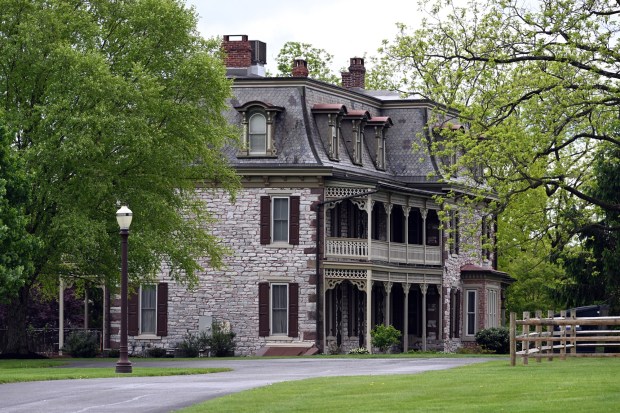 The Tulpehocken Manor in Jackson Township, Lebanon County, just past Myerstown, where George Washington slept during his visits. (BILL UHRICH/READING EAGLE)
The Manor, now an event center owned by twin brothers Jason and Geoff Brown, was built in 1769 in the Georgian style by Michael Ley, who then was a soldier and benefactor in the Revolutionary War, leading to his eventual bankruptcy.
The Browns note from a history of the manor that Washington stayed there in September 1777 as a reprieve from Valley Forge and slept in a second-floor room on the southeast corner.
The home was enlarged in the 1800s, but the room where Washington stayed remains, albeit with a taller ceiling.
The Browns haven’t emphasized the connections to Washington, who undoubtedly visited the manor on his two trips to view the canal locks, which were part of the property in the 1790s.
“We were too busy renovating and restoring the property after we bought it in 2002,” Geoff said with a laugh.
Mount Vernon historians don’t list the Ley house as a place where Washington stayed in 1777, but there is an interesting thread of circumstantial evidence of a Washington visit to Reading while at Valley Forge and perhaps to the manor that year.
Berks historian George Meiser IX, author with his wife, Gloria, of 25 volumes of the Passing Scene, said in a phone interview that Washington was hosted by Peter Nagle in his home in the first block of North Fifth Street, where the post office now stands, based on family history of Cedric Elmer, who now lives in California.
“I don’t doubt it for a minute,” Meiser said. “Washington visited Peter Nagle because Nagle was in charge of the Hessians that were interned at the Hessian Camp (on the slope of Mount Penn in east Reading) and wanted to know the status of what was going on there.”
Elmer owns a sideboard, Meiser said, from where Washington was served food on his visit.
The sideboard raises a furniture corollary to the George Washington Slept Here theme: George Washington Sat Here.
Richards in his presentation to the historical society tells of a low-backed, rush-bottomed armchair that was preserved in the home of William R. Davies, 300 Franklin St., in which Washington was seated on his 1794 visit at the house of Davies’ ancestor, Daniel Rose, the clockmaker who resided near the Federal Inn.
That chair is apparently lost to history.
On display at the Berks History Center, 940 Centre Ave., is a settee once owned by Dr. Peter Palm, a Sinking Spring resident and friend of Washington during the Revolutionary War. Legend had it that Washington rested on the bench during a visit with Palm as he traveled west from Reading in 1794 during the Whiskey Rebellion.
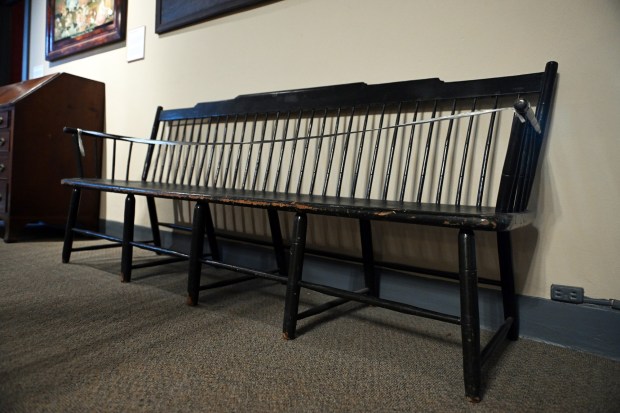 George Washington was thought to have sat on a settee now on display at the Berks History Center during his visit to Reading in 1794. Further research indicated that the bench was made 20 years after his visit. (BILL UHRICH/READING EAGLE)
Further research by the History Center revealed, however, that the settee was made around 20 years after Washington’s visit.
The Pottsgrove Manor in Pottstown is also a link in both the George Washington Slept and Sat Here themes.
Anna E. Meitzler, museum educator at Pottsgrove Manor, points to a chair on display at the manor that once belonged to Isaac Potts, the son of ironmaster and Pottstown founder John Potts.
On loan from the Mercer Museum in Doylestown, the chair has a silver plaque attached to it that reads: “This chair was used by Gen. Washington at Isaac Potts. Valley Forge, 1777 & 78.”
Meitzler is excited about the chair, not so much for the plaque, but the fact that so little of original furniture from the Potts family still survives and that it is on display at Pottsgrove.
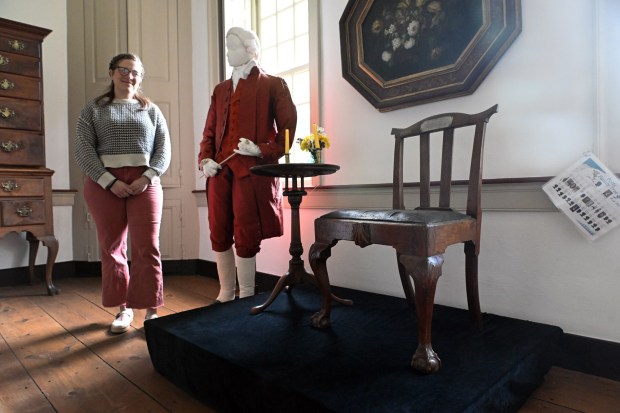 Anna E. Meitlzer, museum educator at Pottsgrove Manor, stands with a chair that belonged to Isaac Potts and was believed that George Washington had sat in it at Potts’ home in Valley Forge. (BILL UHRICH/READING EAGLE)
“However, Isaac Potts was living in Pottstown; his chair was with him in Pottstown,” Meitzler said, while also debunking another Washington legend. “George Washington didn’t come to Pottstown. He never sat in that chair.”
A former owner of the Pottsgrove Manor when it was a hotel early in the 20th century used the George Washington Slept Here motif as a marketing tool, she said.
A state historical marker that was once posted outside the manor erroneously states that Washington was headquartered there in September 1777, Meitzler said.
The marker is now on display in the museum.
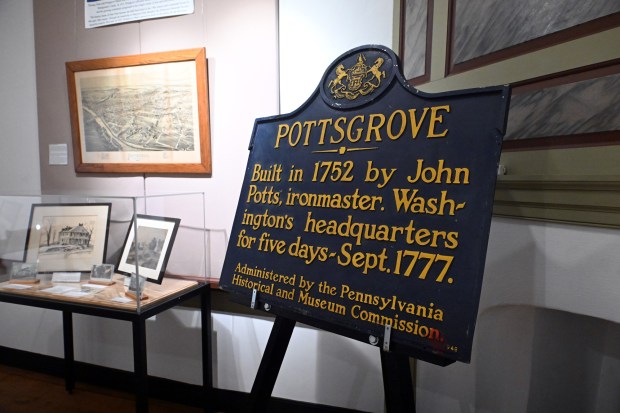 A state historical marker from 1948 mistakenly claims that George Washington stayed at the Pottssgrove Manor in Pottstown in September 1777. (BILL UHRICH/READING EAGLE)
“Washington was camped ‘near’ Pottsgrove at the time,” she said. “Over the years, the ‘near’ was dropped.”
Although the Federal Inn in Reading no longer exists, the site, now owned by developer Alan Shuman, is still sacred space.
“It is a true honor and privilege to be a steward of such a historic site, and we are working very hard to preserve the site’s current historic structures for many generations to come,” Shuman wrote in an email. “If President George Washington would stop back, I hope he would be pleased with the preservation of the grand historic structures on the site.”
The Stouch Tavern still stands despite a fire and several renovations that have somewhat altered the building, and a definite Washington theme is seen throughout the dining areas.
Matthew DeSantis, tavern manager, said that it’s unsure where on the second floor Washington stayed.
“It’s a storage space, now,” he said.
George Washington Slept Here has endured even though it doesn’t have the force for wonder that it once possessed.
“You have to understand that George Washington was venerated to a great degree all over the place, but especially locally,” Meiser said. “Think of how many secret societies years ago used to have pictures of Washington hanging up front.”
Every school, every one-room school, in Berks had George Washington’s picture hanging up over the blackboard, Meiser said.
“I had his portrait over my blackboard,” he said, referring to his teaching years in the Wyomissing School District.
“Not so much anymore, I guess, though,” Meiser said. “That’s kind of all faded, faded out in a lot of ways.
“We’re living in a different age.”