
In 1776, Philadelphia was the undeniable political, cultural, and financial center of America, as well as its largest city. As a result, it was the natural meeting place for the First and Second Continental Congresses which culminated in the adoption of the Declaration of Independence and the birth of our nation. Eleven years later, it hosted the Constitutional Convention which produced the US Constitution — both earth-shattering, momentous events which took place in the same building currently known as Independence Hall. In 1790, Philadelphia became the capital of the new nation.
And it was in the City of Brotherly Love, during the last decade of the 18th century, that General George Washington served two terms as the first President of the United States, and, in an unprecedented peaceful transfer of power, John Adams was sworn in as the second President. It was here that the US Supreme Court issued its first opinion and the US Congress admitted Vermont, Kentucky, and Tennessee into the Union — the first three states after the original thirteen.
Yet in 1800, when the capital moved from Philadelphia to Washington DC, the city quickly slipped into a relative obscurity from which it has rarely resurfaced.
One such notable occasion was a lengthy stop in Philadelphia by a celebrated French hero of the American Revolution, the Marquis de Lafayette, during his American “farewell tour” of 1824-25.
For his triumphant return, he was invited to speak at the Pennsylvania State House. In preparation, a local committee refurbished its Assembly Room which they referred to as “the Hall of Independence” — a name that eventually stuck to the stately, Georgian-style building. It was here that the Declaration had been debated — and eventually signed — and where the Marquis would deliver his remarks, praising the unique and glorious historic nature of the Hall — before being feted with a city parade that attracted tens of thousands.
His sentimental and emotion-filled visit awakened in Philadelphians, and Americans-at-large, a stronger desire to celebrate and preserve its sacred history — starting with the cancellation of the demolition of Independence Hall.
The Semicentennial
And yet, the 50th anniversary celebration of our nation’s splendid experiment in constitutional democracy did not garner near the attention for Philadelphia that the Marquis’ visit had elicited two years earlier. Independence Day had yet to be declared a national holiday and divisive partisan politics seemed to take center stage over the remarkable historic achievement that July 4, 1826, represented.
The day was also sadly overshadowed by the death of the Declaration’s author, President Thomas Jefferson — followed hours later by the passing of President John Adams, who had, along with Jefferson, served on the committee that drafted our nation’s defining, transcendent document.
The Centennial
Fifty years later, however, Philadelphia would, once again, take its rightful place at center stage as the nation prepared to celebrate its remarkable centennial. The 1876 Centennial International Exposition served as a showcase for the latest inventions including Bell’s telephone, the Corliss steam engine, the Remington typewriter, and Edison’s telegraph. Also introduced: Hires root beer, Heinz ketchup, and Whitman’s boxed chocolates, among so many others. The Expo would point to a bright future that lay ahead for a nation which had just recently put the Civil War, and the evil of slavery, behind it.
Among the two hundred buildings that were erected, Memorial Hall still stands on the same spot in Fairmount Park — a reminder of a celebration that attracted the participation of 35 nations, all 26 states, 10 million visitors, and various heads of state — including President Ulysses Grant.
The Sesquicentennial
Anxious to build on The Centennial’s overwhelming success, city leaders, led by John Wanamaker, planned another world’s fair for the 1926 celebration. Despite its best efforts, including the building of Municipal Stadium, one of the nation’s largest (later renamed for JFK), the Delaware River Bridge, the nation’s largest (later renamed for Ben Franklin), and the largest Liberty Bell replica, the Sesquicentennial International Exposition went bankrupt and into receivership — losing $20 million — a staggering sum for its day.
Hampered by World War l, the Spanish Flu Epidemic, and 107 rainy days which started on opening day and lasted throughout the summer, the Expo, held mostly on grounds in South Philadelphia, attracted 6 million visitors — 24 million short of its goal. But among the most prominent visitors were Queen Marie of Romania, the Prince and Princess of Sweden, the Spanish Premier, the Polish Minister, the Haitian President, and other international dignitaries.
On July 5th, President Calvin Coolidge delivered remarks at Municipal Stadium to over 35,000 attendees.
The Bicentennial
For the Bicentennial, a yet another world’s fair was originally planned by noted Philadelphia urban planner and architect, Edmund Bacon, but was unraveled by politics and put to rest by Mayor Frank Rizzo. In its stead, Independence National Historical Park was expanded and refurbished — which, in turn, helped rejuvenate the bordering Society Hill and Old City neighborhoods.
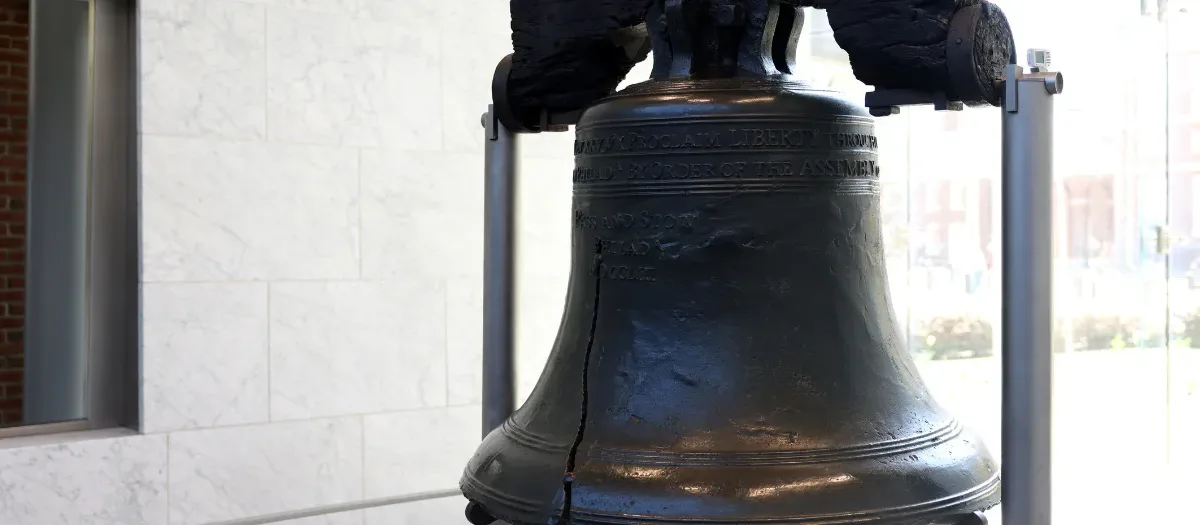
On January 1, 1976, the Liberty Bell was ceremoniously moved from Independence Hall to a new glass building within close proximity to its original home. This was done so that the Bell could be seen by more visitors — 24/7.
On July 4th, President Gerald Ford commemorated the 200th anniversary of the adoption of the Declaration by delivering a speech to over one million Americans gathered on Independence Mall.
And on July 6, the Queen of England came to Independence National Park and dedicated the Bicentennial Bell — her nation’s commemorative gift to the US, which was cast at the same British foundry as the original Liberty Bell. (The Bell still rings from the Park tower built to house it.)
In addition, King Carl XVI Gustaf of Sweden, President Valery Giscard d’Estaing of France, Chancellor Helmut Schmidt of Germany, Crown Prince Harald of Norway, and Prince Rainier and Princess Grace of Monaco also made commemorative stops in Philadelphia.
Like the Centennial Expo which held an international regatta on the Schuylkill River, and the Sesquicentennial Expo which hosted a boxing match, baseball game, and women’s track and field event, Philadelphia bicentennial planners organized numerous sporting events to generate interest and attendance — including MLB baseball games, the NCAA basketball tournament, and the NHL All-Star game. However, mostly due to Mayor Rizzo’s warnings of violent protests, which never materialized, only 2 million visitors attended Philadelphia’s Bicentennial celebration — a major disappointment.
But, a silver lining was the highly-acclaimed and widely-viewed 1976 film “Rocky” which showcased the city before the nation and entire world — winning the Best Picture Oscar along the way.
The Semiquincentennial
Which brings us to our current, underwhelming 250th celebration. It goes without saying that Philadelphia has infrequent opportunities to shine on the world stage. Opportunities like the Live Aid concert are rare.
But what the city does have, thanks to its incredible role in the founding of our nation at Independence Hall in 1776, and the subsequent adoption of the US Constitution in the same building in 1787, is an opportunity to lead our nation in celebrating their significant anniversaries.
Yet, that idea seems to have been completely lost on Mayor Cherelle Parker and the Wawa Welcome America planners. Their hyped-up but uninspired, let’s do the same thing again, parochial Semiquincentennial celebration lacks national and international appeal.
In fact, King Charles and his wife, unlike Queen Elizabeth in 1976, visited Washington DC earlier this year as a tribute to America250 — but bypassed Philadelphia on their way to New York City for further commemorative events. The only high-profile dignitaries to visit Philadelphia this year were King Willem-Alexander and Queen Máxima of the Netherlands.
And on July 4th, itself, there will be no visits from the current President, Vice President, or former Presidents. (It would have been a major coup to get former Presidents George W. Bush and Barack Obama to address a crowd, and the nation, on Independence Mall.)
There will be no world’s fair with elaborate new buildings showcasing the latest inventions and scientific advances — including space technology. No new bridges, stadiums, or Liberty Bell replicas.
To its credit, the National Constitution Center belatedly attempted to get the first American Pope to visit Philadelphia by awarding him the Liberty Medal — which Pope Leo will publicly accept, in absentia, on July 3rd. (He’ll make a video appearance instead.)
Also not happening — the renaming of Philadelphia International Airport after space enthusiast and grandfather of our nation, Ben Franklin — Philadelphia’s best-known international celebrity.
There will be no statues dedicated to the two other indispensable members of the Declaration Committee — Thomas Jefferson, and John Adams. Sadly, there isn’t a single statue of Adams anywhere in the city — and there is only a flimsy, unmarked statue of Jefferson.
Of course, some might argue that there will be a terrific corporate-sponsored concert on the parkway and a corporate-sponsored fireworks display over the Art Museum — along with corporate-sponsored block parties and another corporate-sponsored July 4th parade.
And I would say that we did the same thing last year — and every year prior for decades.
Some might point to the World Cup games being held in Philadelphia. Besides soccer not being an American pastime, I would point out that those high-priced ticketed games are also being held in many other cities throughout North America.
Most disappointing of all is the expected city turnout for this year’s celebration — 1.5 million visitors. From a high of 10 million for The Centennial to 6 million for The Sesquicentennial to 2 million for The Bicentennial to 1.5 million for The Semiquincentennial — the trend is clearly heading in the wrong direction.
Of course, the possibility that this year’s July 4th celebration will be the hottest ever recorded in the city’s history isn’t helpful either.
So, on America’s 250th Anniversary, New York City will once again take center stage over Philadelphia as at least 6 million spectators watch a planned parade of national and international ships sailing up the New York Harbor — just as they did in 1976. And, as an added feature, the iconic Times Square Ball will drop eight times to usher in July 4th for each of America’s eight time zones.
But if it’s not New York hogging center stage on Independence Day, it will be President Trump and whatever festivities he will be attending in Washington DC.
It has long been my hope that Philadelphia will one day get it right, and prove that it is, once again, a world-class city — one worthy of taking the national and international center stage on our nation’s most important anniversaries. Perhaps, in time, for America300?
Don Adams served as a Project Manager for the We The People 200 Committee — the official Bicentennial Celebration of the US Constitution in 1987. He was also a historical interpreter at Independence National Historical Park in the early 1980s.
Today, he is launching a website, IndependenceHallFoundation.US, which will promote the celebration of the Founders. Its first endeavors will be a campaign to rename Philadelphia International Airport after Ben Franklin and the erecting of new city statues to honor Thomas Jefferson and John Adams.