
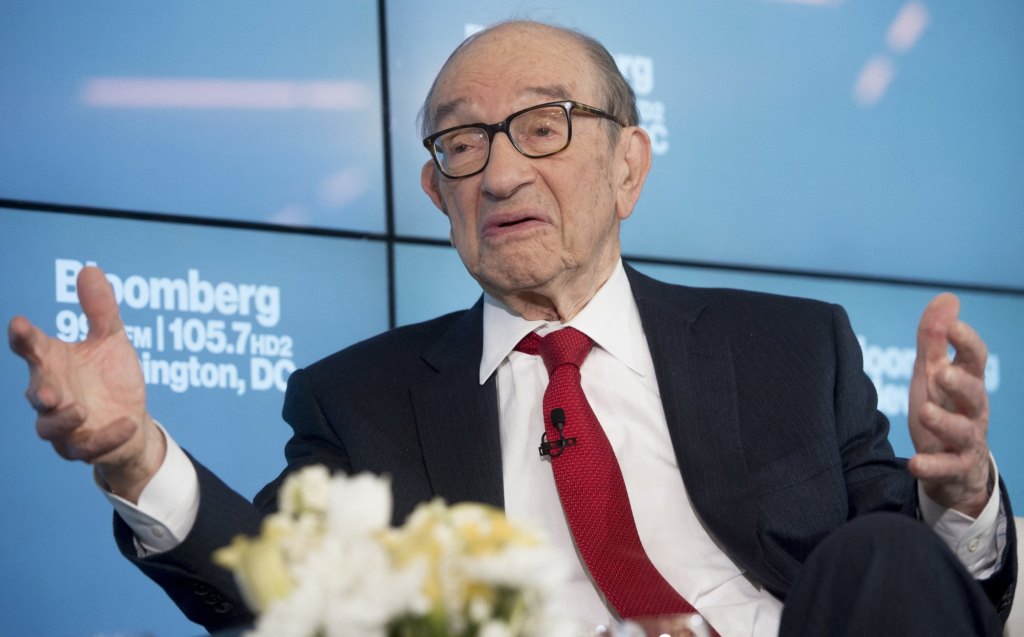
Alan Greenspan is gone, dying at 100 years old on June 22. For decades one of the most powerful men in the world, he served four presidents as an economic adviser and chair of the Federal Reserve. He was an awesome insider. He regulated the money supply and his fierce refusal to use his power to bring fairness to the market place is hailed by some, condemned by others. I’m in the latter category.
I met with him twice in the imposing opulence of the conference room where the Fed Board of Governors set the price of money since early in the 20th century. There is a picture of me shaking hands with Greenspan in the archives of the Lehigh County Historical Society. I was there to beg him to intervene in the credit system that had run amok.
It was late in the 1990s, then again a few years later. I was with a group of community-based bank activists who were members of the board of directors of the National Community Reinvestment Coalition. I had broken open a massive conspiracy to commit fraud in the Allentown mortgage market that victimized more than 200 mostly Latino homebuyers. That put me in the leadership nationally of the activists who were fighting predatory lending. There were real estate agents, title insurance companies, appraisers, mortgage brokers, at least a dozen of them, who were having a feast at the table few were willing to confront.
Developers would buy properties for cheap at sheriff’s sales and tax sales. They would find a buyer with limited English skills or knowledge of homebuying, sell the home for double or triple what they paid with no improvements to the property, sometimes on the same day. They had dirty appraisers who would inflate the value of the property to defraud out-of-state mortgage lenders (not banks but unregulated mortgage finance companies that didn’t understand the local market’s dynamics). They would use a portion of the proceeds to take the buyer to the bank in the morning, deposit some of it in their account, go to closing showing the proceeds as a “down payment,” then return to the buyer’s bank and withdraw the money. They fabricated employment and wages.
Local appraiser Barbara Decker; title insurer Deb Hartman, now deceased; and Morning Call reporter Joe McDermott helped me figure out what was transpiring. Armed with incontrovertible evidence, I went looking for someone to bust these people.
I went to the Pennsylvania Bureau of Consumer Protection, the state Bureau of Professional and Occupational Affairs, the state Department of Banking, the Lehigh County sheriff, then-U.S. Rep. Pat Toomey, Fannie Mae and Freddie Mac. With NCRC, we met with U.S. Rep. Barney Frank, chair of the House of Representatives Financial Services Committee. We had regular meetings with the top executives of the mortgage finance companies who were getting rich at the expense of homebuyers and their communities. Nothing was getting done. I made speeches, told the news media, squawked wherever I could find someone to listen. Nothing. Crickets.
Finally, Lehigh County District Attorney Jim Martin connected me to the FBI. It took the case. Three of the more than a dozen co-conspirators were prosecuted. The U.S. attorney only verified enough of the cases to bust the criminals “to make an example.”
Which brings me back to Greenspan, an avowed acolyte of notorious libertarian Ayn Rand. “I’m a libertarian on credit issues,” the chair said. Great. The man whose job it was to regulate the marketplace didn’t believe in regulating the marketplace.
“The market will correct itself,” the chair said.
And, boy, was he right about that. While banks weren’t making the predatory loans, they were providing the capital, massive tranches of bundled bad loans. They would then get dumb, or lazy, or complicit insurers to insure them.
The credit system of capitalism was on the brink of collapse. It brought the worst recession in a century and with it, untold suffering. The chair was right: The market corrected itself. Of course, if Greenspan hadn’t let his ideology get in the way of reason, it could have been corrected with that boogieman of market purists — regulation.
Greenspan’s legacy was in danger. “Who knew?” was his defense. You knew, Mr. Greenspan. I was in the room — twice. I ain’t no high-fallutin’ economist but at least I know greed and its consequences when I see it.
When the movie about this unfortunate chapter in history, “The Big Short,” came out, I was angry that there wasn’t a character that was a composite of my activist colleagues and I in the movie. But I can at least take solace in, and sleep at night, knowing that we were on the right side of economic justice. Not so for the chair.
This is a contributed opinion column. Alan Jennings is the retired executive director of the Community Action Committee of the Lehigh Valley. The views expressed in this piece are those of its individual author, and should not be interpreted as reflecting the views of this publication. Do you have a perspective to share? Learn more about how we handle guest opinion submissions at themorningcall.com/opinions.