
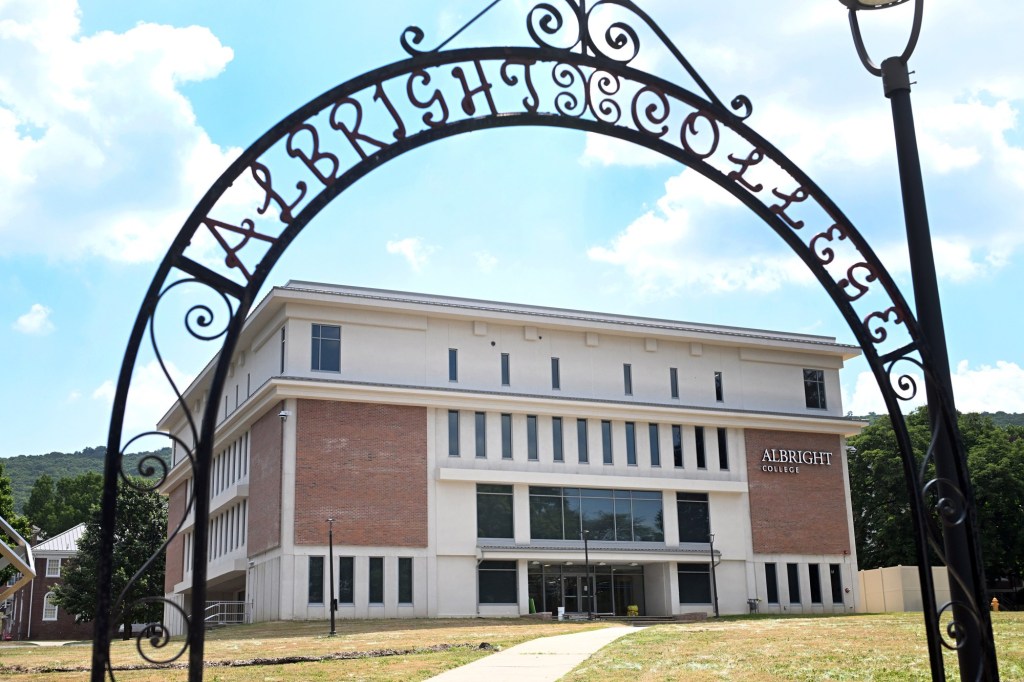
Ongoing financial strains have led Albright College to be issued a warning that its accreditation could be in jeopardy if improvements aren’t made over the next year.
The Middle States Commission on Higher Education, an organization recognized by the U.S. Department of Education to accredit degree-granting institutions, issued the notification of noncompliance warning action in June.
It is based on a self-study report submitted by Albright as well as an on-site evaluation done in March. The warning cites the Reading college’s financial planning and budgeting process as well as documented financial resources, funding base and plans for financial development adequate to support the college’s educational purposes and programs and to ensure financial stability as issues of concern.
The commission asked Albright to provide a monitoring report to be submitted by Feb. 16 that shows evidence the institution has achieved and can sustain ongoing compliance in those areas. A second visit will take place in March.
In the meantime, Albright will remain accredited and students are eligible for federal and state financial aid.
College officials said this week that the school is working toward addressing the commission’s concerns and repairing the school’s finances.
The warning comes as Albright continues to deal with the kinds of financial challenges facing many small, liberal arts schools across the nation. That includes a smaller pool of college attendees, leading to a drop-off in enrollment. Shuttering campuses during the COVID-19 pandemic added to the difficulties.
The financial downturn has impacted Albright so severely that its very existence was threatened in 2024. The school began what it called a “transformational phase,” which Albright leaders have hoped will help steady the ship.
For nearly two years, Albright has been cutting costs by reducing its staff size and phasing out majors that few students choose, such as American civilization, Latin American and Caribbean studies and urban affairs.
Albright has taken measures to generate cash, such as selling off unused dormitories and other properties and auctioning the college’s art collection.
Last July, Albright officials announced that the turnaround efforts appeared to be paying off. They said they had finished the prior fiscal year — which ended June 30, 2025 — with a $10 million surplus.
However, an audit of the school’s finances released in June shows that number was actually only around $4.6 million. It also showed Albright with a $13.6 million operating deficit for that fiscal year.
Albright officials on Monday said they remain dedicated to creating a financially stable organization.
“As we have been saying publicly, Albright began a transformation in the fall of 2024 to focus on the financial issues that the college was facing post-COVID,” a statement from the college reads. “When the report was written, we were only in the first year of this transformation. Turnarounds take time, and the work that this community has done in the last couple of years has been commendable.”
The statement also points out that, despite its financial woes, Albright continues to be recognized for its performance educating students. That includes:
• The Princeton Review naming Albright a Best College in the Mid-Atlantic for 2025, one of only 97 institutions in the region to receive that distinction and an honor the college has earned 20 times in the last 21 years.
• Washington Monthly ranking Albright among the top liberal arts colleges in the nation for social mobility, research and public service while recognizing the college as a “Best Bang for the Buck” institution in the Northeast.
• The U.S. Department of Education College Scorecard reporting that Albright graduates earn a median salary 44% above the national median.
School officials said enrollment at Albright is trending upward, new athletic programs are growing and fundraising has exceeded its goals for the past two years.