
The U.S. Drug Enforcement Administration announced a temporary ban on a kratom-derived synthetic drug amid concerns from public health officials.
The substance known as 7-OH will be reclassified as Schedule I, characterized as having no medical use and with a high potential for abuse. Federal officials cited increased reports of misuse, dependence and overdose, along with growing evidence that the compound poses health risks comparable to those of powerful opioids.
The reclassification will take effect Aug. 5 and remain for two years.
Use of kratom 7-OH, as well as kratom in its botanical leaf form, have been a hot topic locally.
In April, Lackawanna County District Attorney Brian Gallagher and Scranton Councilman Patrick Flynn announced the city planned to introduce an ordinance to ban the sale of kratom in the city. After vigorous debate among city council and members of the public, two kratom-related ordinances were tabled, one targeting sales to adults and the others to minors.
Council tabled the ordinances to clarify legal questions and enforcement measures. Council members sought time to properly address distinctions between natural kratom and much stronger synthetic versions, as well as to review pushback from proponents who argue the substance is helpful for pain relief.
When asked what impact the national legislation might have on the city’s pending ordinances, Flynn said council was consulting with its solicitors.
He’s thrilled with the DEA’s decision to classify 7-OH as a Schedule 1 drug. He also believes that, in addition to the 7-OH ban, leaders should take a hard look at kratom as whole, including natural leaf kratom.
Although kratom in a mild form may be helpful, it should also be regulated, Flynn said.
“It’s not something that should be sold at the corner gas station,” he said.
District attorneys weigh in
Gallagher, in addition to Luzerne County District Attorney Sam Sanguedolce and Wyoming County District Attorney Joe Peters, support the temporary federal ban.
“For months, we’ve warned that these highly concentrated synthetic 7-hydroxymitragynine (7-OH) products pose a serious threat to public safety. They are not traditional botanical kratom, they are powerful, opioid-like substances being aggressively marketed in convenience stores and smoke shops, often without consumers fully understanding their potency or risks,” Gallagher said.
He called the designation a common-sense step to project communities, while preserving the distinction between natural botanical kratom and the more dangerous 7-OH version of the drug.
Sanguedolce said he was relieved to learn that the DEA worked with the Department of Health and Human Services to designate concentrated synthetic 7-OH products as Schedule I controlled substances.
“Much like in the era of bath salts, these dangerous, mind-altering substances, despite being a threat to people’s health and safety, are often sold in local stores and are unregulated. This action represents a first step in protecting both would-be users and innocent bystanders from the threat kratom poses to our communities,” he said.
Peters emphasized the difference between the botanical leaf version of the drug and synthetic 7-OH substance.
“I think it is a positive step, because 7-OH, when concentrated and created synthetically, is very addictive, much like an opioid. It’s dangerous for those who use it.”
The drug, he said, is often marketed as a fix for anxiety or opioid addiction, but in reality, it creates additional anxiety and confusion, he said.
Botanical leaf kratom has a use, but when it is concentrated and synthetically altered, it becomes toxic and dangerous, he said.
Not a means of recovery
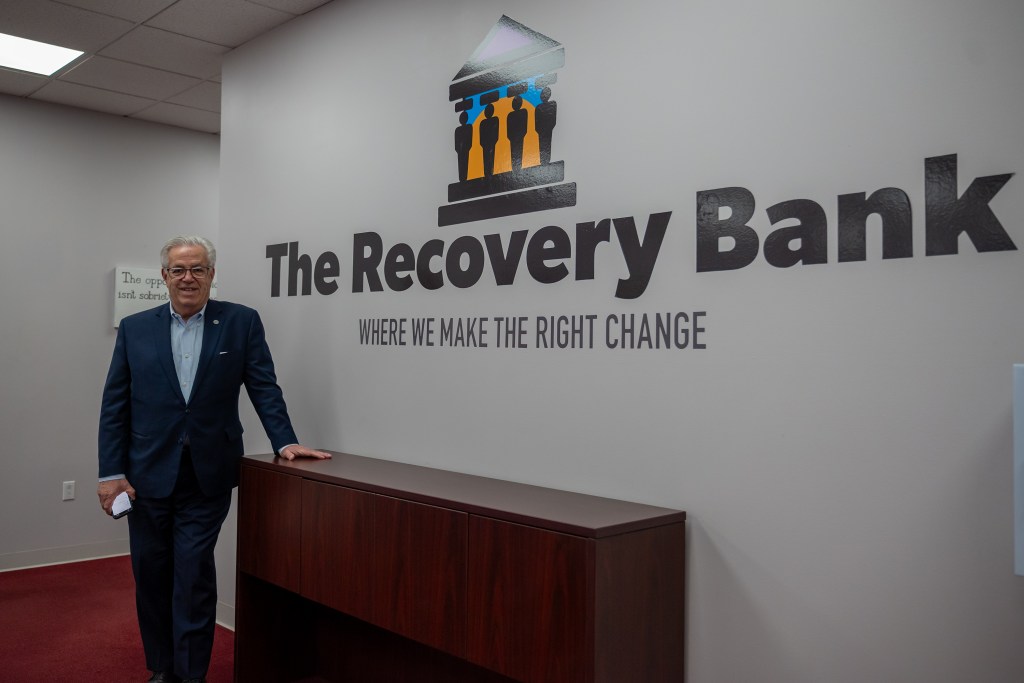
During a tour of the Recovery Bank in Scranton on Tuesday, local recovery advocate and facility director Frank Bolock applauded 7-OH being placed on the list of banned drugs.
Bolock, himself in recovery, doesn’t believe kratom has any redeeming value or place in recovery. He believes people often use kratom as a solution for other addictions, but end up with an even bigger problem.
Three months ago, U.S. Rep. Rob Bresnahan wrote a letter to the DEA urging emergency reclassification of the drug.
“I am glad the DEA heard our concerns and calls to protect Northeastern Pennsylvania and the country from the rapid spread of these high-risk products,” the Republican, who represents the 8th Congressional District, said in a news release. “This temporary classification is a significant step forward in keeping our communities safe.”